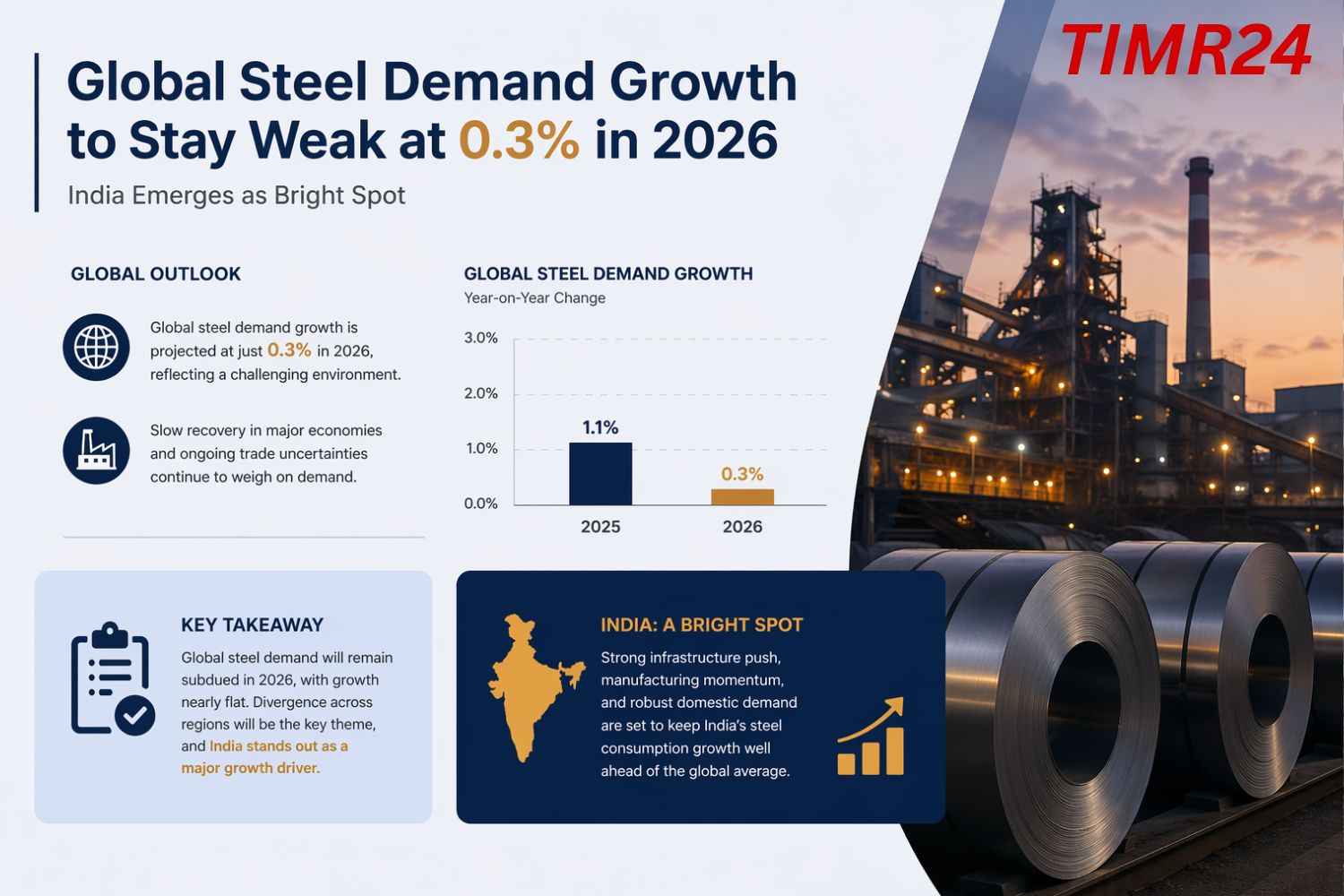
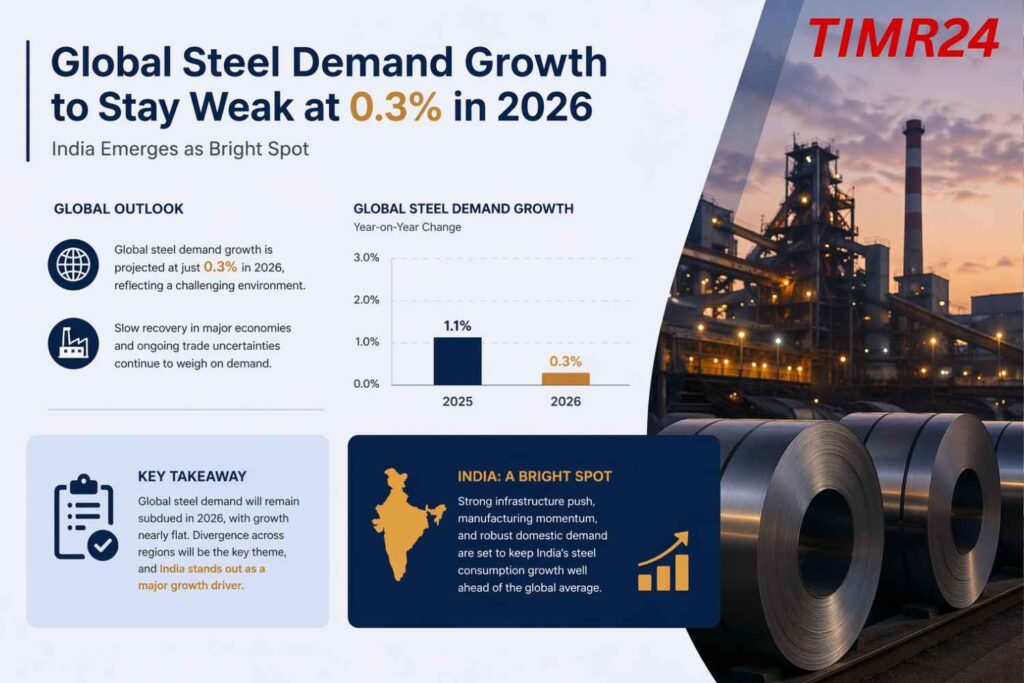
Global steel demand in 2026 is expected to remain almost stagnant, with growth projected at just 0.3%, signaling a cautious and slow-moving recovery in the global industrial ecosystem. This marginal increase reflects ongoing economic uncertainties across major economies, where inflationary pressures, geopolitical tensions, and reduced construction activities continue to impact demand. Despite being a backbone of industrial development, the steel sector is currently navigating one of its most challenging phases, where supply chains are stabilizing but demand remains uneven across regions. that developed markets are still struggling to regain pre-pandemic momentum.
Especially in regions like Europe where energy costs and economic slowdown are creating obstacles for large-scale industrial growth At the same time, China, which has traditionally been the largest consumer and producer of steel, is witnessing a structural shift in its economy. The slowdown in real estate development and reduced infrastructure expansion have significantly impacted steel demand. This transition is not temporary but rather part of a broader economic rebalancing, where China is focusing more on consumption-driven growth instead of heavy industrial reliance. As a result, the global steel market is experiencing a redistribution of demand centers.
Country’s Rapid Urbanization, Increasing
Where emerging economies are beginning to play a more influential role in shaping the future of the industry In this evolving landscape, India has emerged as a clear bright spot, demonstrating strong resilience and consistent growth in steel demand. The country’s rapid urbanization, increasing population, and ambitious infrastructure projects are driving significant consumption of steel across various sectors. Government initiatives focused on highways, railways, housing, and smart cities are creating a sustained demand pipeline, ensuring that the steel industry remains active and expanding, India’s manufacturing sector is gaining momentum under initiatives aimed at boosting.
Domestic production and reducing import dependency. Programs aligned with industrial growth are encouraging investments in steel production capacity, modernization of plants, and adoption of advanced technologies. This transformation is not only increasing output but also improving efficiency and quality, making Indian steel more competitive in the global market Another key factor contributing to India’s strong outlook is the rise in construction and infrastructure activities. Steel demand is closely linked to these sectors, and with continuous development in urban and rural areas, the consumption is expected to remain robust. From large-scale metro projects to.
Environmental Regulations And Need To Reduce
Residential housing schemes, steel is an essential component driving progress While India’s growth story provides optimism, the global steel industry is also undergoing a transformation driven by sustainability concerns. Environmental regulations and the need to reduce carbon emissions are pushing companies to adopt green steel technologies. This includes the use of hydrogen-based production methods, recycling of scrap steel, and energy-efficient manufacturing processes. Although these transitions require significant investment, they are essential for ensuring long-term sustainability and compliance with global climate goals. The shift toward green steel is expected to redefine competitivenes.
Where companies investing in cleaner technologies will have an advantage in the future Digitalization is another important trend reshaping the steel industry. From smart manufacturing to predictive maintenance and data-driven decision-making, technology is helping (India) companies optimize operations and reduce costs. This transformation is especially important in a low-growth environment, where efficiency and innovation become critical for survival. By leveraging digital tools, steel manufacturers can improve productivity and respond more effectively to market fluctuations Despite these positive developments, challenges remain. Fluctuating raw material prices.
Expected To Gradually Stabilize, But Growth
Trade policies, and currency volatility continue to create uncertainties in the market. Additionally, global demand recovery depends heavily on macroeconomic stability, which is still fragile in many regions. The balance between supply and demand will be a key factor determining price trends and profitability for steel producers global steel industry is expected to gradually stabilize, but growth will likely remain moderate in the short term. Emerging economies like India will play a crucial role in driving demand, while developed markets focus on restructuring and sustainability. The shift in demand patterns highlights the importance of diversification, innovation, and strategic planning for companies operating in this sector.
While global steel demand growth of 0.3% in 2026 reflects a cautious outlook, it also marks a period of transition and opportunity. India’s strong performance stands out as a beacon of growth, supported by infrastructure development, manufacturing expansion, and (India) favorable policies. As the industry adapts to new challenges and embraces sustainable practices, the future of steel will be shaped by those who can balance growth with innovation and environmental responsibility.