














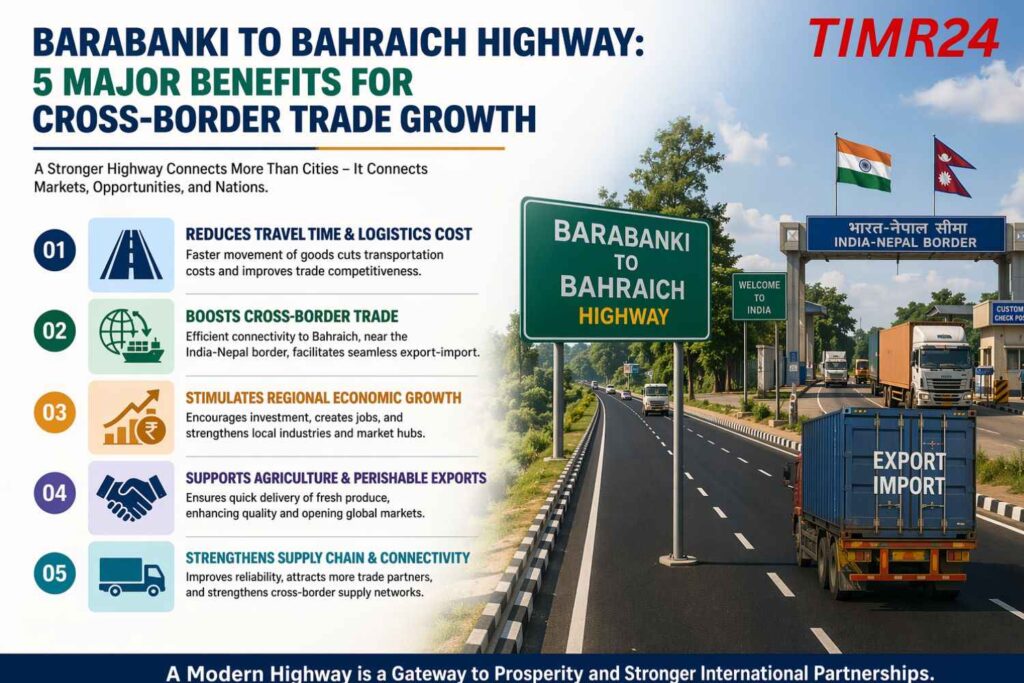
India and Nepal maintain a robust trade relationship, with India being Nepal’s largest trading partner, constituting over 60% of its trade. The Union Cabinet has approved the Barabanki–Bahraich section of National Highway-927, which is set to enhance connectivity to the Rupaidiha Land Port and Nepalgunj. This highway is anticipated to significantly improve cross-border trade, particularly in agricultural products, by reducing transportation time by nearly 50%. The expected increase in vehicle speeds will minimize spoilage of perishable goods, benefiting farmers and traders on both sides. Additionally, the corridor will facilitate the movement of essential goods, ensuring reliable supply.
Opportunities For Related Businesses
Chains and reducing past disruptions. The enhanced road infrastructure will foster logistics growth around Rupaidiha, creating opportunities for related businesses, and will substantially impact border communities that rely on cross-border commerce The Barabanki to Bahraich Highway is poised to emerge as one of the most strategically significant infrastructure projects in northern India, promising to transform regional transportation and strengthen India’s cross-border trade network with Nepal. Approved by the Union Cabinet as part of the National Highway-927 expansion, this four-lane access-controlled highway project is expected to become a major economic catalyst for.
Uttar Pradesh while reinforcing India’s trade corridor to Nepal. With an estimated investment of ₹6,969 crore, the project reflects the government’s long-term infrastructure vision under the PM GatiShakti framework and highlights the growing importance of logistics-led development in India Stretching approximately 101.5 kilometers, the Barabanki-Bahraich Highway will directly connect key districts in Uttar Pradesh while dramatically improving travel efficiency and freight movement. Designed to address congestion, sharp curves, and existing road deficiencies along the current NH-927 alignment, the upgraded corridor will support faster and safer transportation for both.
Passenger and commercial vehicles. Officials expect travel time between Barabanki and Bahraich to reduce by nearly 50 percent, significantly enhancing mobility for residents, transport operators, and businesses One of the most important strategic outcomes of this highway is its role in strengthening India-Nepal trade connectivity. The highway will serve as a critical route to the Rupaidiha Land Port, one of the busiest Indo-Nepal trade gateways, and connect onward to Nepalgunj in Nepal. This border crossing handles a substantial volume of bilateral trade and acts as a vital channel for goods movement between the two nations. Given that India accounts for over 60 percent of Nepal’s total.
Including Agriculture, FMCG, Pharmaceuticals
Trade volume, improving this corridor is expected to substantially enhance regional economic integration From a logistics perspective, the Barabanki to Bahraich Highway will provide seamless freight connectivity for multiple sectors including agriculture, FMCG, pharmaceuticals, and industrial goods. Faster transportation means lower transit times, reduced fuel costs, improved fleet efficiency, and better supply chain predictability. Businesses transporting goods toward Nepal will particularly benefit from reduced bottlenecks and enhanced road quality, enabling higher trade throughput and improved export competitiveness. This makes the project not just a transportation.
Initiative but a strategic logistics infrastructure upgrade for northern India The agricultural sector is expected to gain significantly from the improved highway connectivity. Uttar Pradesh’s Terai and adjoining districts produce large quantities of rice, wheat, vegetables, dairy products, and other perishables. Better road infrastructure will reduce spoilage during transport and help farmers access broader markets more efficiently. With faster routes to border markets and logistics hubs, farmers and agri-traders can improve profitability while lowering post-harvest losses. This is especially critical for perishable commodities where transit time directly impacts product quality and market value.
Cross-Border Commerce Improved Accessibility
Beyond trade and agriculture, the highway is likely to stimulate substantial local economic development across Barabanki, Bahraich, and nearby districts. Border towns and local marketplaces near the Rupaidiha-Nepalgunj corridor rely heavily on cross-border commerce. Improved accessibility will encourage greater movement of traders, buyers, and logistics operators, boosting business activity in wholesale markets, retail centers, hotels, dhabas, fuel stations, and warehousing facilities. Local entrepreneurs and SMEs are expected to benefit from the increased economic circulation generated by the highway Employment generation is another major benefit associated with the project.
During the construction phase, thousands of direct and indirect jobs are expected to be created in engineering, construction, transportation, materials supply, and labor contracting. Once operational, the corridor will support sustained employment growth in logistics, hospitality, trade services, vehicle maintenance, roadside retail, and warehousing operations. This will strengthen the economic base of districts that have traditionally lacked large-scale industrial development The Barabanki-Bahraich Highway also aligns with India’s broader infrastructure modernization strategy. Under the PM GatiShakti National Master Plan, the government is focusing on integrated, multimodal connectivity projects.
Connect Several Economic And Logistics Nodes
That support logistics efficiency and economic growth This highway is part of that larger vision to build future-ready infrastructure that links industrial nodes, logistics parks, food parks, and border trade centers. According to official reports, the corridor will connect several economic and logistics nodes, enhancing its long-term strategic relevance beyond just road transport From a regional planning perspective, the highway will improve access to remote and underserved districts in eastern Uttar Pradesh. Enhanced connectivity can accelerate social development by improving access to healthcare, education, government services, and emergency transportation.
Residents of Bahraich and surrounding areas will benefit from reduced travel times and safer road conditions, which can have lasting socio-economic impacts beyond the commercial advantages The project will be executed under the Hybrid Annuity Model (HAM), a (India) public-private partnership framework that combines government support with private sector execution. Under HAM, the government typically provides 40 percent of the project cost upfront while the remainder is paid over time through annuities. This model has been widely used in India for large highway developments and helps balance public funding with private sector efficiency.
The Barabanki-Bahraich Highway’s adoption of HAM indicates the project’s strategic importance and financial viability Importantly, the current project is only part of a broader connectivity vision. Government officials have also indicated that a Detailed Project Report is being prepared for the extension of the highway from Bahraich to Rupaidiha. Once completed, this would create a fully four-lane access-controlled corridor from Barabanki all the way to the Nepal border, establishing one of the strongest road-based trade links between India and Nepal in the region. This future expansion would further multiply the economic and logistical benefits of the present project.
In conclusion, the Barabanki to Bahraich Highway is far more than a road-widening project it is a strategic infrastructure investment that will reshape regional connectivity, empower border economies, strengthen India-Nepal trade relations, and accelerate economic (India) growth across Uttar Pradesh. By reducing travel time, improving logistics efficiency, supporting farmers, enabling businesses, and unlocking new employment opportunities, the project is set to become a transformative development milestone for northern India. As construction progresses and future extensions toward the Nepal border are completed, this corridor is expected to emerge.
Q1. What is the Barabanki to Bahraich Highway Project?
It is a new 4-lane access-controlled NH-927 highway connecting Barabanki and Bahraich in Uttar Pradesh.
Q2. Why is this highway important?
Because it will improve trade connectivity to Nepal via Rupaidiha Land Port and Nepalgunj border.
Q3. What is the total project cost?
The estimated cost is approximately ₹6,969 crore.
Q4. How much travel time will reduce?
Travel time is expected to reduce from around 150 minutes to nearly 75 minutes.
Q5. Which sectors will benefit most?
Logistics, agriculture, hospitality, transport, retail, and cross-border trade businesses.