












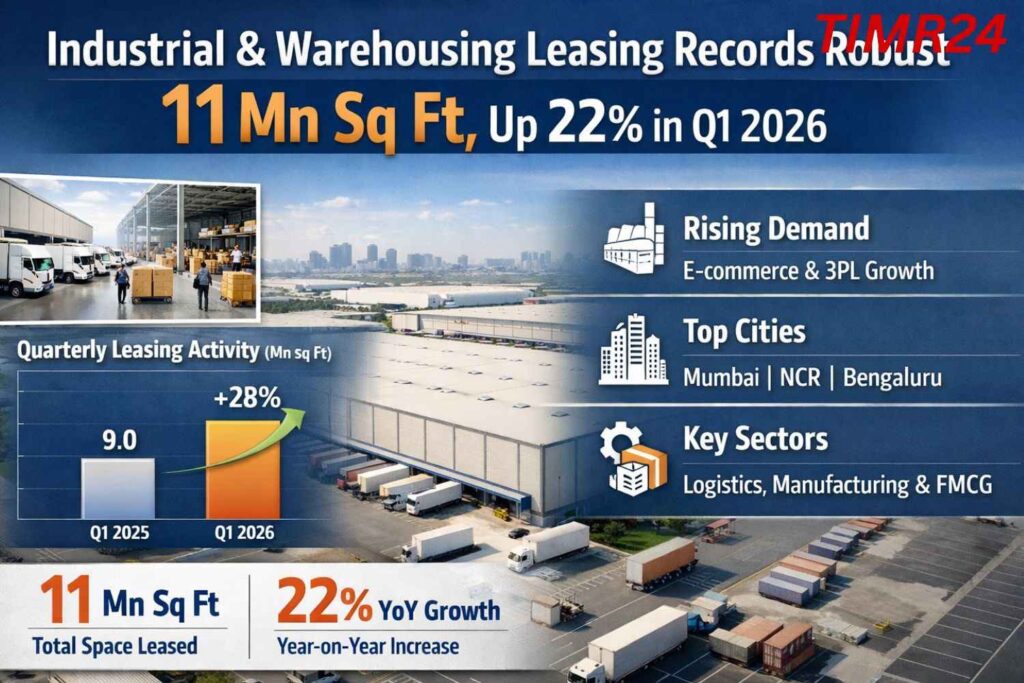
Industrial and warehousing demand in India’s top eight cities remained strong in Q1 2026, with 11 million sq ft leased, a 22% increase year-on-year. Delhi NCR led with 28% of leasing, followed by Chennai at 21%. Notably, Hoskote–Narsapura in Bengaluru was the most active micro-market, highlighting robust demand driven primarily by third-party logistics (3PL) players, which accounted for one-third of leasing activity 1.8 times more than Q1 2025. Key contributors also included the e-commerce and automobile sectors, with significant growth in space uptake. Vijay Ganesh from Colliers India emphasized the resilience of demand amidst challenges, with 3PL firms expected to continue leading.
India’s Supply Chain Ecosystem, Increased
Large deals over 200,000 sq ft comprised 48% of demand, primarily due to e-commerce companies India’s industrial and warehousing real estate sector has entered 2026 with strong momentum, registering impressive leasing activity in the first quarter. According to a recent report by Colliers India, the sector recorded 11 million square feet of leasing in Q1 2026, marking a robust 22% year-on-year growth. This surge reflects a combination of structural changes in India’s supply chain ecosystem, increased demand from key industries, and ongoing infrastructure development across the country The growth trajectory of the industrial and warehousing segment.
How businesses are rapidly adapting to evolving consumption patterns. The rise of e-commerce platforms and the increasing reliance on faster delivery models have significantly boosted the demand for modern warehousing facilities. Companies are focusing on strategically located warehouses to optimize last-mile delivery and reduce operational costs. This shift is not just limited to metro cities but is gradually expanding into Tier II and Tier III locations as well One of the primary drivers behind this growth is the continued expansion of the e-commerce sector. With consumers demanding quicker deliveries and seamless logistics experiences, companies are investing.
Manufacturing Companies Are Also Contributing
Heavily in warehousing infrastructure. Additionally, third-party logistics (3PL) providers have played a crucial role in driving leasing activity, as businesses increasingly outsource their logistics operations to specialized firms. Manufacturing companies are also contributing to this demand, particularly with the government’s push towards ‘Make in India’ and increased focus on domestic production capabilities From a geographical perspective, Tier I cities such as Mumbai, Delhi NCR, Bengaluru, and Chennai continue to dominate leasing activity due to their established infrastructure and connectivity. However, Tier II cities are emerging as attractive alternatives due to.
Lower land costs, improved connectivity, and supportive government policies. Cities like Lucknow, Jaipur, and Coimbatore are witnessing increased interest from occupiers looking to expand their footprint while optimizing costs. This shift indicates a more balanced growth pattern across regions, which is essential for long-term sustainability Infrastructure development has been another critical factor supporting the growth of the warehousing sector. Government initiatives such as the development of dedicated freight corridors, logistics parks, and improved highway connectivity have significantly enhanced the efficiency of supply chains.
Growth Potential. Institutional Investors
These developments are making it easier for companies to set up warehouses in strategic locations, ensuring faster movement of goods across the country. You can explore more about infrastructure initiatives on platforms like Investor confidence in the industrial and (India) warehousing segment remains strong, driven by stable returns and long-term growth potential. Institutional investors and private equity firms are increasingly focusing on logistics assets as part of their portfolios. The sector’s resilience, even during economic uncertainties, has made it an attractive investment option. Additionally, the rise of Grade A warehousing facilities, equipped with modern.
Technology and sustainability features, is further enhancing the appeal of this segment Another important trend shaping the sector is the adoption of technology in warehouse operations. Automation, robotics, and data-driven inventory management systems are becoming increasingly common, enabling companies to improve efficiency and reduce operational costs. Smart warehouses equipped with advanced tracking systems and real-time analytics are setting new benchmarks in the industry. This technological transformation is not only improving productivity but also enhancing the overall customer experience Sustainability is also gaining prominence in the industrial real estate sector.
Sustainability Is Expected To Play A Significant
Developers are focusing on green building practices, energy-efficient designs, and environmentally friendly construction methods. The demand for sustainable warehouses is rising as companies aim to reduce their carbon footprint and align with global ESG (Environmental, Social, and Governance) standards. This shift towards sustainability is expected to play a significant role in shaping the future of the sector outlook for India’s industrial and warehousing sector remains highly positive. The combination of strong demand fundamentals, supportive government policies, and ongoing infrastructure development is expected to drive continued growth throughout 2026 and beyond.
As supply chains become more complex and customer expectations continue to rise, the importance of efficient and well-located warehousing facilities will only increase The 22% year-on-year growth in leasing activity during Q1 2026 is a clear indicator of the sector’s (India) strength and resilience. With increasing participation from various industries, growing investor interest, and rapid technological advancements, India’s industrial and warehousing market is well-positioned for sustained expansion. Stakeholders across the ecosystem, including developers, investors, and occupiers, stand to benefit from the opportunities presented by this dynamic and evolving sector.
Q1. What is the total leasing volume in Q1 2026?
Industrial & warehousing leasing reached 11 million sq ft.
Q2. What is the YoY growth rate?
The sector recorded a 22% year-on-year growth.
Q3. Which sectors are driving demand?
E-commerce, 3PL (third-party logistics), and manufacturing sectors.
Q4. Which cities are leading the market?
Tier I cities dominate, but Tier II cities are growing rapidly.
Q5. What is the future outlook?
The sector is expected to see sustained growth due to supply chain expansion and infrastructure development.