












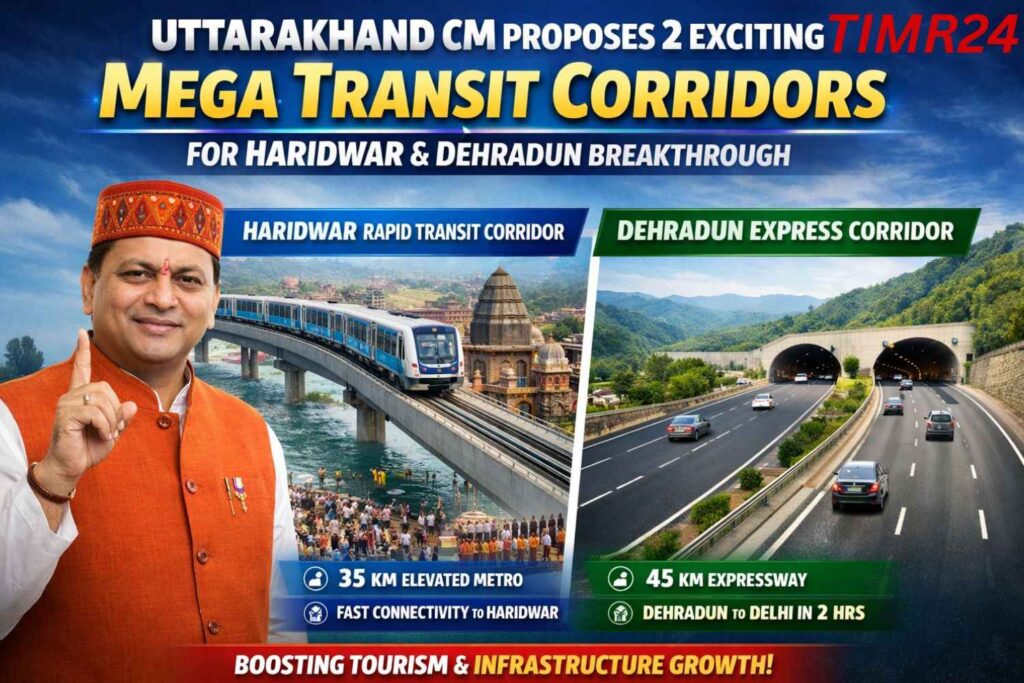
Uttarakhand Chief Minister Pushkar Singh Dhami has proposed extending the Namo Bharat Regional Rapid Transit System (RRTS) corridor from Modipuram to Haridwar and developing a new metro rail corridor connecting Dehradun, Haridwar, and Rishikesh. This RRTS extension will enhance rapid rail connectivity along National Highway-58, linking Meerut, Muzaffarnagar, Roorkee, and Haridwar. The metro corridor aims to improve intra-state urban connectivity and meet the rising travel demand in Uttarakhand’s urban and tourist centers. If approved, the initiatives could cut travel time between Delhi and Rishikesh to approximately 2.5–3 hours.
Regional Connectivity As Chief Minister Pushkar Singh
Further enhancing connectivity, tourism, and economic growth in the region Uttarakhand is preparing for a major leap in regional connectivity as Chief Minister Pushkar Singh Dhami has formally proposed the extension of the Meerut–Haridwar Regional Rapid Transit System (RRTS) along with the development of a new Dehradun–Haridwar–Rishikesh Metro Corridor. The proposal, submitted to the central government during recent high-level infrastructure discussions, could transform transport connectivity between the National Capital Region and Uttarakhand’s most important religious and tourism destinations. According to recent reports.
The state government has requested that the existing Namo Bharat RRTS corridor, which currently terminates at Modipuram in Meerut, be extended further toward Haridwar to create seamless high-speed rail connectivity between Delhi NCR and Uttarakhand The proposal has emerged as one of the most ambitious transport expansion plans for northern India in recent years because it combines rapid regional transit with intra-state urban mobility. If implemented, travelers from Delhi and nearby NCR cities may be able to reach Haridwar and even Rishikesh significantly faster than today. Current projections discussed in reports suggest Delhi-to-Rishikesh travel time could potentially fall to.
Around 2.5 to 3 hours with integrated high-speed connectivity. This would be a major improvement for pilgrims, tourists, business travelers, and daily commuters The Meerut–Haridwar RRTS extension is particularly significant because it would build on the success of the operational Delhi–Meerut Namo Bharat corridor, India’s first Regional Rapid Transit System. The Delhi–Meerut corridor has already established a benchmark for semi-high-speed regional commuting, and extending it into Uttarakhand would create the first major rapid transit connection between NCR and the Himalayan gateway region. This expansion could help decongest highways, reduce private vehicle dependency, and improve.
State’s Most Densely Traveled Urban-Religious Triangle
Sustainable transportation between the two states Parallel to the RRTS extension, the Uttarakhand government has also proposed a dedicated Dehradun–Haridwar–Rishikesh Metro Corridor, aimed at strengthening mobility within the state’s most densely traveled urban-religious triangle. Dehradun, Haridwar, and Rishikesh collectively represent Uttarakhand’s administrative, spiritual, and tourism backbone. A metro or metro-neo style system connecting these cities could support both residents and the millions of annual visitors who travel for pilgrimage, yoga tourism, adventure tourism, and education. Earlier surveys and planning work for such connectivity have already been explored in Uttarakhand’s transport roadmap.
The proposed rail expansion also aligns with preparations for future large-scale religious events, particularly the Haridwar Kumbh Mela 2027, which is expected to bring millions of pilgrims to the region. Better rail and metro connectivity would play a critical role in crowd management, reducing road congestion, and enhancing last-mile transportation within pilgrimage zones. The Uttarakhand government has simultaneously requested infrastructure support for Haridwar’s urban development and Kumbh preparations, indicating that transport modernization is part of a larger integrated city-upgrade strategy From an economic perspective, the project could trigger substantial regional development.
Haridwar And Rishikesh May Witness Stronger
Across western Uttar Pradesh and Uttarakhand. Improved high-speed connectivity often drives real estate demand, hospitality growth, logistics investments, and commercial expansion near stations and transit nodes. Cities like Haridwar and Rishikesh may witness stronger tourism-linked investments, while Dehradun could further strengthen its position as an educational and administrative hub. Better transit access also tends to increase land values and accelerate transit-oriented development in surrounding corridors However, despite the excitement around the announcement, the project still faces multiple implementation challenges.
One of the key concerns is land acquisition along the proposed alignment, especially in densely populated and environmentally sensitive areas. Sections near Rajaji National Park and ecologically sensitive Himalayan foothill zones may require extensive environmental clearances. Additionally, the terrain complexity between Haridwar, Rishikesh, and Dehradun may necessitate elevated structures, tunneling, or specially engineered alignments. Reports have highlighted that environmental and land-related hurdles will be major factors during DPR and approval stages.
Another critical issue will be project funding and execution model. Mega transit projects such as RRTS and metro corridors require multi-thousand-crore investments, often shared between state governments, central government agencies, and institutional lenders. The final project structure whether conventional metro, Metro Neo, MetroLite, or expanded RRTS will likely depend on traffic projections, cost-benefit analysis, and feasibility studies. The central government will evaluate these parameters before granting formal approval Strategically, the proposed network would complement several other infrastructure upgrades underway in the region, including the Delhi–Dehradun Expressway, highway widening projects.
Pilgrimage Circuits For Travelers And Residents
Railway station redevelopment, and urban renewal initiatives in Haridwar and Rishikesh. Together, these projects indicate a broader government push to create multimodal transport integration across northern India’s tourism and pilgrimage circuits For travelers and residents, the biggest advantage of this proposal lies in convenience and reliability. Today, road travel between Delhi, Haridwar, Rishikesh, and Dehradun often suffers from severe congestion during weekends, festive seasons, and pilgrimage periods. A dedicated rapid rail and metro network would provide predictable travel times, improved comfort, and lower environmental impact compared to private vehicles and buses.
If approved, the project could also serve as a model for future interstate rapid transit integration in India, demonstrating how RRTS systems can extend beyond NCR into neighboring states and connect long-distance tourism corridors with urban metro systems. (India) Such multimodal integration would represent a new chapter in Indian public transport planning While no final timeline has yet been announced, the proposal marks a major step toward transforming Uttarakhand’s mobility landscape. The next phase will involve feasibility studies, DPR preparation, route finalization, inter-agency coordination, and central government review. Once these stages are completed.
The project can move toward formal sanction and implementation Overall, the proposed Meerut–Haridwar RRTS Extension and Dehradun–Haridwar–Rishikesh Metro Corridor represent a bold and future-focused vision for northern India’s transport infrastructure. If (India) executed successfully, the twin projects could redefine connectivity between Delhi NCR and Uttarakhand, unlock economic opportunities, improve tourism accessibility, and deliver a sustainable mass-transit alternative for one of India’s busiest inter-state travel corridors.
Q1. What is the Meerut–Haridwar RRTS extension proposal?
It is a proposed extension of the Namo Bharat RRTS corridor from Modipuram in Meerut to Haridwar.
Q2. Which cities will the new metro corridor connect?
The proposed metro corridor will connect Dehradun, Haridwar, and Rishikesh.
Q3. Who proposed the project?
Uttarakhand Chief Minister Pushkar Singh Dhami proposed the project to the central government.
Q4. What will be the benefit of this project?
It will reduce travel time, boost tourism, improve pilgrimage connectivity, and support economic growth.
Q5. Is the project approved?
No, it is currently in the proposal stage and awaits central government review/approval.