















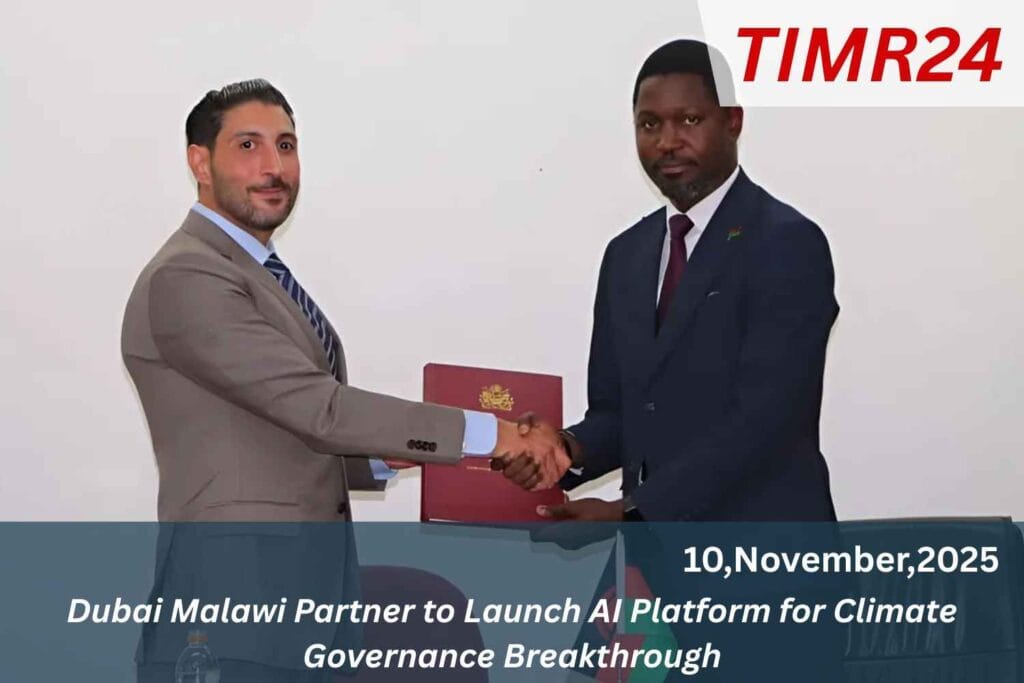
The Government of Malawi has partnered with Dubai’s Green Economy Partnership to create the world’s first AI-powered Paris Agreement Implementation Platform (PAIP), aimed at managing emissions, carbon trading, and compliance with the Paris Agreement. This system combines Malawi’s sustainability goals with Dubai’s innovations in providing a global first in automating compliance components such as emission inventories and transparency reporting, all built on secure blockchain technology. Dr. Yusuf Malsellino Mkungula highlighted that this platform positions Malawi as a leader in climate innovation, while GEP CEO Arthur Chirinikian noted it sets.
A global precedent for digital climate governance. The initiative will launch at COP30, with plans to extend this model to other developing nations In a pioneering move that pushes the frontiers of digital climate governance, the governments of Dubai (via its innovation ecosystem) (Climate) and Malawi have joined forces to launch the world’s first powered implementation platform for the Paris Agreement. The platform, developed by the Dubai-based climate-tech firm Green Economy Partnership (GEP), integrates artificial intelligence and blockchain infrastructure to enable Malawi’s Ministry of Natural Resources and Climate Change to manage emissions inventories.
Dubai’s Innovation Ecosystem
Carbon trading, transparency reporting and compliance within a unified digital framework This collaboration is significant on multiple levels. First, it signals how emerging economies in Africa can leapfrog traditional, paper-based climate governance systems and instead adopt next-generation digital platforms. Second, by anchoring the system in Dubai’s innovation ecosystem, it shows how Gulf states are positioning themselves not just as hosts of climate diplomacy but as active exporters of climate-tech solutions. Third, by building the system with full attention to data sovereignty, blockchain security and international standards (ISO, ESG, UNFCCC).
The project responds to demands for integrity and transparency in climate data flows How does the platform work? At its core, the system consolidates national emissions data agriculture, forestry, energy, industrial processes and land into a secure registry. It leverages to forecast mitigation opportunities, optimize national strategies, detect anomalies, and generate reports required under the Paris Agreement (such as National Communications, Biennial Transparency Reports, Long-Term Strategies The blockchain layer ensures that once data enters the system it is tamper-proof and its provenance is fully traceable which is critical.
Internationally Transferable Mitigation
When carbon credits or Internationally Transferable Mitigation Outcomes (ITMOs) are traded under Article 6 frameworks Malawi, the implications are transformative. The country now has a digital “digital embassy” architecture hosted in neutral jurisdictions, enabling it to keep full sovereignty over its data while enabling interoperability with global systems. This makes Malawi one of the first African nations to meet advanced climate-tech governance thresholds previously seen only in richer countries. As the Ministry noted, the platform “allows us to manage Internationally Transferable Mitigation Outcomes (ITMOs) and mobilise climate finance unprecedented efficiency with economic opportunity.
Dubai’s perspective, the project underscores the emirate’s ambition to become a global hub for climate and innovation. Dubai’s own national agenda of embedding across government planning (as seen in the UAE’s three-year driven planning cycle) shows a strong domestic precedent for this kind of advanced digital governance helping Africa adopt these tools, Dubai is building a new pillar of diplomatic–industrial influence climate-tech export, rather than simply climate diplomacy It’s worth emphasising that the platform is being offered at no cost to adopting countries a free-access model, enabling wider uptake across the Global South.
Smartest Digital Platform
The GEP states that this model allows governments in Africa, Asia and the Pacific to integrate advanced governance tools with minimal financial burden However, as exciting as the potential is, there are challenges ahead. Data quality remains a major bottleneck in many developing nations: without reliable measurement, monitoring and verification (MMV) systems, even the smartest digital platform cannot generate accurate outcomes. Capacity-building of national institutions, local technical expertise, and ensuring that the algorithms are transparent and free from bias remain critical. The governance of such platforms who oversees.
The decisions are mapped, how algorithmic accountability is ensured becomes a sensitised issue when national sovereignty and climate finance are at stake Another complexity is the ethical and practical dimension of connecting carbon markets and digital governance. While the system enables ITMOs to be tracked and climate finance mobilised, it also raises questions: who benefits from the carbon credits? Are local communities receiving the value? How are natural-capital and social-benefits accounted alongside emissions metrics? These issues are well-documented in the broader field of nature-based solutions and climate-tech governance.
Instance, organisations such as the International Telecommunication Union show how ML solutions for climate change must embed equity, transparency and global standards This partnership also raises broader implications for the global climate architecture. As more countries adopt similar systems, we could be moving toward a future where national climate governance is managed on interoperable digital platforms making real-time tracking of emissions, finance flows, and mitigation outcomes possible. This could accelerate progress toward the United Nations’ Sustainable Development Goals (SDGs) and enhance the credibility of national climate pledges.
Replicability :- Will other developing countries adopt the same platform, or a competing one? The free-access model and Dubai’s innovation ecosystem could give this platform an early lead.
Integration across sectors :- How well will sectors such as agriculture, forestry, land-use change, energy, industry, transport integrate with the platform? Emissions-related data often sits in silos.
Linking finance to outcome:- The linkage between mitigation outcomes captured digitally and the financial flows (public/private) is still nascent. The real test will be whether climate finance becomes more efficient and transparent because of this system.
Sovereignty and governance :- Who governs the platform? Who audits the algorithms? How are risks managed? Ensuring that national governments retain control while benefiting from advanced technology will be key to trust and scalability.
Community and nature-based integrity :- As part of national registries and emission-reduction mechanisms, ensuring that local communities and ecosystems receive meaningful co-benefits remains a social imperative.
The Dubai-Malawi collaboration is a landmark in climate-tech innovation and governance. It recasts the narrative: rather than seeing developing nations merely as recipients of climate aid or compliance obligations, they become participants in tech-driven governance transformation. For Malawi, the platform offers a leap into digital climate readiness; for Dubai, a proof point of how its innovation ecosystem can serve global goals. And for the global climate architecture, this offers a glimpse of what next-generation climate governance might look like: real-time, enabled, transparent, and globally interoperable.
As the world moves toward the next major climate milestone COP30 and beyond initiatives like this will matter not just for compliance but for credibility. If emissions data, (RAD) finance flows and outcome tracking can be digitised, auditable and accessible, then the accountability deficit in international climate governance may finally begin to shrink.
Q1. What exactly is the new platform?
The system developed by Green Economy Partnership (GEP) is an and blockchain-based climate-governance platform designed to automate the requirements of the Paris Agreement (emissions inventory, national registry, carbon trading, transparency reporting) and support countries like Malawi in managing mitigation outcomes.
Q2. Why are Dubai and Malawi partnering on this?
Dubai, via its innovation ecosystem and GEP, has the technological capacity to develop climate-tech platforms. Malawi is seeking to modernise its emissions-governance architecture and meet international climate obligations. The partnership leverages each side’s strengths for mutual benefit.
Q3. Will the platform cost Malawi or other countries a fee?
No. The platform is being offered under a free-access model to adopting countries, enabling wider uptake without upfront licensing costs.
Q4. What are the governance and data-sovereignty safeguards?
The system uses blockchain to ensure data integrity and traceability; it provides “digital embassy” architecture for national data sovereignty; and it aligns with internationally recognised standards (ISO, ESG, UNFCCC) to ensure transparency.
Q5. Why does this matter for global climate action?
Because it potentially shifts climate governance from policy and paperwork to digital, real-time, traceable systems. That enhances accountability, may accelerate climate finance flows and could help close the credibility gap in national climate pledges.