












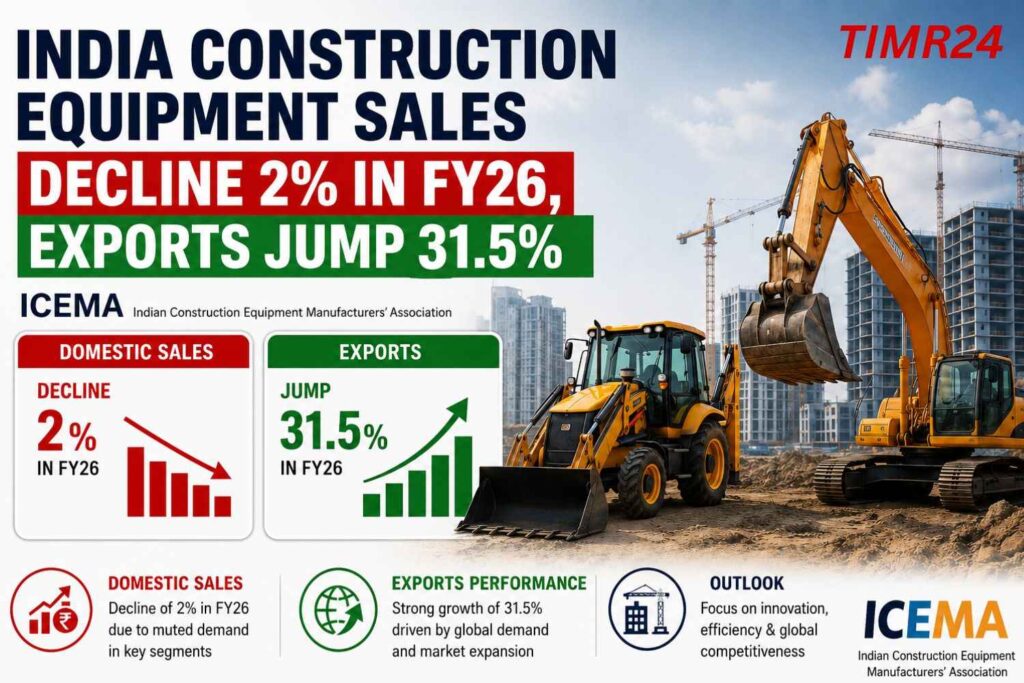
The Indian construction equipment industry experienced a ~2% decline in total sales during FY 2025–26, with sales dropping to 1,36,995 units due to challenges in domestic infrastructure execution and project delays. Despite this, the sector demonstrated resilience with a 32% increase in exports, affirming India’s position as the world’s third-largest construction equipment market. Key insights include a significant decrease in domestic demand by ~7% YoY, with earthmoving equipment maintaining a market share of ~71%. The industry’s long-term growth is supported by the increasing government focus on infrastructure development and manufacturing growth despite temporary hurdles.
Recovery Are Expected As Project Execution
The upcoming Union Budget 2026–27 introduces an incentive scheme to enhance manufacturing capabilities, which is anticipated to invigorate future demand as infrastructure projects accelerate. Overall, while FY26 presented challenges, optimistic outlooks for recovery are expected as project execution improves The construction equipment sector in India during FY26 has presented a contrasting economic picture, where domestic sales have witnessed a slight contraction of 2%, while exports have surged impressively by 31.5%. This divergence highlights both the challenges within India’s infrastructure pipeline and the growing global acceptance of Indian-made construction machinery.
The insights shared by ICEMA reflect a critical transition phase for the industry, where domestic caution is balanced by international opportunity The domestic slowdown is largely attributed to delayed execution of large-scale infrastructure projects, slower disbursement of government funds in certain regions, and cautious investment behavior from private construction companies. Rising input costs and financing constraints also contributed to reduced equipment purchases. However, despite these headwinds, the industry continues to remain a vital pillar of India’s infrastructure growth story On the other hand, export growth has emerged as a significant positive factor.
Indian Construction Machinery For Roads, Housing
Indian manufacturers have successfully expanded their footprint across international markets, particularly in developing economies. Countries in Africa and Southeast Asia are increasingly relying on cost-effective and durable Indian construction machinery for roads, housing, mining, and energy projects. This shift has strengthened India’s position as a competitive global supplier A major factor driving export expansion is the improved manufacturing quality and technological advancement within the sector. Indian companies are investing heavily in automation, digital monitoring systems, fuel-efficient engines, and smart equipment solutions.
These innovations are making Indian machinery more attractive in global markets where efficiency and cost-effectiveness are key purchasing factors From a policy perspective, government initiatives supporting “Make in India” and infrastructure development are (India) expected to play a crucial role in stabilizing domestic demand. Large-scale projects in highways, railways, smart cities, and logistics parks are likely to revive equipment demand in the coming fiscal periods. Additionally, financial reforms and better credit availability for infrastructure contractors are expected to support market recovery The construction equipment ecosystem also includes major segments such as.
Slowdown, Road Construction Machinery Showed
Earthmoving machinery, material handling equipment, road construction machines, and mining equipment. Each of these segments has shown different performance patterns. While earthmoving and mining equipment faced domestic slowdown, road construction machinery showed relatively stable demand due to ongoing highway development projects Another important trend is the increasing role of sustainability in construction equipment manufacturing. Companies are now focusing on reducing carbon emissions, improving fuel efficiency, and adopting electric or hybrid machinery. This aligns with global environmental standards and enhances export competitiveness.
In terms of employment and economic contribution, the sector continues to support a large workforce across manufacturing units, dealerships, and maintenance services. Despite short-term fluctuations, the long-term employment outlook remains strong due to expanding infrastructure needs both in India and abroad Industry experts believe FY27 may witness a rebound in domestic demand as project execution speeds up and government spending increases.
Meanwhile, exports are expected to maintain steady growth as global infrastructure investment remains strong Overall, FY26 reflects a balancing phase for India’s (India) construction equipment industry. While domestic sales faced temporary pressure, export performance has provided a strong growth cushion. With continued policy support, technological innovation, and global market expansion, the industry is well-positioned for long-term sustainable growth.
Q1. Why did India’s construction equipment sales decline in FY26?
Domestic demand slowed due to delayed infrastructure projects, tighter liquidity conditions, and reduced private sector capital expenditure.
Q2. How much did exports of construction equipment grow?
Exports registered a strong growth of 31.5% in FY26, driven by global demand and improved manufacturing competitiveness.
Q3. Which regions contributed most to export growth?
Key contributions came from Africa, Middle East, and Southeast Asia due to ongoing infrastructure expansion projects.
Q4. What is ICEMA’s role in this sector?
ICEMA represents manufacturers and tracks industry performance, policy issues, and market trends in India.
Q5. What is the future outlook for the industry?
The outlook remains positive with expected recovery in domestic demand and continued export growth supported by global infrastructure development.