










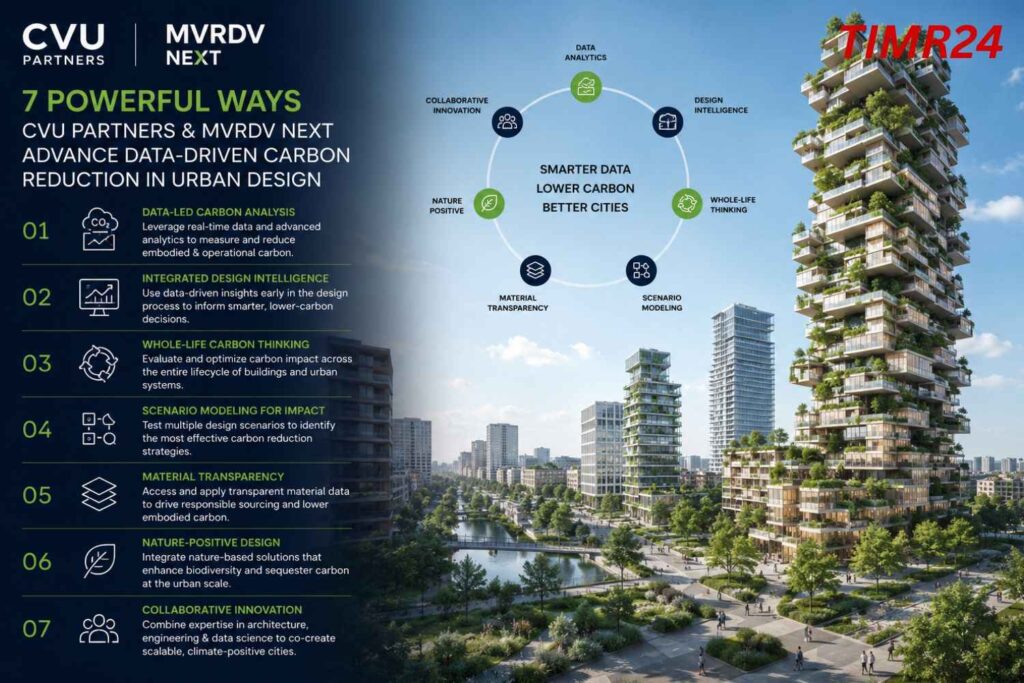
Council on Vertical Urbanism (CVU) and MVRDV NEXT will continue their partnership through the 2026 Sustainability Executive Program to enhance measurement and reduction of embodied carbon in urban developments. MVRDV NEXT’s CarbonSpace platform will provide a data-driven approach for early carbon assessments in building design, aiming to establish benchmarks across various regions and building types. The goal is to promote measurable sustainability through shared data and insights for better decision-making by stakeholders In a separate development, the Supreme Court endorsed a revival framework under.
Financial Burden To Homebuyers, Marking
The Insolvency and Bankruptcy Code (IBC) for stalled projects, allowing Alpha Corp Development to resume construction and deliver projects after a prolonged financial distress period. The court mandated that Alpha clear dues over 24 months without financial burden to homebuyers, marking a significant step toward restoring confidence in the insolvency resolution framework. Alpha is set to invest INR 750 crore for completion and upgrades, with expected revenues of INR 1,200 crore CVU Partners and MVRDV NEXT are taking a significant step toward transforming the future of sustainable urban development through a new collaboration focused on.
Data-driven carbon reduction strategies. The initiative reflects the growing global demand for environmentally responsible city planning and infrastructure development as governments, developers, and urban planners seek innovative solutions to combat climate change. By integrating advanced analytics, smart urban technologies, and computational design methodologies, the partnership aims to create more efficient, resilient, and low-carbon urban environments capable of meeting future sustainability goals The collaboration increasing role of digital intelligence in architecture and urban planning. As cities continue to expand rapidly.
Partnership, CVU Partners And MVRDV NEXT
Carbon emissions from construction activities, transportation systems, and building operations have become major environmental concerns. Modern urban design now requires a balance between economic growth and ecological responsibility. Through this partnership, CVU Partners and MVRDV NEXT intend to use real-time data modeling and predictive analysis to optimize urban infrastructure planning while minimizing environmental impact. Their approach combines technological innovation with sustainable development principles to support climate-conscious city growth One of the major objectives of the initiative is to improve decision-making in large-scale urban projects.
Traditional urban planning methods often rely on static models and generalized assumptions that fail to capture the complexity of modern cities. Data-driven systems, however, allow planners to evaluate energy performance, carbon output, mobility patterns, and resource efficiency with far greater accuracy. This enables architects and developers to make informed choices during the early stages of project planning The partnership also demonstrates how sustainability is becoming central to real estate and infrastructure investment strategies worldwide. Investors and developers are increasingly prioritizing projects that align with global environmental standards and ESG objectives.
Greener Economic Models While Maintaining
Smart carbon reduction models can improve operational efficiency, lower long-term costs, and enhance the overall value of urban developments. By leveraging digital tools and sustainability metrics, the collaboration seeks to help cities transition toward greener economic models while maintaining urban functionality and livability Another important aspect of the initiative is the integration of computational design into sustainable architecture. Computational systems enable designers to simulate urban performance scenarios before physical construction begins. This process allows project teams to identify energy-intensive elements, optimize natural lighting.
Improve ventilation systems, and reduce material waste. Such strategies can significantly decrease the carbon footprint of urban projects while improving environmental performance. The emphasis on predictive sustainability modeling is expected to influence future construction practices across smart city developments and green infrastructure projects The growing urgency of climate action has placed urban sustainability at the center of international policy discussions inclusive, resilient, and environmentally sustainable to address future global challenges. Urban centers currently account for a substantial portion of global greenhouse gas emissions.
Making innovative planning solutions essential for long-term climate resilience. Through their collaborative framework, CVU Partners and MVRDV NEXT are contributing to broader efforts aimed at reducing environmental impact while supporting sustainable urban growth Technology-driven sustainability solutions are rapidly reshaping how infrastructure projects are conceptualized and executed. Advanced urban analytics can now evaluate transportation networks, energy systems, public spaces, and building performance simultaneously. This integrated approach helps planners understand how different components of a city interact with one another.
Encourage Stronger Collaboration Between Public
It also allows urban developers to identify opportunities for carbon reduction across multiple sectors. Readers exploring future-ready infrastructure strategies may also find value in our article on “Green Building Technologies for Future Cities,” which discusses (India) innovations in sustainable construction materials and energy-efficient design The initiative may also encourage stronger collaboration between public institutions, private developers, and technology firms. Sustainable urban transformation requires coordinated efforts across multiple industries and governance systems. Data-driven frameworks can provide policymakers with actionable insights for improving.
Zoning regulations, transportation planning, and environmental compliance standards. As governments worldwide introduce stricter climate regulations, smart planning technologies will become increasingly important in ensuring that urban expansion aligns with sustainability targets The construction sector itself is undergoing a major transition toward low-carbon practices. Green infrastructure solutions such as renewable energy integration, energy-efficient buildings, and sustainable mobility systems are now becoming standard considerations in modern developments. Through advanced carbon tracking and environmental performance analysis, partnerships like.
Urban Development Will Depend Heavily
This can help reduce emissions throughout the lifecycle of urban projects. The approach also supports the broader shift toward circular economy principles in construction and infrastructure planning Industry experts believe that the future of urban development will depend heavily on the successful integration of digital intelligence and environmental responsibility. Smart cities are no longer focused solely on connectivity and automation; they are increasingly centered on sustainability, resilience, and climate adaptation. By combining research-driven urban analytics with practical design strategies, CVU Partners and MVRDV NEXT aim to contribute meaningful.
Solutions to some of the most pressing environmental challenges facing modern cities today As global urbanization accelerates, the need for scalable and data-informed sustainability solutions will continue to grow. Cities worldwide are searching for effective ways to reduce emissions while supporting population growth and economic development. The collaboration between CVU Partners and MVRDV NEXT reflects a broader industry.
Transformation in which technology, sustainability, and urban innovation are becoming deeply interconnected. Readers interested in related sustainability initiatives (India) can also explore our internal coverage on “Sustainable Construction Innovations” and “Smart City Infrastructure Trends in India” to understand how the global infrastructure sector is evolving toward a greener and more intelligent future.
Q1. What is the partnership between CVU Partners and MVRDV NEXT about?
The partnership focuses on using data-driven technology and analytics to reduce carbon emissions in urban development and smart city planning.
Q2. How will this collaboration help sustainable urban design?
It will enable architects, planners, and developers to make informed decisions that lower environmental impact and improve energy efficiency.
Q3. What role does MVRDV NEXT play in the project?
MVRDV NEXT contributes advanced computational design, urban analytics, and AI-driven sustainability solutions for modern city development.
Q4. Why is carbon reduction important in urban planning?
Urban areas contribute significantly to global emissions, making sustainable infrastructure and low-carbon construction essential for future cities.
Q5. What industries can benefit from this initiative?
Real estate, infrastructure, smart cities, architecture, engineering, and urban planning sectors can benefit from the collaboration.