



















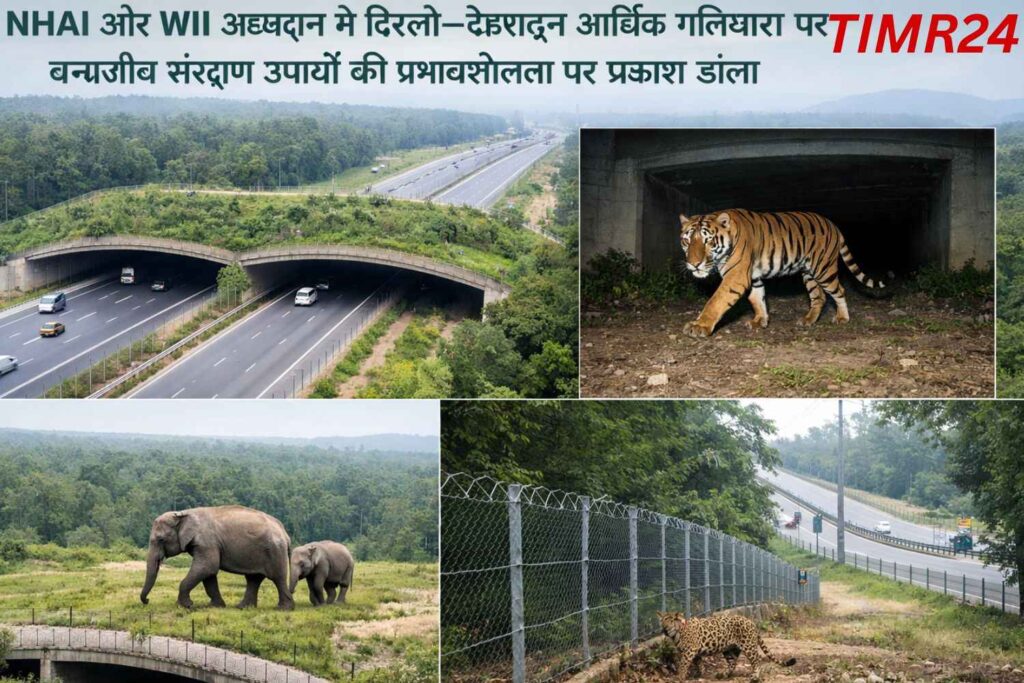
Achieving a significant milestone in sustainable highway development, the NHAI and the Wildlife Institute of India released the report ‘Landscapes Reconnected,’ showcasing wildlife use of underpasses along the Delhi – Dehradun Economic Corridor. The study documents wildlife interactions with a 10.97 km long underpass, crucial for species like tigers and elephants, revealing successful coexistence of infrastructure and ecology. Conducted over 40 days with advanced monitoring equipment, the research recorded over 40,000 interactions among 18 unique species, with noise management as a key factor in underpass use. The corridor mitigates human-wildlife conflict and promotes.
Delhi Dehradun Economic Corridor
Ecological connectivity, highlighting NHAI’s commitment to environmentally sustainable highway projects The Delhi–Dehradun Economic Corridor has emerged as one of India’s most innovative infrastructure developments after a joint study by the National Highways Authority of India (NHAI) and the Wildlife Institute of India (WII) confirmed that wildlife mitigation measures implemented along the corridor are delivering positive results. The study, titled Landscapes Reconnected, has provided the first documented evidence of animals actively using specially designed wildlife underpasses and elevated sections built along the expressway.
This marks a major breakthrough for sustainable infrastructure development in India, proving that economic growth and ecological preservation can move together when projects are planned intelligently. According to the study, wildlife movement has been successfully recorded across the mitigation structures built on the Delhi–Dehradun Economic Corridor, validating the effectiveness of the design strategy adopted by NHAI for this flagship highway project The wildlife mitigation measures were introduced on the ecologically sensitive Ganeshpur–Asharodi stretch of the Delhi–Dehradun corridor, which passes through crucial forest areas connected to.
Forested Landscapes Can Fragment Habitats
The Shivalik landscape and Rajaji Tiger Reserve ecosystem. This region is home to several endangered and protected species, including elephants, leopards, tigers, king cobras, and greater hornbills. Since highway development in forested landscapes can fragment habitats and disrupt migration patterns, NHAI worked closely with WII to design infrastructure that minimizes ecological damage. The result is one of Asia’s most advanced wildlife-friendly highway stretches, featuring a combination of long animal underpasses, elevated corridors, and specially engineered crossing zones that allow animals to move naturally beneath the roadway without interference from traffic.
A major highlight of the project is the 10.97-kilometre-long animal underpass and elevated wildlife corridor built along nearly 20 kilometres of the expressway between Ganeshpur and Asharodi. These structures stand at an average height of six to seven metres, allowing even large mammals such as elephants to move comfortably below the roadway. The elevated design ensures that the natural terrain and vegetation remain largely intact, preserving habitat continuity while enabling high-speed road connectivity above. This infrastructure model is being hailed as a benchmark for future expressway projects in environmentally sensitive zones across India.
According to the WII study, around 40,444 wildlife images representing 18 unique species were documented using these underpasses and mitigation structures, clearly indicating that the crossings are functioning as intended. The findings demonstrate not only the frequency of wildlife movement but also the diversity of species adapting to the infrastructure. This is particularly significant because one of the biggest concerns in linear infrastructure development is whether animals will actually use the provided crossing structures. The success of the Delhi–Dehradun corridor proves that scientifically designed mitigation measures can deliver measurable ecological outcomes.
Animals And Motorists By Separating Wildlife
Beyond biodiversity conservation, the mitigation measures are also expected to reduce human–wildlife conflict and road accident risks. Wildlife crossings on conventional highways often lead to collisions that are dangerous for both animals and motorists. By separating wildlife movement from traffic flow through dedicated crossing infrastructure, the Delhi–Dehradun corridor significantly lowers the likelihood of such incidents. This improves road safety while also supporting long-term conservation of wildlife populations in the region. Experts believe this integrated model can help India address the growing challenge of balancing rapid infrastructure expansion with environmental responsibility.
The Delhi–Dehradun Economic Corridor itself is a transformative transport project that will reduce travel time between Delhi and Dehradun from approximately 6.5 hours to just 2.5 hours. Spanning roughly 210 kilometres, the expressway is designed to improve connectivity (India) across Delhi, Uttar Pradesh, and Uttarakhand while boosting tourism, logistics efficiency, and regional economic development. The incorporation of wildlife mitigation measures into such a major expressway demonstrates how next-generation infrastructure in India is moving beyond traditional engineering to include sustainability, resilience, and ecological intelligence.
NHAI has stated that the success of the Delhi–Dehradun wildlife corridor will influence future highway planning across India, especially for projects passing through forest reserves, eco-sensitive zones, and biodiversity hotspots. The authority is increasingly integrating environmental sustainability into project design through data-driven approaches, wildlife movement mapping, and expert ecological consultation. This aligns with the broader government vision of building infrastructure that supports both economic progress and environmental stewardship. The Wildlife Institute of India has also emphasized that empirical evidence from this project provides.
Environmental Concerns Do Not Necessarily
A valuable template for future transportation corridors requiring ecological safeguards From a policy perspective, the Delhi–Dehradun Economic Corridor may become a defining case study in India’s infrastructure sector. It shows that environmental concerns do not necessarily (India) have to delay or obstruct development when addressed proactively through scientific planning and collaborative execution. Instead, they can enhance project quality and long-term viability. The successful deployment of wildlife mitigation structures also improves India’s standing globally in sustainable transport engineering and demonstrates the country’s capacity to deliver world-class environmentally integrated infrastructure.
In conclusion, the NHAI and WII study on the Delhi–Dehradun Economic Corridor confirms that wildlife mitigation measures are not merely symbolic environmental additions but highly functional infrastructure elements that can preserve biodiversity while supporting major economic corridors. The project sets a new benchmark for sustainable highway development in India by proving that carefully designed underpasses, elevated corridors, and ecological planning can maintain habitat connectivity even in large-scale transport networks. As India continues expanding its expressway and highway network, the Delhi–Dehradun model is likely to shape future standards for environmentally responsible infrastructure nationwide.
Q1. What is the NHAI and WII wildlife mitigation study about?
The study evaluates how wildlife underpasses and elevated corridors on the Delhi–Dehradun Economic Corridor are helping animals cross safely.
Q2. Which animals were observed using the corridor?
Species including elephants, deer, leopards, and other wildlife were recorded using the underpasses.
Q3. Why is the Delhi–Dehradun wildlife corridor important?
It reduces habitat fragmentation and human-wildlife conflict while preserving ecological connectivity.
Q4. How long is the wildlife mitigation stretch?
The key mitigation section covers nearly 20 km, including 10.97 km of dedicated animal underpasses/elevated structures.
Q5. Why is this project significant for India?
It demonstrates how large infrastructure can coexist with biodiversity conservation through sustainable planning.