







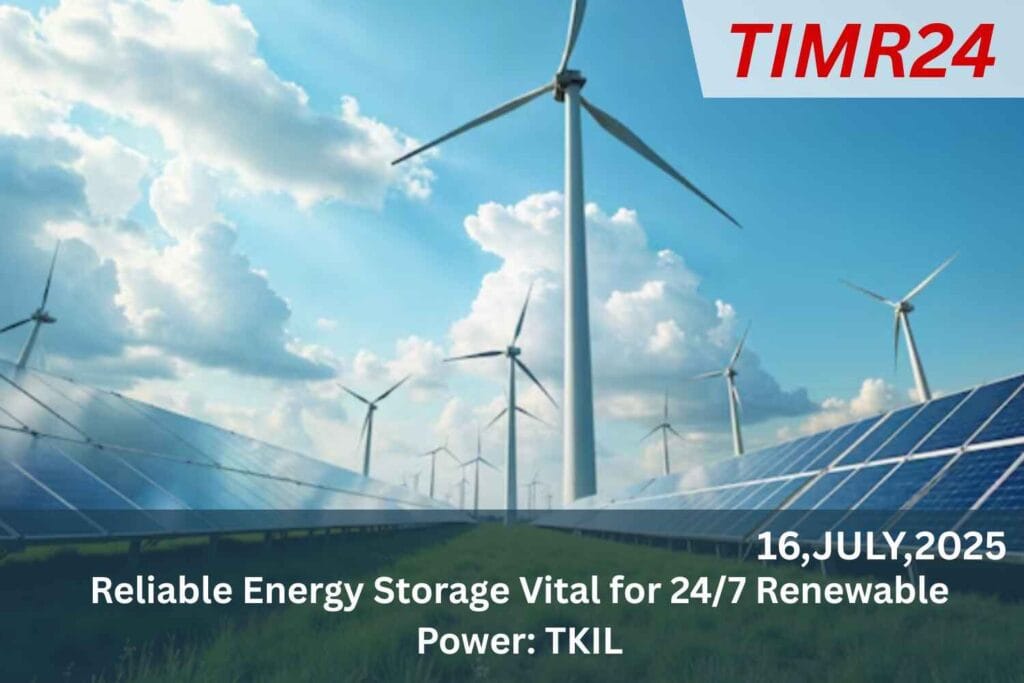
TKIL Industries highlighted the importance of reliable, scalable, and efficient energy storage systems for uninterrupted renewable energy supply. India aims to achieve 500 GW of renewable energy capacity within five years, driven by innovations in storage technology. TKIL is collaborating with Germany’s HOPPECKE Batterie GmbH & Co. to develop battery storage solutions for India’s railway sector. The IESW 2025 event showcases over 300 new products in renewable technologies.
Introduction
TKIL (Thermax-Kalyani Industrial Ltd) has emphasized the importance of reliable energy storage systems as a critical component for enabling 24/7 renewable energy supply. As India moves towards an ambitious clean energy transition, energy storage technologies are emerging as the backbone of round-the-clock (RTC) renewable power. With the variability of solar and wind generation, storage becomes essential to balance supply and demand across the grid.
The Need for 24/7 Renewable Power
India has set aggressive targets for clean energy, aiming to achieve by 2030. However, renewable sources like solar and wind are inherently intermittent. To overcome this challenge and provide uninterrupted power to households and industries, energy storage solutions such as batteries, pumped hydro, and thermal energy storage play a vital role. TKIL’s insights underscore that without dependable storage infrastructure, large-scale integration of renewables will remain inefficient and unstable.
TKIL’s Role in Energy Infrastructure
TKIL, a joint venture of Thermax and the Kalyani Group, is known for its contributions to energy efficiency and sustainable industrial solutions. The company is actively exploring advanced energy storage options to support India’s shift toward a greener grid. It advocates for hybrid systems where renewable generation is combined with reliable storage units, ensuring continuous power even when solar or wind generation dips.
Advancements in Battery Technologies
Battery storage, particularly lithium-ion and newer alternatives like sodium-ion and flow batteries, are becoming more commercially viable. Companies like JSW Energy and already have investing in grid-scale battery projects. TKIL has highlighted the need for innovation and scale in this sector, pointing out that affordability, efficiency, and lifecycle management will determine the success of battery adoption.
Policy and Market Enablers
India’s government is actively promoting energy storage through schemes such as the National Energy Storage Mission (NESM), which aims to foster innovation and manufacturing. TKIL supports policy mechanisms that create a level playing field for storage technologies, including time-of-day tariffs, storage procurement obligations, and financial incentives for hybrid projects. Such frameworks are essential to attract private investment and accelerate deployment.
Conclusion
The call by TKIL to prioritize reliable energy storage is a timely reminder that renewable energy alone cannot guarantee 24/7 power. As India strives for a cleaner and more resilient power system, integrating robust storage to into the grid architecture will be critical. By investing in next-generation technologies and supporting enabling policies, companies like TKIL are helping pave the way for a future where renewable energy can truly power the nation—day and night. For the latest updates on staying informed on technology trends and industry developments is crucial.
q1. Why is energy storage important for renewable power?
It ensures continuous power supply by storing excess energy for use when solar or wind sources are unavailable.
q2. What did TKIL highlight about energy storage?
TKIL emphasized that reliable storage is key to enabling round-the-clock renewable energy delivery.
q3. Which storage technologies are relevant?
Technologies like lithium-ion batteries, flow batteries, and pumped hydro are vital for large-scale energy storage.
q4. How does storage support India’s green goals?
It helps integrate more renewable power into the grid, supporting India’s clean energy targets.
q5. What role does TKIL play?
TKIL is working on advanced industrial and energy solutions, promoting hybrid systems for sustainable power.