









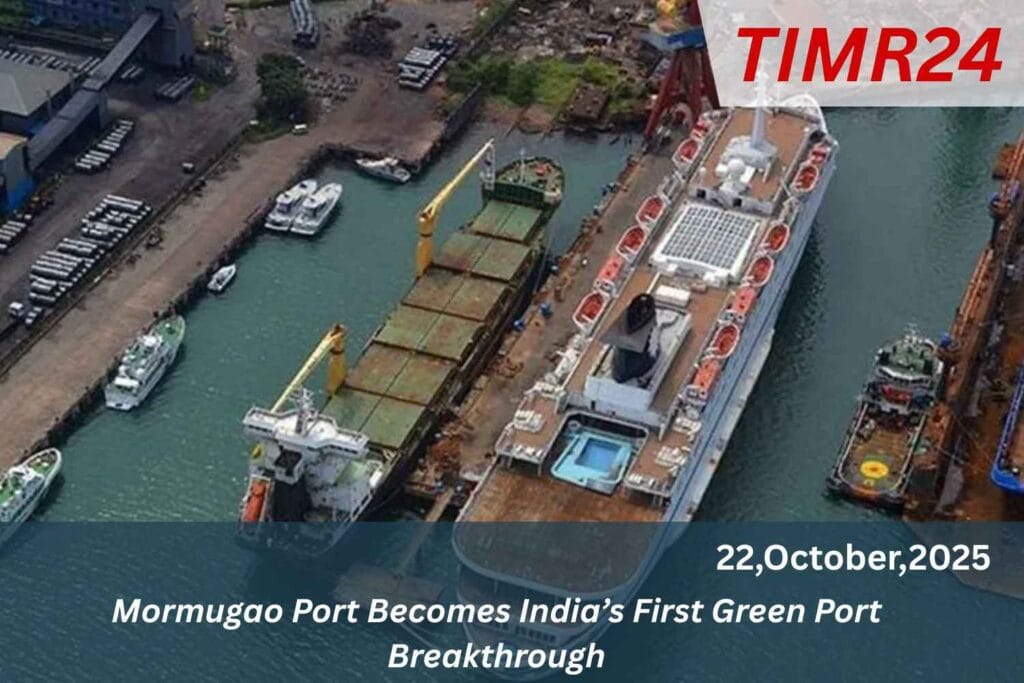
Mormugao Port in Goa has been declared the first accredited green port in India under the Green Port Certification Programme. The port is among three World Bank-selected greening initiatives. Mormugao is also implementing smart ports, 5G communication technologies, and indigenous vessel traffic management systems for safer navigation. These initiatives align with global efforts to reduce shipping emissions and modernize India’s maritime infrastructure. India’s maritime sector has achieved a historic milestone as the Mormugao Port in Goa has officially become the country’s first green port, setting a new benchmark for sustainable coastal development and eco-friendly trade operations.
This transformation is part of India’s long-term vision to make its ports not only global trade enablers but also models of environmental responsibility under the Maritime Vision 2030 framework. The initiative demonstrates how infrastructure growth and ecological balance can coexist in a modern, technology-driven economy, paving the way for future ports across the country to follow a similar path toward sustainability. (Green Port Strategy) The Mormugao Port Authority (MPA) began this ambitious transition by focusing on reducing carbon emissions, enhancing renewable energy usage, and adopting zero-waste management systems. The port’s operations have undergone an extensive.
Modernization process, integrating solar and wind energy systems that now power most of its logistics and administrative facilities. Rooftop solar panels, wind turbines along the coastal line, and energy-efficient LED installations have significantly lowered the port’s carbon footprint. This major leap aligns with the government’s target of reducing the maritime sector’s carbon intensity by 30 percent by the year 2030, echoing the nation’s commitments under the Paris Climate Agreement and the National Green Hydrogen Mission One of the most impressive achievements at Mormugao Port is the installation of a state-of-the-art waste management system that treats solid and liquid waste before.
Disposal, ensuring zero contamination of nearby marine ecosystems. The port now operates a wastewater recycling plant that repurposes water for industrial use, reducing freshwater consumption drastically. Similarly, bio-digesters and composting units handle organic waste from port activities and nearby communities, promoting a circular economy model. The integration of eco-dredging technologies has also played a vital role in maintaining navigational depth without harming marine biodiversity. These innovations are a testament to India’s commitment to balancing trade growth with environmental conservation, a topic further emphasized in the country’s Blue Economy Policy 2025.
Another key area where Mormugao Port has shown remarkable progress is its digital transformation and smart operations. The implementation of AI-driven logistics management, Internet of Things (IoT) sensors, and automated gate systems has revolutionized the port’s day-to-day functioning. These technologies reduce truck idle time, enhance cargo movement efficiency, and minimize emissions caused by long waiting periods. The port’s command center now monitors real-time energy consumption, cargo handling, and traffic flow, making it one of India’s most advanced digital ports. This approach not only boosts productivity but also cuts down on energy wastage, positioning Mormugao as a model for smart port innovation.
Beyond infrastructure and technology, the port’s green transformation has deeply involved the local Goan community. Mormugao Port has launched a series of outreach programs under the “Clean Coast, Blue Future” campaign, promoting coastal clean-up drives, waste segregation awareness, and marine biodiversity preservation. Green belts have been planted around the port’s periphery to act as natural air filters, reducing dust and noise pollution for nearby residents. The collaboration between the port authority, local panchayats, and environmental NGOs has turned Mormugao into a community-driven sustainability hub. These measures not only improve the quality of life for.
From an economic perspective, Mormugao’s green transformation represents a breakthrough in sustainable maritime economics. The port’s cleaner and more efficient operations attract international shipping companies that prioritize eco-compliance and lower carbon trade routes. By adhering to IMO 2020 standards which mandate the use of low-sulfur fuels and greener shipping methods Mormugao has positioned itself as a competitive global trade destination. This move has already begun to draw foreign investment and collaborations with European and East Asian partners interested in green logistics. The government plans to replicate this success story in other major ports.
Like Jawaharlal Nehru Port (Navi Mumbai), Chennai Port, and Visakhapatnam Port, under the Green Port Policy 2025, ensuring that India’s entire coastline adopts environmentally sustainable practices in the coming decade Environmental monitoring at Mormugao has also been elevated to a new level through continuous assessment of air, water, and soil quality using sensor-based environmental dashboards. The data collected helps the port maintain transparency in its sustainability efforts, regularly sharing updates with the Ministry of Ports, Shipping and Waterways (MoPSW). These initiatives foster accountability and align with global frameworks like.
The United Nations Sustainable Development Goals (SDGs), particularly Goal 13 (Climate Action) and Goal 14 (Life Below Water). Such integration ensures that India’s maritime ecosystem evolves responsibly and remains globally competitive (Ports, Shipping and Waterways) The success of Mormugao as India’s first green port also underscores the growing importance of public-private partnerships (PPP) in sustainable development. Collaboration with private logistics firms and renewable energy companies has accelerated the port’s green infrastructure expansion. For instance, the deployment of electric cargo vehicles, shore-to-ship power.
Connections, and low-emission cranes were made possible through joint ventures with green technology providers. These partnerships prove that sustainability can also be a driver of economic growth, creating new job opportunities while reducing long-term operational costs Looking at the broader picture, Mormugao Port’s transformation represents a critical component of India’s ambition to become a global leader in green maritime operations. As global trade increasingly emphasizes sustainability, India’s early adoption of green port practices enhances its reputation in international shipping circles. The shift also encourages domestic industries especially.
Exporters and importers to adopt sustainable logistics chains, aligning the entire ecosystem with carbon-neutral goals. Moreover, the success of Mormugao acts as a learning model for other developing nations seeking to modernize their ports without harming natural habitats the Mormugao Port Green Port Breakthrough is more than just a milestone in infrastructure; it is a symbol of how India envisions its future a balance between growth, technology, and sustainability. The port stands as proof that development can be clean, responsible, and economically beneficial. As India continues expanding its maritime network, the lessons learned from Mormugao.
Journey will shape the future of ports across the subcontinent. Through renewable energy integration, digital smart systems, environmental consciousness, and community inclusion, Mormugao Port has set the foundation for a new era of green maritime growth that will define India’s position in the global trade and sustainability landscape.
Q1. Why is Mormugao Port called India’s first green port?
Because it fully adopts renewable energy systems, eco-friendly infrastructure, and zero-emission logistics operations.
Q2. What technologies make Mormugao a green port?
Use of solar power, electric vehicles, LED lighting, waste recycling, and smart monitoring systems.
Q3. How will the green port benefit Goa and India?
It boosts eco-tourism, supports sustainable trade, and reduces carbon emissions significantly.
Q4. Is Mormugao Port aligned with global environmental standards?
Yes, it meets the IMO 2020 standards and supports India’s Maritime Vision 2030 goals.
Q5. Are other Indian ports following this model?
Yes, ports in Mumbai, Chennai, and Visakhapatnam are next in line under the Green Port Policy 2025.