



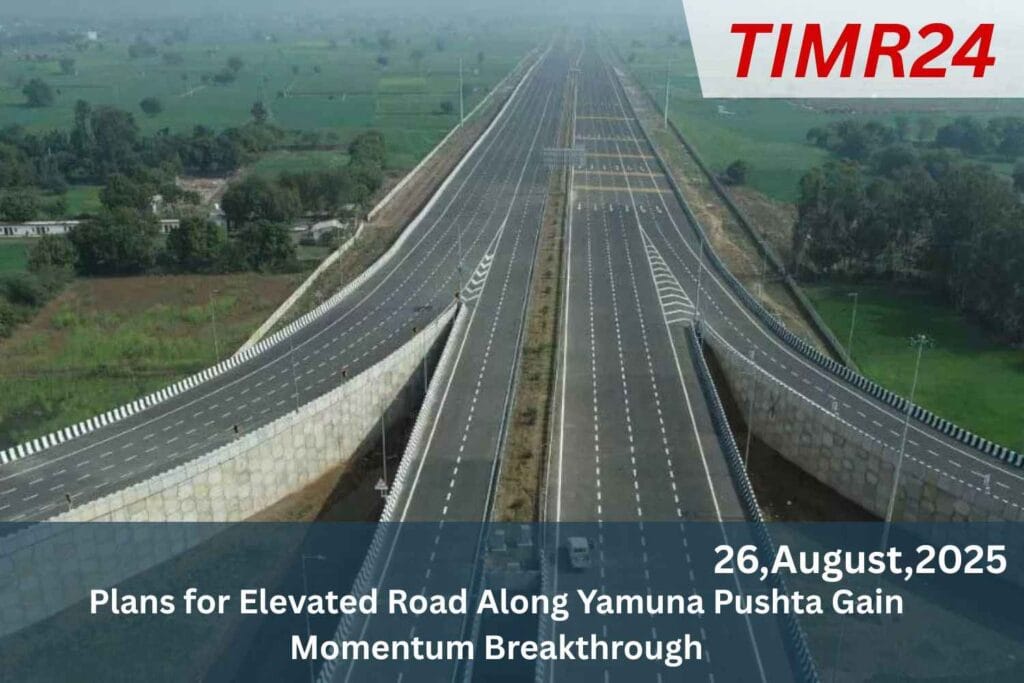
Uttar Pradesh Public Works Department (PWD) is preparing for a 30 km elevated road along the Yamuna Pushta stretch, which will connect Delhi to Noida International Airport and ease congestion on the Noida-Greater Noida Expressway. The project will be submitted to the irrigation department for recommendations and national highway status. The ambitious plan for an elevated road along Yamuna Pushta in Delhi is steadily gaining momentum, bringing renewed focus on the capital’s long-term vision for easing traffic congestion, improving connectivity, and balancing urban expansion with environmental responsibility. The Yamuna riverbank has long been a critical but problematic stretch for commuters
As heavy vehicular movement towards ITO, Geeta Colony, Mayur Vihar, and the Akshardham area results in daily bottlenecks With the Delhi Development Authority (DDA) and the Public Works Department (PWD) leading discussions, the proposed elevated corridor is being designed as a sustainable urban mobility solution that will not only address immediate congestion but also (Road Highways), integrate with the broader infrastructure goals of the city. As Delhi has witnessed rapid population growth and urban migration, the pressure on existing arterial roads like Ring Road and NH-24 has intensified, making this project a vital necessity rather than a luxury. According to urban transport specialists, the elevated road could potentially cut travel time by up to half an hour during peak hours.
Benefitting lakhs of commuters daily and easing stress on parallel road networks that are already overstretched. Beyond traffic management, the project has generated discussions around its environmental implications, particularly because the Yamuna floodplains are ecologically sensitive zones that need to be protected. Authorities have highlighted that the road will be constructed using environment-friendly technologies such as noise-reduction barriers, green landscaping, and modern drainage systems to prevent direct impact on the river. This is in line with the government’s broader Yamuna Rejuvenation Mission, which aims to restore the river’s ecosystem while allowing carefully planned infrastructure growth.
A balance between urban mobility and environmental conservation has become central to Delhi’s planning, and this project is expected to set a precedent for how future developments can respect ecological boundaries while addressing civic challenges. For readers interested in the ecological aspect, we have covered detailed initiatives under which shows how various departments are aligning to revive the lifeline of the city Connectivity is another strong pillar of this elevated road project. Once operational, the corridor will seamlessly link East Delhi with the heart of the capital, creating smoother access to commercial hubs near ITO, administrative centers around Pragati Maidan, and residential clusters in Mayur Vihar.
It will also reduce dependency on crowded alternatives like the Geeta Colony bridge, thereby ensuring balanced traffic distribution Furthermore, the project has implications for NCR integration, particularly with Noida, as it will provide commuters with an additional option besides the overburdened Delhi-Noida Link Road. The benefits are not only limited to transport but extend to urban growth, since improved road infrastructure often attracts real estate development, business investment, and commercial activity. As we explored in our coverage of the Noida Expressway, transport corridors play a crucial role in shaping real estate dynamics and housing demands, and Yamuna Pushta is expected to follow a similar trajectory. On the social and economic front, the project promises to uplift living standards
By reducing travel stress, curbing vehicular emissions, and making public spaces more accessible. Residents of East Delhi, who often feel disconnected from the city’s core due to traffic bottlenecks, will gain smoother mobility and faster commutes. From an economic perspective, reduced travel time translates into greater productivity, fuel savings, and a more efficient flow of goods and services. Businesses located in East and Central Delhi may experience a positive impact as connectivity improves, opening up opportunities for new offices, retail spaces, and urban amenities. The Delhi government has been increasingly vocal about adopting modern transport
Solutions to align with the Smart City Mission, and this elevated road forms part of that forward-looking strategy Nevertheless, challenges remain. Land acquisition, environmental clearances, and financial planning are still hurdles that require careful navigation. Experts have suggested that a public-private partnership (PPP) model could ensure funding stability while distributing risk among stakeholders. This approach has already shown success in other national infrastructure projects overseen by the which emphasizes sustainable financing frameworks for large-scale projects. While government officials remain optimistic, local communities and environmental activists continue to call for transparency in planning and accountability in execution.
Ensuring that the project does not harm the fragile river ecosystem while delivering its promised mobility benefits will be the ultimate test of governance the elevated road along Yamuna Pushta is emerging as more than just a transport corridor; it symbolizes Delhi’s attempt to reinvent its urban fabric in a way that is modern, sustainable, and commuter-friendly. If executed with diligence (Ministry of Road Transport) the project has the potential to transform daily travel experiences, spur economic activity, and serve as a model for balancing development with ecology. For residents, businesses, and policymakers alike, this is not merely a road but a blueprint for Delhi’s future. As the city continues to evolve, infrastructure initiatives.
Q1 What is the Yamuna Pushta elevated road project?
It is a proposed elevated corridor in Delhi aimed at reducing congestion along the Yamuna riverbank.
Q2 Which areas will benefit from this project?
Key regions include ITO, Geeta Colony, Mayur Vihar, and parts of East Delhi.
Q3 Who is handling the construction?
The Delhi government, DDA, and PWD are the primary agencies involved.
Q4 What are the expected benefits?
Reduced travel time, less congestion, improved connectivity, and eco-friendly urban planning.
Q5 When is the project expected to start?
The project is currently in its planning stage, with approvals in progress.