














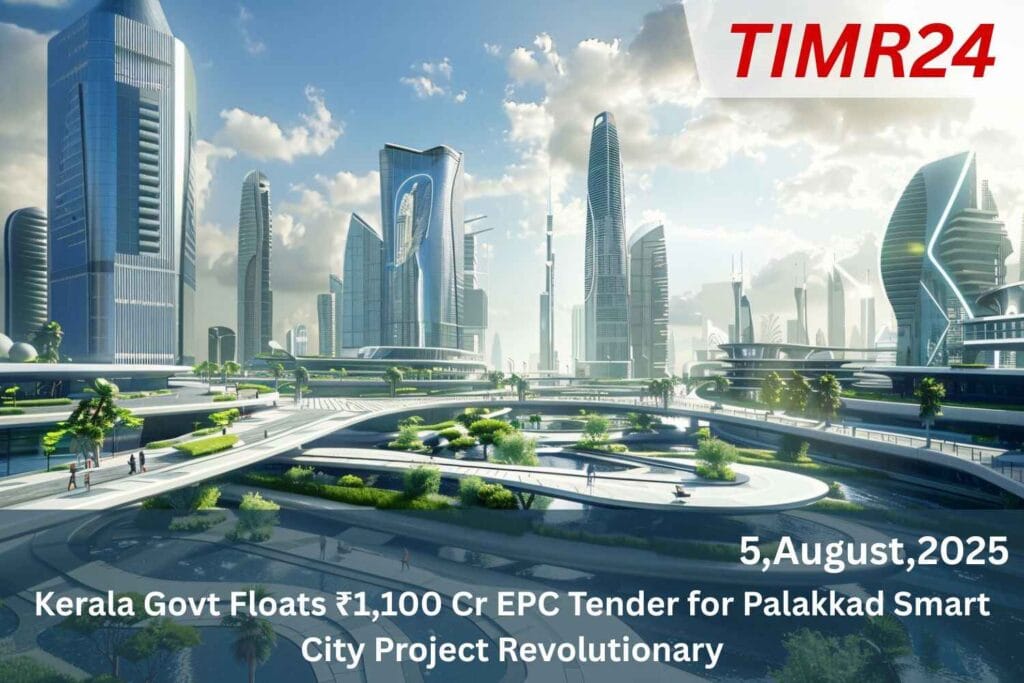
Kerala government invites tenders for a ₹1,100 crore infrastructure development project under the Palakkad Smart City initiative, part of the Kochi-Bengaluru Industrial Corridor. The project will cover 1,400 acres of land with a four-year completion timeline The Kerala Government has recently floated an ambitious ₹1,100 crore Engineering, Procurement, and Construction (EPC) tender aimed at accelerating the Smart City development of Palakkad. The initiative, part of the larger Smart Cities Mission spearheaded by the Central Government, signals a major step forward in transforming Palakkad into a digitally enabled, sustainable, and citizen-centric urban centre.
Project Overview
The EPC tender released covers a wide array of developmental components ranging from urban mobility and smart governance to sustainable energy infrastructure. This move is a clear indication of the state’s dedication to building next-generation cities that align with the core principles of the (Smart Cities) project envisions the complete transformation of Palakkad’s urban fabric, touching upon essential services and facilities, including roads, water supply, waste management, street lighting, e-governance platforms, and smart surveillance systems.
Urban Infrastructure and Connectivity
A substantial portion of the ₹1,100 crore tender has been earmarked for enhancing urban infrastructure and transport networks. This includes the redesign and upgrade of existing roadways, creation of dedicated pedestrian and cycling lanes, and integration of Intelligent Transport Systems (ITS). These developments are expected to significantly reduce traffic congestion and promote eco-friendly commuting. Notably, the proposed multi-modal transport hubs aim to synchronize public transport modes for seamless travel across the district.
Sustainability and Green Technologies
Sustainability is a cornerstone of the Palakkad Smart City vision. The project gives high priority to renewable energy sources, energy-efficient public lighting systems, and eco-friendly construction materials. Smart water management technologies—including sensor-based water meters, rainwater harvesting systems, and smart drainage planning—will be deployed to reduce water loss and ensure equitable distribution. The Kerala government is also looking to set up solar panels on public buildings and integrate them with the grid to encourage.
The implementation of robust Information and Communication Technology (ICT) solutions is another major highlight of the project. Plans include the installation of digital kiosks, CCTV surveillance with AI analytics, Wi-Fi hotspots, and a centralized command control centre for emergency response and real-time monitoring. The initiative will also push for end-to-end digitization of public services under the e-Governance framework, empowering citizens with more transparency and faster grievance redressal. (Smart Cities)
Employment and Local Economy
In addition to the long-term urban benefits, the ₹1,100 crore project is expected to create a significant number of especially for engineers, IT professionals, and skilled construction workers. The local economy stands to benefit immensely, both from short-term construction contracts and long-term service delivery models driven by innovation and digital transformation. The launch of this EPC tender for the Palakkad Smart City project reaffirms Kerala’s commitment to creating sustainable, inclusive, and technologically advanced urban landscapes. As the project unfolds, it promises to serve as a model not just for other cities in Kerala, but for urban development across the nation.
Q1. What is the total value of the Palakkad Smart City EPC tender floated by the Kerala Government?
The total value of the EPC tender is ₹1,100 crore.
Q2. What areas will the project focus on under the Smart City initiative?
The project will focus on urban mobility, smart governance, waste and water management, ICT integration, and sustainable energy solutions.
Q3. Who is eligible to bid for the EPC tender?
National and international EPC contractors with proven experience in large-scale infrastructure and smart city projects are eligible.
Q4. What is the expected impact of the project on Palakkad’s development?
It aims to modernize infrastructure, boost connectivity, improve public services, and promote sustainable urban living.
Q5. What does EPC stand for in the context of this project?
EPC stands for Engineering, Procurement, and Construction — a turnkey model where the contractor handles design, supply, and execution.