
















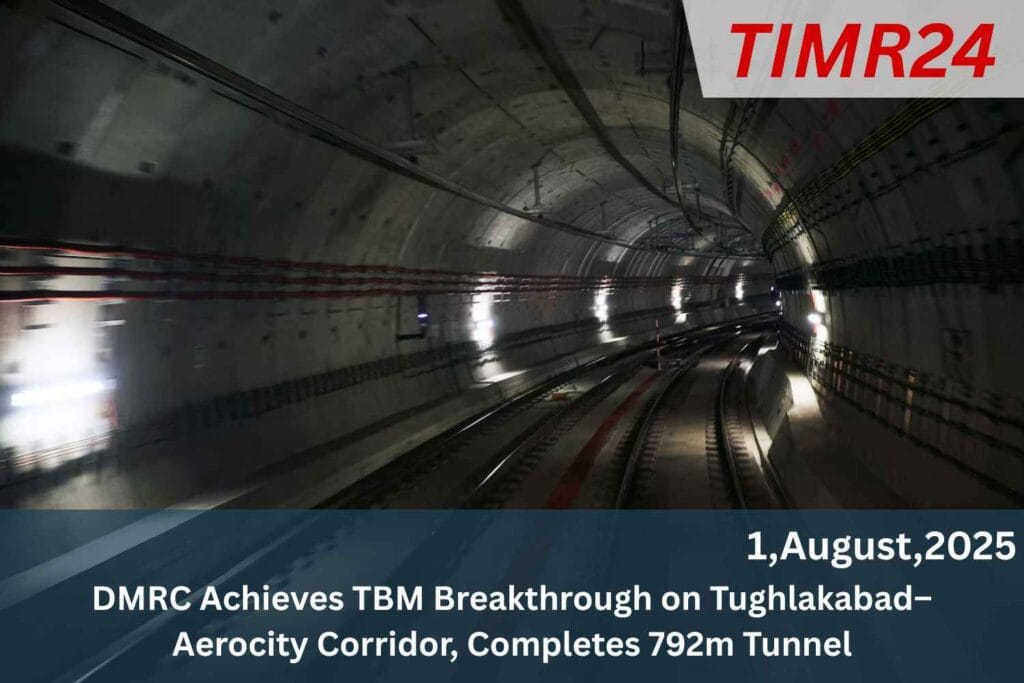
The Delhi Metro Rail Corporation (DMRC) has completed a 792-metre-long tunnel on the Tughlakabad–Aerocity corridor, marking a significant milestone in Phase 4 of its network expansion. The tunnel, constructed using a Tunnel Boring Machine, will feature two parallel tunnels between Tughlakabad and Tughlakabad Railway Colony stations. The Delhi Metro Rail Corporation (DMRC) marked a major milestone on the Tughlakabad–Aerocity Silver Line with the successful TBM breakthrough, completing a 792-meter tunnel section, enhancing progress on Phase 4 expansion.
The Delhi Metro Rail Corporation (DMRC) has achieved a significant milestone with the Tunnel Boring Machine (TBM) breakthrough on the Tughlakabad–Aerocity corridor of Delhi Metro Phase IV. The breakthrough marks the completion of a 792-meter-long tunnel between Sangam Vihar and Ambedkar Nagar metro stations, further boosting connectivity in South Delhi and adjacent areas.
Project Milestone: 792m Tunnel Completed
The breakthrough occurred using TBM ‘Wanda’, which began its operation in late 2023. This 792-meter tunnel was executed with a diameter of 6.6 meters and passed under densely populated residential zones with minimal surface disruption. According to DMRC, the operation involved advanced geological mapping and vibration control techniques to ensure minimal environmental impact. (Metro Rail Corporation)
Connectivity Boost: Tughlakabad to Aerocity
The Tughlakabad–Aerocity corridor is one of the three approved corridors under Delhi Metro Phase IV, stretching approximately 23.6 km with 15 stations. Once completed, it will offer seamless access between South Delhi, Mehrauli, IGNOU, Vasant Kunj, and IGI Airport’s Aerocity. The corridor will also connect with the existing Violet Line at Tughlakabad and the Airport Express Line at Aerocity, reducing travel time and easing inter-line transfers.
This development will significantly benefit daily commuters and airport travellers, reducing dependency on road-based transport like buses and cabs (DMRC Official Site).
Technology and Execution
DMRC employed state-of-the-art TBM technology, including advanced navigation systems and reinforced cutter heads, to tunnel efficiently through varying soil strata. Engineers used real-time monitoring systems to track machine alignment, tunnel pressure, and ground stability. The project also adhered to stringent safety and sustainability protocols, including slurry separation and groundwater management.
Urban Impact and Sustainability
The Tughlakabad–Aerocity corridor supports Delhi’s goal of developing sustainable, multi-modal transport systems. By extending the metro’s reach into underserved neighbourhoods, the project is expected to decongest arterial roads like Mehrauli-Badarpur Road and improve last-mile connectivity through integrated feeder bus and e-rickshaw networks. Furthermore, the use of tunnelling minimizes displacement and land acquisition, aligning with Delhi Metro’s eco-sensitive approach. The corridor is also expected to reduce vehicular emissions, contributing to cleaner air quality in the region.
What’s Next?
With this breakthrough, tunnelling work on multiple stretches of the corridor is progressing swiftly. DMRC aims to complete the Tughlakabad–Aerocity corridor by late 2026, enhancing capacity on Delhi’s southern transit backbone. As work advances, similar breakthroughs are expected near Saket G-Block and Vasant Vihar, accelerating the pace of the capital’s largest metro expansion yet.
q1. What is the Tughlakabad–Aerocity Corridor?
It is part of Delhi Metro’s Phase 4 expansion under the Silver Line, aimed at improving east-west connectivity in Delhi.
q2. What does TBM breakthrough mean?
TBM (Tunnel Boring Machine) breakthrough refers to the successful completion of a tunnel segment, where the machine emerges at the designated endpoint after boring underground.
q3. How long is the tunnel completed in this breakthrough?
DMRC has completed a 792-meter-long tunnel as part of the Tughlakabad–Aerocity Corridor.
q4. Where did the TBM breakthrough occur?
The breakthrough occurred between Chhatarpur and IGNOU stations on the upcoming Silver Line.
q5. How does this milestone impact the project timeline?
This breakthrough marks a significant step toward timely completion of the corridor and brings the metro line closer to operational readiness.