













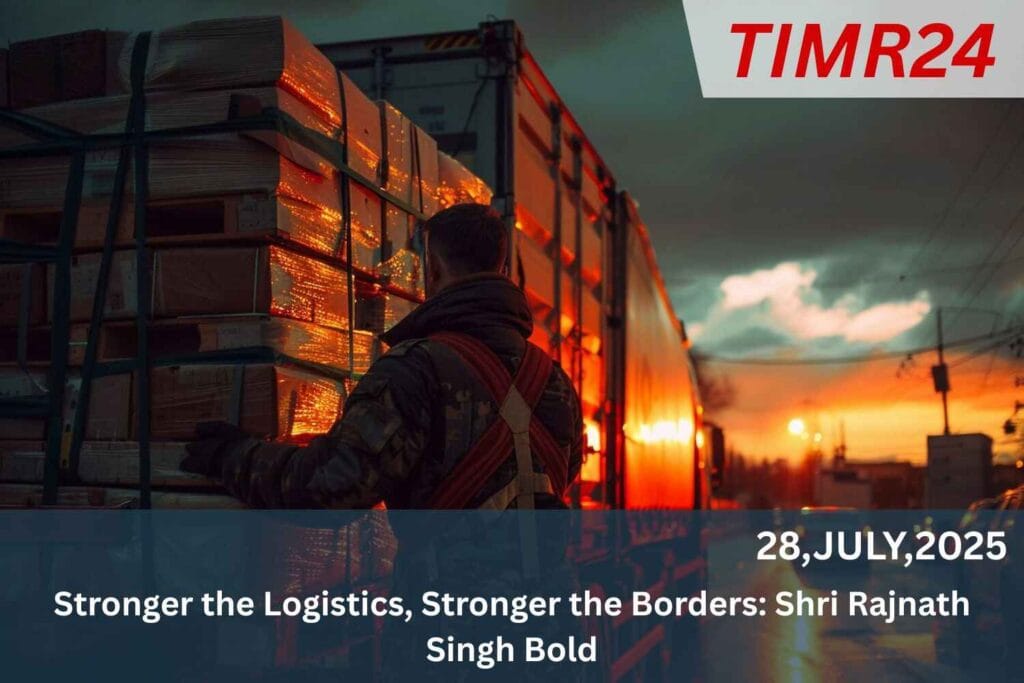
India’s first university dedicated to transport and logistics education, Gati Shakti Vishwavidyalaya (GSV), held its third convocation in Vadodara, Gujarat. Raksha Mantri Shri Rajnath Singh emphasized the role of infrastructure and logistics in India’s economic development, highlighting the importance of stronger logistics services for a developed nation. Union Minister for Railways and Chancellor of GSV, Shri Ashwini Vaishnav, praised the Indian Railways’ transformation and encouraged students to support India’s global economy. 194 students received degrees, with awards for academic excellence and outstanding projects.
Logistics as the Backbone of National Security
During a recent address, Defence Minister Shri Rajnath Singh emphasized the critical role in safeguarding India’s borders, stating, “Stronger, stronger the borders.” This powerful message underlines the increasing relevance of supply chain efficiency, infrastructure resilience, and technological integration in modern military preparedness. The Indian government has been steadily pushing for reforms in the defence logistics sector through its (Logistics Framework), aiming to ensure faster deployment, uninterrupted supply chains, and real-time support for armed forces stationed in remote or high-altitude areas.
India’s Ongoing Defence Modernization
Under the leadership of Shri Rajnath Singh, the Ministry of Defence has focused on developing dual-use infrastructure, such as border roads and airstrips, that serve both military and civilian needs. Projects like have significantly improved road connectivity in areas like Arunachal Pradesh, Ladakh, and Sikkim. These efforts directly reflect Singh’s vision where logistics are not just a support arm but a strategic pillar in national defence. Additionally, recent policy initiatives encourage the private sector to participate in defence production, fostering self-reliance through the Division – Department for Promotion of Industry and Internal Trade (DPIIT)
(Logistics)
Tech-Enabled Défense
One of the most significant shifts in India’s defence logistics has been the integration of digital platforms and AI-based systems. Technologies such as predictive supply chain analytics, UAV-based monitoring, and automated inventory systems are being introduced to enhance operational efficiency. The currently being drafted is expected to formalize these developments. Shri Rajnath Singh has often reiterated that future wars will not just be fought with weapons but also with data and agility—both of which are anchored in a well-oiled logistics backbone.
Border Infrastructure and Strategic Preparedness
Logistics has become a front-line priority, especially along India’s sensitive borders with China and Pakistan. The improvement in storage facilities, fuel depots, and forward operating bases ensures that troops remain battle-ready with minimal delays. The creation of near Line of Actual Control (LAC) is a step toward minimizing response times in emergencies. Shri Singh has highlighted that with better logistics, India can defend with confidence, deter adversaries, and support extended missions without relying on foreign supply chains.
Empowering Local Industries in Defence Supply
A major emphasis has also been placed on indigenizing the supply chain. Local MSMEs and start-ups are being encouraged to develop components, drones, smart warehousing solutions, and specialized vehicles tailored for defence use. This not only creates domestic employment but reduces dependency on global suppliers. Organizations like (Society of Indian Defence Manufacturers) are working in collaboration with the Ministry of Defence to accelerate this process.
q1. What did Shri Rajnath Singh emphasize about Industries?
He stated that Industries stronger lead to stronger and more secure borders.
q2. Why is logistics important for national Défense?
Efficient logistics ensure timely troop movement, equipment supply, and mission readiness.
q3. What steps has India taken to improve Défense Industries?
India is investing in border infrastructure, digital tracking, and integrated networks Industries
q4. Which organizations are involved in Défense logistics?
Key players include Industries the Ministry of Defence, BRO, DRDO, and private sector partners.
q5. How does this benefit the armed forces?
It enhances operational efficiency, response speed, and overall mission success at the borders.