



















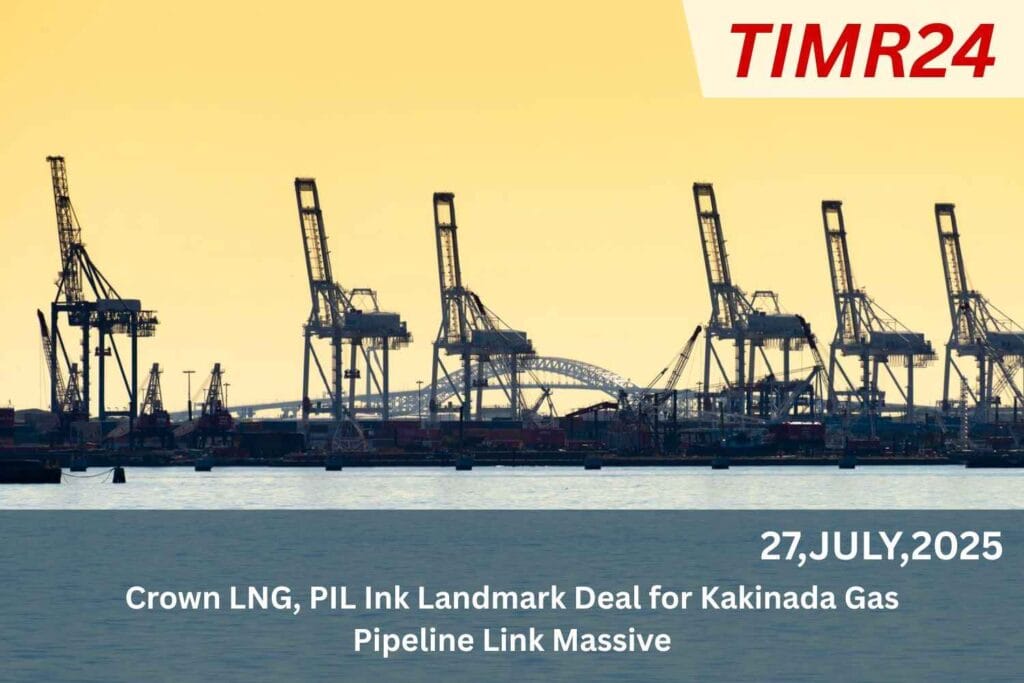
Pipeline Infrastructure Ltd (PIL) and Crown LNG Holdings Ltd have signed a Memorandum of Understanding to establish pipeline connectivity between Crown LNG’s proposed 7.2 million tonnes per annum gravity-based LNG terminal in Kakinada, Andhra Pradesh, and PIL’s existing natural gas pipeline. The agreement aims to link the regasification unit (GBSRU) with PIL’s injection point in Kakinada, facilitating the evacuation of 25 million standard cubic meters per day of gas to major demand centres across India.
In a move that strengthens India’s energy infrastructure, Crown LNG has signed a key agreement with Pipeline Infrastructure Limited (PIL) to develop a gas pipeline link from the proposed offshore LNG terminal near Kakinada, Andhra Pradesh. The pipeline will connect Crown LNG’s floating storage and regasification unit (FSRU) to the national gas grid, facilitating the efficient distribution of natural gas to various industrial and power sectors across southern and central India. This development is poised to significantly boost clean energy access and strengthen the gas-based economy envisioned by the Indian government. (Patel Engineering)
About the Kakinada LNG Terminal Project
Crown LNG is setting up a floating LNG import terminal off the coast of Kakinada, which will be among the first of its kind in India. This offshore facility will use an FSRU, which allows for lower infrastructure costs, quicker setup, and more flexibility compared to onshore terminals. The terminal will have an initial capacity of around 7.2 million tonnes per annum (MTPA), with potential for expansion based on demand. The PIL agreement is a critical step toward linking this offshore terminal to India’s expanding natural gas infrastructure. Crown LNG Official Website
➤ (Crown LNG)
PIL’s Role in the Agreement
Pipeline Infrastructure Limited (PIL), a major player in India’s midstream energy sector, brings robust technical connecting the FSRU to the onshore expertise in pipeline design, construction, and operations. As part of this IS ALL agreement, PIL will be responsible for laying and maintaining the subsea and land pipelines connecting the FSRU to the onshore grid network. This partnership is expected to reduce lead times and ensure seamless gas delivery to high-demand regions.
Strategic Significance for India’s Energy Security
The agreement aligns with India’s broader objective to increase the share of natural gas in its energy mix to 15% by 2030, up from around 6% currently. This deal not only adds much-needed capacity but also reduces India’s connecting the FSRU to the onshore dependence on coal and oil. The Kakinada terminal will serve industries, power plants, city gas distribution (CGD) networks, and even export markets like Bangladesh and Sri Lanka. It also complements the government’s One Nation, One Gas Grid mission by strengthening southern India’s connectivity to the main gas pipeline network.
Environmental and Economic Impact
LNG is a cleaner fuel alternative, and its expanded use will help lower CO₂ emissions in industrial and transportation sectors. Additionally, the Crown LNG and PIL collaboration is expected to generate employment, promote local connecting the FSRU to the onshore engineering capabilities, and attract foreign investment into Andhra Pradesh’s energy sector. The project could act as a catalyst for industrial development in coastal regions.
Q1. What is the deal between Crown LNG and PIL about?
It’s an agreement to build a pipeline linking Crown LNG’s terminal to the gas grid.
Q2. Where is the LNG terminal located?
Offshore near Kakinada, Andhra Pradesh.
Q3. What role will PIL play in the project?
PIL will design, build, and operate the pipeline infrastructure.
Q4. Why is this project important?
It boosts clean energy access and supports India’s gas-based economy.
Q5. When will the pipeline be operational?
Post regulatory approvals, construction is expected to begin soon.