















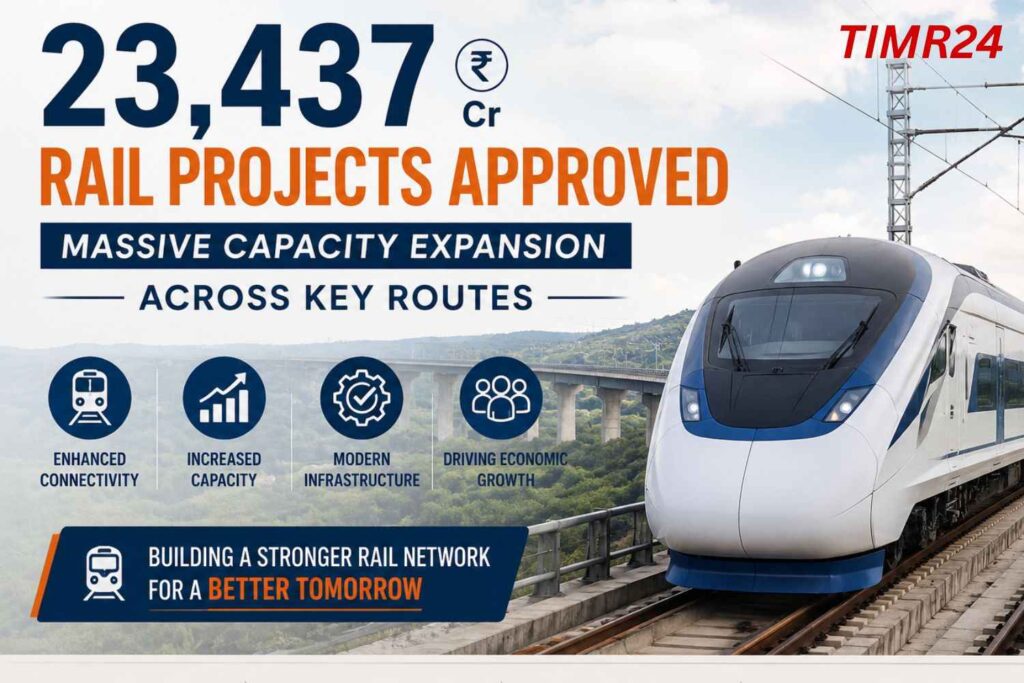
The Cabinet Committee on Economic Affairs, led by Prime Minister Narendra Modi, has sanctioned three railway projects worth approximately Rs 23,437 crore to boost network capacity and efficiency. These projects encompass adding third and fourth lines on the Nagda–Mathura, Guntakal–Wadi, and Burhwal–Sitapur routes, aimed at reducing congestion and enhancing the operational performance of Indian Railways This capacity expansion is expected to enhance mobility, service reliability, and streamline train operations across vital corridors, thereby supporting the government’s goal of a self-reliant economy through regional development and job creation.
Projects Extend Indian Railways’ Network
Planned under the PM-Gati Shakti National Master Plan, these projects focus on improving multi-modal connectivity and logistical efficiency Spanning 19 districts in Madhya Pradesh, Rajasthan, Uttar Pradesh, Karnataka, Andhra Pradesh, and Telangana, the projects will extend Indian Railways’ network by about 901 kilometers. They will also provide improved connectivity to approximately 4,161 villages, benefiting around 83 lakh people. Additionally, the enhanced rail connectivity will facilitate access to notable tourist destinations and is critical for transporting various commodities, leading to an expected increase in freight traffic of 60 MTPA.
The projects promise environmental benefits by reducing oil imports, lowering CO2 emissions, and supporting climate goals The Indian government has taken another major step toward strengthening the nation’s transport infrastructure with the approval of railway projects aimed at expanding rail capacity across several strategic routes. The Cabinet decision reflects the government’s long-term commitment to improving connectivity, accelerating freight movement, and modernising the country’s railway network to support India’s rapidly growing economy. The latest investment is expected to significantly enhance operational efficiency while reducing congestion on heavily used rail corridors.
Modernising Rail Tracks, And Improving Connectivity
With rising industrial activity and increasing passenger demand, the railway sector has become one of the most critical components of India’s infrastructure development strategy The newly approved projects will focus on increasing line capacity, modernising rail tracks, and improving connectivity between industrial hubs, ports, mining zones, and key economic centres. Several routes identified under the expansion plan currently experience high traffic volumes, leading to delays in both freight and passenger train operations. By introducing additional rail lines and upgrading existing infrastructure, the government aims to improve train speeds, ensure smoother.
Logistics movement, and reduce operational bottlenecks. These developments are expected to play a crucial role in supporting the country’s economic growth ambitions over the next decade India’s railway network is one of the largest in the world and serves as the backbone of domestic transportation. Over the years, growing urbanisation, industrial expansion, and increased freight demand have placed tremendous pressure on existing rail infrastructure. In response, the government has accelerated investments in railway modernisation and capacity enhancement. The latest Cabinet approval further strengthens this vision and aligns with.
Cement, Steel, Food Grains, Fertilisers, And Industrial Goods
broader infrastructure initiatives being implemented across the country One of the primary objectives of the approved projects is to improve freight transportation efficiency. Indian Railways plays a vital role in transporting coal, cement, steel, food grains, fertilisers, and industrial goods across different regions. However, limited line capacity on certain routes often leads to congestion and slower cargo movement. The expansion projects are expected to address these challenges by creating additional tracks and improving route flexibility. Faster freight operations will not only reduce logistics costs but also strengthen supply chain efficiency for industries nationwide.
The rail capacity expansion programme is also expected to contribute significantly to regional economic development. Improved connectivity often acts as a catalyst for industrial growth, urban development, and employment generation. Regions connected through upgraded railway infrastructure typically witness increased investment activity and stronger business opportunities. Better transport access encourages industries to establish manufacturing units, warehouses, and logistics parks in emerging economic zones. This can create new employment opportunities while supporting local economies and small businesses.
Congested Rail Routes Frequently Impact Train
Apart from freight movement, passenger transportation is also expected to improve substantially through these projects. Congested rail routes frequently impact train punctuality and reduce overall service quality for travellers. With the addition of new tracks and upgraded infrastructure, Indian Railways will be able to operate more trains while reducing delays. Passengers are likely to benefit from improved travel reliability, enhanced safety measures, and better connectivity between cities and rural regions. The railway sector continues to remain a preferred transportation mode for millions of Indians due to its affordability and extensive reach.
The government’s focus on infrastructure-led growth has been visible across sectors including highways, metro rail, airports, renewable energy, and logistics corridors. Railways remain at the centre of this strategy because of their ability to efficiently move large volumes of (India) passengers and freight over long distances. Investments in railway infrastructure also complement the broader goals of sustainable transportation and reduced carbon emissions. Rail transport is considered more energy-efficient compared to road transportation, making it an important component of India’s long-term sustainability goals Another important aspect of the approved railway projects.
Improve Operational Performance Technological
The integration of advanced technologies and modern engineering practices. Indian Railways has been increasingly adopting digital monitoring systems, automated signalling solutions, and modern track construction methods to improve operational performance. These technological upgrades are expected to improve safety standards while increasing network reliability. Enhanced signalling and communication systems can help reduce train delays and improve route management efficiency across busy corridors The large-scale investment approved by the Cabinet is also expected to generate significant employment opportunities during both.
The construction and operational phases. Infrastructure projects of this scale require extensive manpower across engineering, construction, project management, logistics, and technical services. Local contractors, suppliers, and small businesses associated with the railway ecosystem are also likely to benefit from increased economic activity. The multiplier effect of infrastructure investments often contributes positively to regional income generation and industrial development Experts believe that continuous investment in railway capacity expansion is essential for achieving India’s long-term economic and infrastructure goals. As the country continues to grow as.
Scalable Solution For Moving Goods And Passengers
A manufacturing and logistics hub, efficient transport systems will become increasingly important. Railways provide a cost-effective and scalable solution for moving goods and passengers across long distances. Improved connectivity also enhances competitiveness by reducing transportation costs and improving delivery timelines for businesses.
The Cabinet’s approval of railway projects represents another major milestone in India’s infrastructure transformation journey. By focusing on capacity enhancement, operational efficiency, and improved connectivity, the government aims to (India) strengthen the railway sector’s role in supporting economic growth and national development. The projects are expected to deliver long-term benefits for industries, passengers, and regional economies while reinforcing India’s commitment toward building a modern and efficient transport infrastructure network.
Q1. What is the total value of the approved rail projects?
The Union Cabinet has approved railway projects worth Rs 23,437 crore for capacity expansion across major routes in India.
Q2. What is the main objective of these railway projects?
The projects aim to improve rail connectivity, increase freight efficiency, reduce congestion, and support economic growth.
Q3. Which sectors will benefit from these rail expansions?
Industries including logistics, mining, manufacturing, agriculture, and passenger transportation will benefit significantly.
Q4. How will the projects improve freight transportation?
The new rail corridors and upgraded lines will reduce transit time, improve cargo movement, and increase operational efficiency.
Q5. Will these projects generate employment?
Yes, the railway expansion projects are expected to create thousands of direct and indirect jobs during construction and operations.