










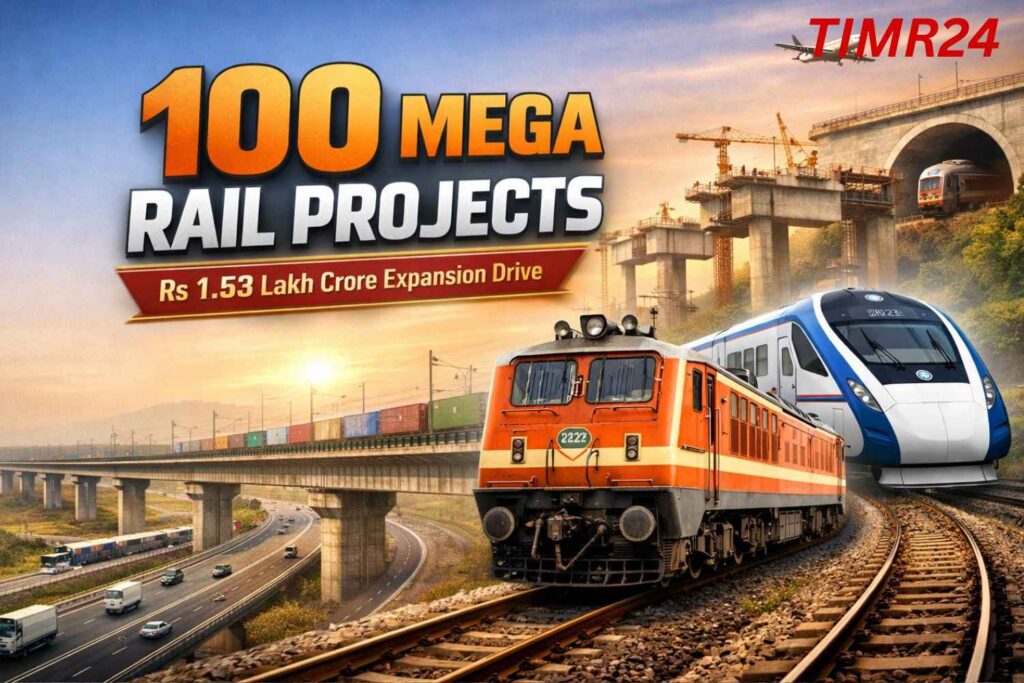
Ministry of Railways has approved 100 infrastructure projects for FY 2025–26, with a total investment of Rs 1.53 lakh crore, expanding the railway network by over 6,000 km. The projects include new lines, doubling, and multi-tracking to alleviate congestion and enhance capacity. They aim to improve connectivity to underserved areas, boost operational efficiency, and facilitate smoother passenger and freight movement. This marks a significant increase in investment and scope compared to the previous year, driving capacity augmentation and modernization of India’s rail infrastructure.
Indian Railways has taken a historic leap in infrastructure development by sanctioning 100 railway projects worth ₹1.53 lakh crore during FY26, marking one of the largest annual expansion approvals in its history. According to official government data, these newly approved projects will cover more than 6,000 kilometers of railway network across India, including new lines, track doubling, multitracking, flyovers, bypass lines, and chord routes. This expansion reflects the government’s aggressive push to modernize India’s transport backbone and strengthen national logistics under the PM Gati Shakti National Master Plan. The announcement highlights a significant rise in railway.
Enhance Freight Efficiency, And Connect Underserved
Capital expenditure, with investment commitments more than doubling year-on-year compared with FY25 The approved projects are strategically designed to decongest saturated rail corridors, improve punctuality of trains, enhance freight efficiency, and connect underserved regions of the country. Railway officials have emphasized that these projects will directly support India’s long-term economic ambitions by enabling faster cargo movement between industrial hubs, ports, mining belts, and consumption centers. In an economy increasingly focused on manufacturing and logistics competitiveness, railway capacity expansion has become central to reducing transport costs and improving supply chain resilience.
A large share of these sanctioned works will focus on capacity augmentation through track doubling and multitracking, especially in freight-heavy corridors where congestion has historically delayed both goods and passenger trains. These improvements are expected to reduce bottlenecks, improve train turnaround times, and allow more trains to operate on key routes. For businesses dependent on coal, steel, cement, agriculture, and container transport, this capacity boost could significantly improve delivery timelines and logistics efficiency.
States such as Maharashtra, Bihar, Jharkhand, and Madhya Pradesh have emerged as major beneficiaries of the FY26 railway sanction list due to their strategic importance in freight corridors, industrial production, and passenger demand. Maharashtra reportedly leads with the highest number of sanctioned projects, followed by Bihar and Jharkhand. These regions are expected to witness improved rail connectivity for industrial zones, mining operations, and regional mobility, further strengthening local economic development.
Latest Approvals Represent a 56% Increase
The FY26 railway expansion package also demonstrates the increasing scale of India’s infrastructure ambitions. Compared with FY25, when 64 railway projects worth approximately ₹72,869 crore were sanctioned covering 2,800+ km, the latest approvals represent a 56% increase in project count, a 114% jump in route coverage, and more than 110% growth in financial commitment. This sharp rise underscores the government’s accelerated infrastructure strategy and commitment to long-term transport modernization From an economic perspective, the multiplier effect of such a large railway investment is expected to be substantial. Railway projects create significant direct and indirect.
Employment across construction, engineering, steel, cement, signaling, electrical equipment, and rolling stock manufacturing. Thousands of contractors, suppliers, and infrastructure firms are likely to benefit from the upcoming tender pipeline, making the rail sector one of the biggest contributors to India’s infrastructure-led growth strategy in FY26 Passenger services are also expected to improve meaningfully as a result of this expansion. Route decongestion allows for better punctuality, higher train frequencies, and smoother scheduling of both long-distance and suburban services. In densely populated and high-demand regions, multitracking and bypass.
Ticketing Systems, And Safety Upgrades
Infrastructure can dramatically reduce delays and enhance commuter convenience. This aligns with Indian Railways’ broader modernization agenda that includes station redevelopment, new-generation trains, digital ticketing systems, and safety upgrades The sanctioned projects further complement other major railway modernization initiatives already underway, including Vande Bharat train expansion, dedicated freight corridors, Kavach safety system deployment, and station redevelopment under the Amrit Bharat scheme. Together, these initiatives indicate that Indian Railways is transitioning from incremental upgrades to full-scale systemic modernization.
For investors and infrastructure observers, this announcement is especially important because such large project sanctions often translate into order inflows for railway EPC contractors, engineering companies, signaling providers, wagon manufacturers, and public (INDIAN) sector railway-linked enterprises. Companies involved in track laying, electrification, civil works, and signaling may benefit from increased tendering activity over the coming quarters The broader significance of the FY26 railway sanction package lies in its alignment with India’s long-term infrastructure and logistics vision. Efficient rail transport reduces dependence on road freight, lowers carbon emissions.
Reducing Logistics Costs As A Percentage
Improves fuel efficiency, and supports sustainable transport goals. With India aiming to become a global manufacturing and export hub, large-scale rail network expansion is crucial for maintaining competitive freight economics and reducing logistics costs as a percentage of GDP Another important aspect is regional inclusion. Several sanctioned projects reportedly target underserved and remote regions to improve last-mile connectivity, promote balanced regional development, and integrate less-developed areas into national trade and passenger networks. Improved rail access can unlock economic opportunities in rural and semi-urban areas by facilitating movement of goods, labor, and services.
As execution begins, key challenges will include land acquisition, environmental clearances, utility shifting, and inter-agency coordination. Historically, railway infrastructure projects in India have faced delays due to such bottlenecks. However, the government’s increasing use of digital project monitoring and PM Gati Shakti integration may help improve coordination and execution timelines.
Overall, the sanctioning of 100 railway projects worth ₹1.53 lakh crore marks a transformational moment for India’s rail infrastructure landscape. It reflects not only the scale of public investment being directed into transport modernization but also the central role (INDIAN) railways will play in India’s economic and logistics future. If executed efficiently, this 6,000+ km railway expansion can significantly improve freight capacity, passenger mobility, industrial connectivity, and regional development over the next several years.
Q1. How many railway projects were sanctioned in FY26?
Indian Railways sanctioned 100 railway infrastructure projects in FY26.
Q2. What is the total investment approved?
The total approved investment is ₹1.53 lakh crore.
Q3. How much railway network will be expanded?
Over 6,000 km of railway network will be added or upgraded.
Q4. Which states are expected to benefit the most?
Major beneficiary states include Maharashtra, Bihar, Jharkhand, and Madhya Pradesh.
Q5. Why is this railway expansion important?
It will improve freight movement, decongest routes, boost passenger connectivity, and support economic growth.