



















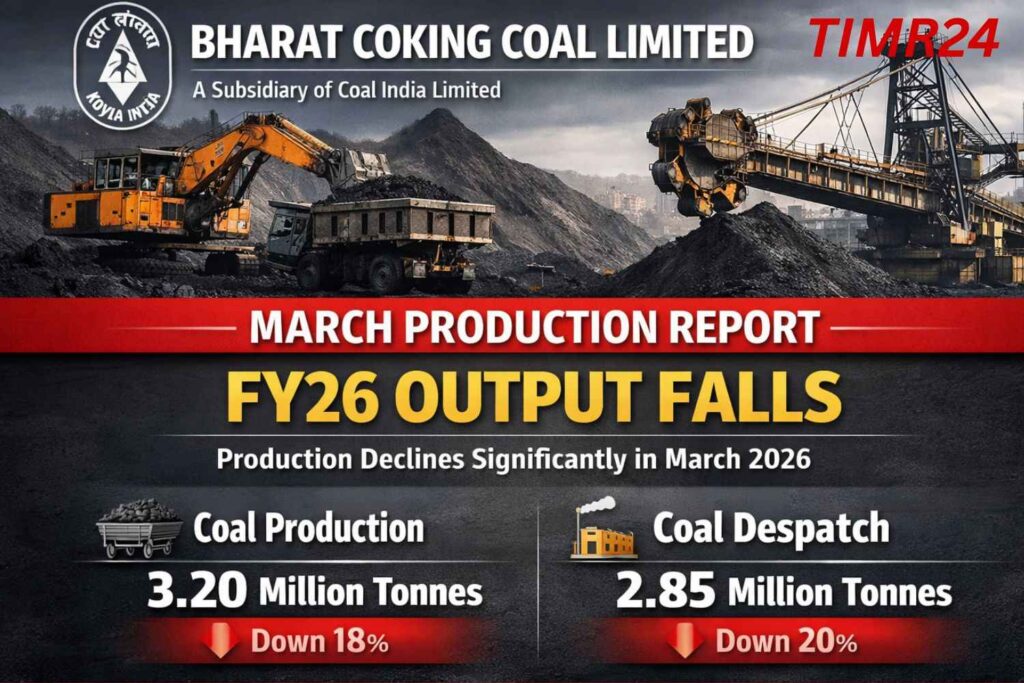
Bharat Coking Coal Limited (BCCL) reported provisional production figures for March 2026 and the financial year April 2025–March 2026, indicating slight operational improvements contrasted by an overall production decline. In March 2026, raw coal output increased to 4.42 million tonnes, a 2% rise from 4.33 million tonnes in March 2025. Coking coal production saw a 3.6% rise to 4.22 million tonnes, while non-coking coal fell by 22.9% to 0.20 million tonnes. For the full fiscal year, BCCL’s raw coal production totaled 35.52 million tonnes, down 12.3% from 40.50 million tonnes in FY25, with coking coal production down 13.4%. March coal dispatches also decreased, with shipments of 2.66 million.
Underlining Persistent Operational And Logistical Challenges
Tonnes, a 24.4% drop year-on-year. These trends highlight potential challenges in domestic metallurgical coal supply for the steel sector, necessitating operational improvements by BCCL to enhance output and sales Coking Coal Limited (BCCL), a subsidiary of Coal India Limited and one of India’s most critical coking coal producers, has reported mixed operational performance for March 2026 and the full financial year FY26. While the company posted a modest rise in monthly production during March, its overall annual output declined sharply, underlining persistent operational and logistical challenges within the mining sector. The latest provisional production data indicates.
That BCCL produced 4.42 million tonnes of raw coal in March 2026, compared to 4.33 million tonnes in the same month last year, reflecting a growth of around 2 per cent. However, despite this short-term increase, the company’s full-year production for FY26 dropped significantly to 35.52 million tonnes from 40.50 million tonnes in FY25, marking a 12.3 per cent decline on a year-on-year basis The production figures reveal that BCCL’s coking coal segment remained the primary contributor to its March growth. Coking coal output increased to 4.22 million tonnes in March 2026 from 4.07 million tonnes a year earlier, registering growth of approximately 3.6 per cent.
However, non-coking coal production fell sharply to 0.20 million tonnes from 0.26 million tonnes, indicating a decline of nearly 23 per cent. This suggests that the company’s core metallurgical coal business remained relatively stable for the month, but diversification into non-coking coal continued to face headwinds. The March performance provided some relief to investors and industry stakeholders, but it was not enough to offset the weak annual performance recorded throughout FY26 On a full-year basis, BCCL’s coking coal production dropped significantly to 33.70 million tonnes from 38.89 million tonnes in FY25. This decline of over 13 per cent is particularly notable because coking.
Domestic Coal Supplies To Reduce Import
Coal is essential for steel manufacturing and remains a strategically important resource for India’s industrial growth. The lower output from BCCL could potentially impact domestic steel producers, many of whom rely heavily on domestic coal supplies to reduce import dependence. Non-coking coal production, however, increased to 1.82 million tonnes in FY26 from 1.61 million tonnes in FY25, offering a limited positive offset to the broader production weakness One of the biggest concerns highlighted in the latest data is the sharp fall in coal dispatch. BCCL’s March dispatch dropped to 2.66 million tonnes from 3.52 million tonnes in March 2025, a decline of 24.4 per cent.
For the full financial year, dispatch volumes declined to 33.05 million tonnes compared with 38.25 million tonnes in FY25, reflecting a 13.6 per cent drop. This fall in dispatch is important because it directly impacts revenue realization and supply chain efficiency. Lower dispatch volumes can indicate logistical bottlenecks, weak customer offtake, transportation issues, or inventory build-up at pitheads. The dispatch decline also raises concerns over the company’s ability to efficiently convert production into sales Industry experts believe the fall in BCCL’s annual output reflects a combination of operational challenges in underground mining, land acquisition hurdles.
Infrastructure And Lower Productivity
Regulatory clearances, and lower overburden removal during the year. BCCL has historically depended heavily on opencast mining for production growth, while underground mining has remained under pressure due to ageing infrastructure and lower productivity. The latest numbers show that opencast operations continue to support most of the company’s output, but that dependence also exposes BCCL to environmental and land-related risks in the future The decline in BCCL’s production could have broader implications for India’s steel and infrastructure sectors. Since coking coal is a critical raw material for blast furnace steelmaking, any sustained weakness in domestic production may.
Force steel manufacturers to increase imports from countries such as Australia, Indonesia, and Russia. This would raise raw material costs for domestic steelmakers and potentially impact steel pricing in the infrastructure and construction sectors. For an economy aggressively investing in roads, railways, metro networks, housing, and industrial corridors, stable domestic coking coal availability remains strategically important.
Despite the FY26 weakness, BCCL remains one of the most important mining companies in India due to its dominant position in coking coal reserves and production. The company operates mainly in the Jharia coalfields of Jharkhand, which hold some of India’s richest coking (India) coal reserves. As the government continues to push for self-reliance in critical mineral and raw material production, BCCL’s long-term strategic relevance remains intact even if short-term operational performance remains volatile Going forward, BCCL is expected to focus on improving mine productivity, modernising underground operations, enhancing mechanisation, and resolving logistics bottlenecks to restore growth momentum.
Bharat Investors And Industry Observers Will Closely
The company may also benefit from broader reforms by the Ministry of Coal aimed at boosting domestic production, improving rail connectivity for mines, and streamlining environmental approvals for expansion projects. Investors and industry observers will closely monitor whether BCCL can reverse the FY26 decline in the coming quarters and align with India’s long-term coal production targets Another important aspect to watch will be the company’s pricing strategy. BCCL recently approved revised modulated pricing for certain coking coal and washed coal products, effective from April 2026. Any pricing improvement may partially offset lower production.
Volumes and support margins if demand remains healthy. However, sustained profitability will depend on both volume recovery and efficient dispatch execution Overall, BCCL’s latest performance presents a mixed picture. The March 2026 production increase offers a positive sign of short-term recovery, but the substantial annual decline in output and dispatch reflects deeper structural and operational issues that the company must address urgently. For India’s mining, steel, and infrastructure ecosystem, BCCL’s performance remains highly significant given its central role in the domestic coking coal supply chain.
As India targets accelerated industrial expansion and infrastructure development, improving the performance of strategic public sector miners like BCCL will be (India) crucial. The company’s FY26 results serve as a reminder that while demand fundamentals for coal remain strong, execution and operational efficiency will determine whether domestic producers can meet the nation’s rising industrial requirements in the years ahead.
Q1. What was BCCL’s coal production in March 2026?
Bharat Coking Coal Limited produced 4.42 million tonnes of raw coal in March 2026.
Q2. How much did BCCL’s FY26 coal output decline?
The company reported a 12.3% year-on-year decline in FY26 raw coal production.
Q3. What caused the fall in BCCL’s FY26 output?
Operational constraints, lower underground mine output, and weaker washed coal production impacted annual performance.
Q4. Did BCCL’s coal dispatch also decline?
Yes, BCCL’s annual coal dispatch fell 13.6% during FY26.
Q5. Why is BCCL important to India’s steel sector?
BCCL is India’s largest producer of coking coal, a key raw material for steel manufacturing.