





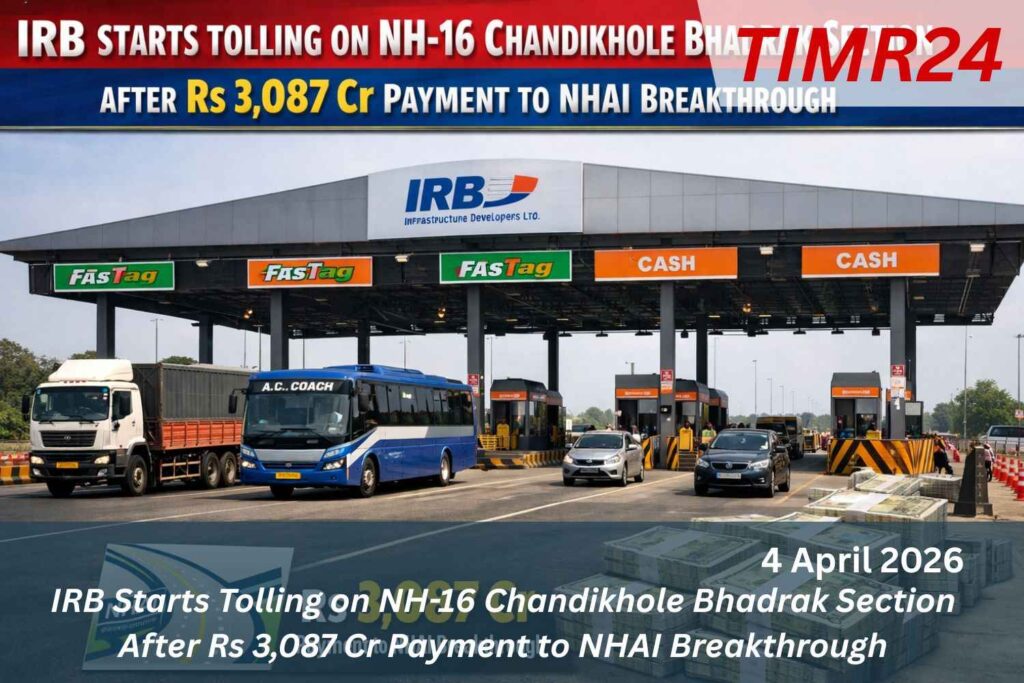
IRB Chandibhadra Tollway Pvt. Ltd., an SPV of IRB Infrastructure Trust, began tolling the Chandikhole–Bhadrak section of NH-16 on April 1, 2026, after receiving the appointed date from NHAI. The company paid an Upfront Concession Fee of Rs.3,087 Crores on March 30, 2026, following Financial Closure. Chairman Virendra D. Mhaiskar highlighted the significance of this entry into Odisha, making the group present in 13 states, and emphasized the corridor’s role in enhancing travel efficiency and boosting regional growth through steady pilgrimage and tourism traffic. The project, a part of India’s Golden Quadrilateral, spans 74.5 km and represents the group’s commitment to high-quality services during.
The concession period, reinforcing toll revenue growth. IRB Infrastructure Trust was the highest bidder and signed the Concession Agreement with NHAI on February 4, 2026, for tolling and operation of the project India’s highway infrastructure sector received a landmark boost at the very start of the new financial year when IRB Chandibhadra Tollway Pvt. Ltd., a Project SPV of IRB Infrastructure Trust, commenced tolling on the Chandikhole Bhadrak section of NH-16 from April 1, 2026, at midnight, after receiving the Appointed Date from NHAI. development is far more than a routine operational update it signals the group’s strategic push into eastern India and adds a significant and stable revenue-generating.
The Financial Architecture Behind the Deal
Before a single toll booth became operational, the financial groundwork for this project took months of meticulous planning. The SPV paid an upfront concession fee of ₹3,087 crore to NHAI on March 30, 2026, completing its financial closure and transitioning the project from a development phase to a live revenue-generating asset payment, structured under NHAI’s one of the largest single upfront concession fee payments seen in recent months in the Indian highway sector. Under the concession model, IRB Infrastructure Trust secured tolling rights for 20 years under a revenue-linked arrangement, with annual tariff adjustments fixed at 3% plus 40% of the variation in the Wholesale.
Built-in tariff revision mechanism ensures that revenues are partially insulated from inflationary pressures, making it an attractive long-duration asset for institutional investors The financing involved some of the most credible names in infrastructure lending and global investment. Union Bank of India served as the primary lender, while GIC Singapore and Spain-based Ferrovial Group came in as strategic partners, bringing a combination of global expertise in infrastructure asset management and patient capital involvement of Ferrovial a global leader in highway operations also points toward international confidence in India’s TOT framework as a reliable model for private sector highway monetisation.
The Strategic Importance of the Chandikhole Bhadrak Corridor
Not every 74-kilometre stretch of highway carries the same strategic weight. The Chandikhole–Bhadrak section forms part of India’s Golden Quadrilateral, a high-priority national corridor that links the southern and eastern regions of the country, supporting both commercial freight movement and passenger travel Golden Quadrilateral is the backbone of India’s intercity trade logistics, and any section of it that receives structured tolling and professional maintenance directly benefits supply chains across multiple industries. For more on how Golden Quadrilateral projects are planned and monitored.
What makes this corridor particularly interesting beyond pure logistics is its social and economic texture. The corridor receives steady pilgrimage and tourism-linked traffic, with Odisha being home to the Jagannath Puri Dham, one of India’s holiest sites, ensuring year-round footfall from across the country adds a relatively stable and predictable layer of traffic volume over and above commercial freight, which typically fluctuates with industrial cycles. The combination of freight, passenger, and pilgrimage traffic gives this corridor resilience that pure freight-only highways may lack.
IRB’s Expanding Footprint Across India
This project is not just about one corridor it is the capstone of a broader national expansion strategy. With the activation of this Odisha project, IRB Group now operates in 13 Indian states, having made its first-ever entry into Odisha through this very concession group that has built its identity as India’s largest integrated private toll road and highway developer, adding Odisha to its map is both symbolic and commercially meaningful. The eastern coast of India is increasingly becoming a growth frontier for infrastructure investment, driven by industrial corridors, port connectivity, and coastal economic zones.
Earlier, in November 2025, IRB Infrastructure Trust had won the TOT-17 bundle worth ₹9,270 crore, covering a 366-km stretch across key sections of National Highway 27 and National Highway 731 in Uttar Pradesh Together, TOT-17 and TOT-18 represent an aggressive consolidation of IRB’s position in the TOT segment. The company’s market share in the TOT segment has now risen to approximately 44%, with its total asset base approaching ₹94,000 crore, positioning it firmly as the dominant private player in this space.
Revenue Outlook and Investor Implications
From a financial market perspective, the commencement of tolling on this section is a material revenue event. IRB’s management indicated that the addition of TOT-17 and TOT-18 together is expected to enhance toll revenues by approximately ₹1,000 crore in FY27 This is a significant top-line addition for a group that already reported strong momentum IRB Group’s year-on-year toll revenue rose approximately 22% in February 2026 to ₹746 crore, compared to ₹614 crore in February 2025 consistent double-digit growth in toll revenues across the portfolio reflects both organic traffic volume increases and the systematic addition of new concessions.
The project is also expected to add ₹1,600 crore to the group’s O&M order book, enhancing revenue visibility from long-duration highway assets with stable and predictable cash flow-focused investors and analysts tracking the InvIT space, IRB Infrastructure Trust’s steady (India) conversion of awarded projects into operational assets is becoming a defining characteristic of its investment thesis.
What This Means for Travellers on NH-16
Beyond the balance sheets and regulatory filings, this development has real-world significance for the millions of people who use the Chandikhole–Bhadrak stretch of NH-16 daily. Professional highway O&M under a structured concession framework typically means better pothole response times, improved lighting, emergency response systems, and consistent road surface quality. IRB is committed to developing world-class highway infrastructure with higher safety standards, ensuring consistent delivery of value to end users, neighbouring communities, and all stakeholders group holds ISO certifications in quality management, environmental management.
Occupational health and safety, and IT security standards that are expected to govern operations on this corridor for the full 20-year concession period As India accelerates its national highway modernisation agenda, the TOT model where the government monetises existing (India) operational assets and transfers management to experienced private operators is proving to be a win-win for both fiscal consolidation and service quality improvement. The Chandikhole–Bhadrak tolling commencement is one more proof point that this model, when executed well, delivers results for governments, investors, and travellers alike.
Q1. Which highway section has IRB started tolling on?
IRB Infrastructure has started tolling on the Chandikhole–Bhadrak section of NH-16.
Q2. How much payment was made to NHAI?
IRB has made an upfront payment of ₹3,087 crore to NHAI for this project.
Q3. Under which model is this project developed?
The project is developed under the Toll-Operate-Transfer (TOT) model.
Q4. What is the purpose of this tolling?
The main objective is to improve highway maintenance, operations, and revenue generation.
Q5. What benefits will travelers get from this?
Travelers will benefit from improved road quality, better safety, and enhanced travel efficiency.