












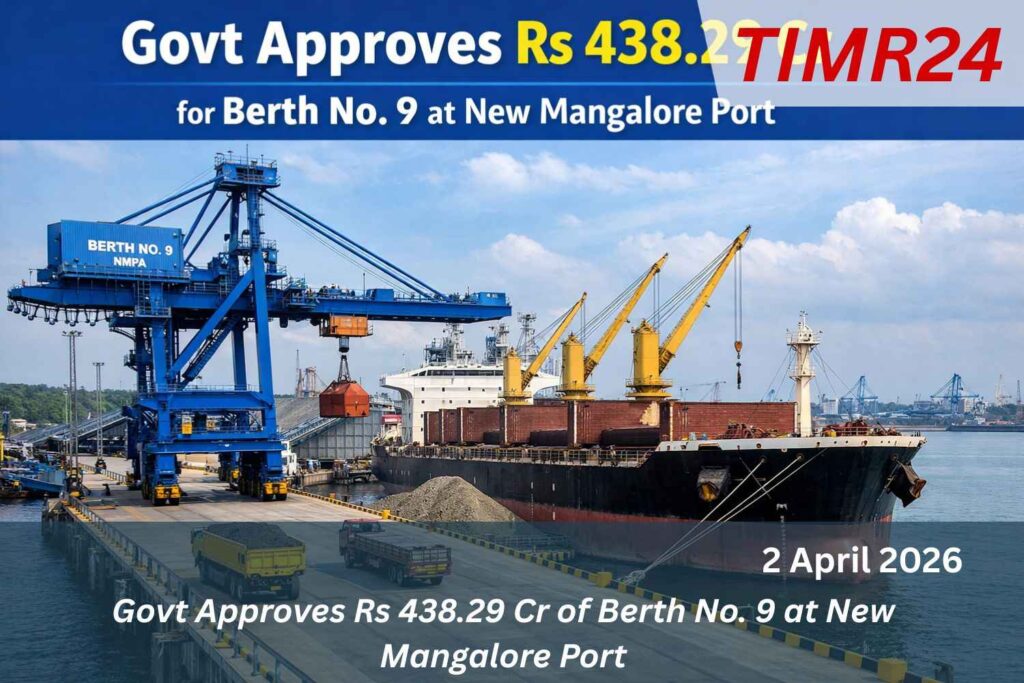
The Govt New Mangalore Port Authority has secured approval for the redevelopment of Berth No. 9 to manage liquid bulk cargo via a PPP model. The project, costing Rs 438.29 crore, involves dismantling current infrastructure to build a modern berth for crude oil, petroleum products, and LPG, increasing the berth draft from 10.5 to 14 metres, with future expansion up to 19.8 metres. The upgraded facility will handle 10.90 MTPA and will be developed on a DBFOT basis by a private concessionaire. Completion is expected in two years with a 30-year concession period, aimed at improving port infrastructure and cargo handling efficiency to meet rising demand in the region.
India’s port infrastructure story has been steadily rewritten over the past decade, and the latest chapter arrives from the coastline of Karnataka. The Minister of Ports, Shipping and Waterways formally approved the proposal of the New Mangalore Port Authority (NMPA) for the redevelopment of Berth No. 9 to handle liquid bulk cargo on a Public-Private Partnership basis under the DBFOT model, with the approval conveyed on March 25, 2026.This single decision, carrying a price tag of Rs 438.29 crore, is far more than a construction announcement it is a calculated long-term investment in India’s energy security, trade logistics, and regional economic growth.
Background Why Berth No. 9 Needed Urgent Attention
New Mangalore Port, officially known as NMPA, has served as one of India’s major port trusts for decades. However, much of its infrastructure, including Berth No. 9, dates back nearly half a century. The project will replace nearly 50-year-old structures with modern marine infrastructure designed for a 50-year structural life, ensuring long-term sustainability and resilience Ageing berths not only create operational bottlenecks but also impose safety risks and limit the size of vessels a port can receive. In the age of super-tankers and Very Large Gas Carriers, a berth constrained by outdated depth specifications simply cannot compete. The redevelopment, therefore, is not an upgrade of convenience it is a structural necessity that has been long overdue.
India’s energy import demands have surged in lockstep with its economic growth. Crude oil, petroleum products, and LPG are the lifelines of industrial activity, transportation, and domestic cooking fuel supply. A port that cannot efficiently receive and process these commodities becomes a chokepoint, and no government committed to energy self-reliance can afford that.
Project Scope What the Redevelopment Entails
The project envisages the dismantling of legacy infrastructure and comprehensive redevelopment of Berth No. 9 to handle liquid bulk cargo such as crude oil, petroleum products (POL), and LPG. As part of the modernisation, the berth draft will be enhanced from the existing 10.5 metres to 14 metres, with a future-ready design provision up to 19.8 metres, enabling the port to accommodate vessels up to 2,00,000 DWT, including Very Large Gas Carriers (VLGCs).
To put this in perspective, increasing draft depth from 10.5 metres to 14 metres is not merely an engineering upgrade it unlocks an entirely new class of global shipping traffic. VLGCs are among the largest vessels plying international trade routes, and a port that can receive them commands a significant strategic and commercial advantage. Arrangements will also be made to potentially increase the draft depth to 19.8 metres in the future, based on the port’s requirements signals that this project has been deliberately engineered with a 50-year horizon in mind rather than just addressing today’s constraints.
Beyond the structural dimensions, the modernisation of the berth is also expected to enhance the port’s overall safety, by means of advanced firefighting systems, nitrogen generation skids, and integrated control systems liquid bulk commodities like crude oil and LPG involves significant fire and explosion hazards, and the integration of nitrogen generation skids alongside modern firefighting systems represents a serious commitment to operational safety that previous infrastructure could not guarantee.
The PPP-DBFOT Model How the Project Will Be Executed
With an estimated project cost of Rs 438.29 crore, the redevelopment will be undertaken by a private concessionaire selected through an open competitive bidding process using a single-stage, two-envelope system. The DBFOT model Design, Build, Finance, Operate, Transfer is a widely used framework in Indian infrastructure that allows private sector expertise and capital to drive development, while ultimately returning the asset to public ownership. The project will have a capacity of 10.90 MTPA, and the concessionaire will commit to a Minimum Guaranteed Cargo (MGC) of 7.63 MTPA by the 5th year of operations. The construction period is 2 years, with a concession period of 30 years, inclusive of construction.
The Minimum Guaranteed Cargo commitment is a particularly significant detail. It de-risks revenue uncertainty for the Port Authority and ensures that private operators maintain genuine commercial effort rather than simply holding a concession passively. From a financial standpoint, the project will ensure stable and sustained revenue streams for the Port Authority through fixed royalty payments linked to cargo volumes, along with mandatory MGC commitments.
Strategic Importance Karnataka, Kerala And The Energy Corridor
The significance of this project cannot be assessed in isolation from the geography it serves. Strategically, the upgraded berth will strengthen the role of New Mangalore Port as a key maritime gateway for the Karnataka and Kerala hinterlands, improving energy supply chain efficiency and supporting regional industrial growth The Karnataka coast, with its proximity to major industrial clusters in Mangaluru, Hubballi, and even Bengaluru’s logistics networks, depends heavily on this port for energy commodity imports. Kerala’s demand for LPG and petroleum products similarly flows through this maritime gateway.
This would be a major step in increasing the port’s capacity to handle liquid cargo to 10.9 million tonnes per annum (MTPA), and comes amid the raging war in the Gulf, which has seen the port emerge as a hotspot for India-bound tankers over the past few weeks geopolitical dimension here is worth pausing on. With Gulf shipping routes under pressure, Indian ports that can efficiently receive and process large tanker volumes are becoming strategically indispensable. New Mangalore, positioned on the western coast, is ideally located to serve as a critical node in India’s energy import corridor, and the timing of this upgrade, given ongoing Gulf disruptions, is particularly strategic.
Environmental and Safety Considerations
Any port redevelopment of this scale raises legitimate environmental questions, particularly in ecologically sensitive coastal zones. The project is expected to incorporate modern environmental management systems as part of its integrated control framework. The use of (India) nitrogen generation skids, for instance, reduces the risk of volatile organic compound emissions during liquid bulk transfers, which is both a safety and an environmental benefit. For communities along the Karnataka coast, the replacement of ageing infrastructure with engineered-for-safety modern systems also means reduced risk of spills and industrial accidents that have historically threatened coastal ecosystems.
Conclusion A Port That Builds the Future
The Rs 438.29 crore sanction for Berth No. 9 at New Mangalore Port is a well-structured, future-oriented investment that speaks to India’s evolving maritime ambitions. It replaces crumbling legacy infrastructure with a berth capable of handling the world’s largest gas (India) carriers, serves an energy-hungry hinterland covering two major southern states, and does so through a financially disciplined PPP framework that protects public revenue while enabling private execution. As India accelerates its march toward becoming a top-five global economy, the ports that fuel its industries and power its homes must keep pace and this project is an important step in ensuring they do.
Q1. What is the Berth No. 9 project at New Mangalore Port?
Berth No. 9 is a new port infrastructure project aimed at increasing cargo handling capacity and improving operational efficiency at New Mangalore Port.
Q2. How much investment has been approved for this project?
The government has approved an investment of Rs 438.29 crore for the development of Berth No. 9.
Q3. What is the main objective of this project?
The key objective is to boost maritime trade, handle larger vessels, and enhance overall port productivity.
Q4. How will this project benefit the economy?
It will create jobs, increase export-import activities, and support regional industrial growth, especially in Karnataka.
Q5. When is the project expected to be completed?
While the exact timeline may vary, such port infrastructure projects typically take 2–3 years for completion.