















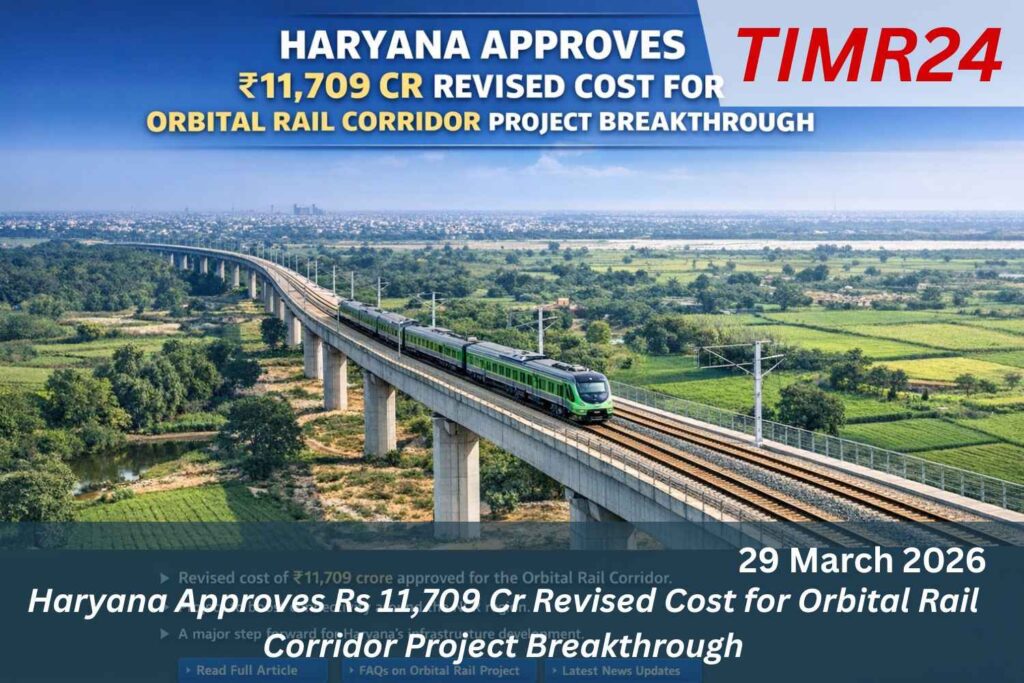
The Haryana government has approved a revised cost estimate of Rs 11,709 crore for the Haryana Orbital Rail Corridor, enhancing rail connectivity and industrial growth in the NCR region. Managed by the Haryana Orbital Rail Corporation Limited, the project will connect industrial hubs like Kharkhauda, Manesar, and Sohna. The updated cost reflects additional components, including infrastructure improvements and better links with existing freight corridors, aiming to improve freight movement, reduce transit times, and foster new townships in Haryana.
Ambitious Project Is Designed To Reduce Congestion
The Haryana government’s approval of the revised ₹11,709 crore budget for the Orbital Rail Corridor project marks a significant milestone in the region’s infrastructure development journey, especially for areas connected to the National Capital Region. This ambitious project is designed to reduce congestion on existing railway lines while creating a more efficient and modern rail network that supports both freight and passenger movement across Haryana and surrounding regions. As urbanization and industrial activities continue to grow rapidly, the need for an alternative rail route has become critical, and this corridor is expected to address long-standing challenges related to.
Overburdened rail traffic in Delhi and nearby areas. The Orbital Rail Corridor will connect key industrial zones, logistics hubs, and urban centers, helping businesses reduce transportation time and costs while ensuring smoother supply chain operations. This development aligns closely with the broader vision of enhancing connectivity under initiatives linked to Indian Railways and regional planning authorities working within the NCR framework One of the most important aspects of this project is its potential to decongest existing railway routes passing through Delhi, which are currently operating at near-saturation levels. With increasing freight movement and passenger demand.
Freeing Up Capacity For Passenger Trains
Delays and inefficiencies have become common, affecting both economic productivity and commuter experience. The Orbital Rail Corridor will function as a bypass route, allowing freight trains to move without entering Delhi, thereby freeing up capacity for passenger trains and improving overall service quality. This will not only benefit Haryana but also neighboring states by enabling faster and more reliable transportation networks. Additionally, the project is expected to support industrial growth in regions such as Sonipat, Palwal, and Manesar, which are already emerging as major manufacturing and logistics hubs. By improving rail connectivity, these areas will attract more.
Investments and create employment opportunities, contributing to regional economic development The revised cost of ₹11,709 crore reflects the increasing complexities involved in large-scale infrastructure projects, including land acquisition, construction material costs, and technological upgrades. While cost escalation is a common challenge in mega projects, the government’s approval demonstrates its commitment to completing this critical initiative without compromising on quality or scope. The inclusion of modern rail technologies, better safety mechanisms, and improved station infrastructure will ensure that the corridor meets future transportation demands effectively.
An Environmental Perspective, Orbital Rail
Moreover, the project is expected to integrate seamlessly with existing and upcoming infrastructure developments, including expressways and industrial corridors, thereby creating a multi-modal transport network that enhances overall efficiency From an environmental perspective, the Orbital Rail Corridor also offers significant advantages by promoting rail-based transportation over road transport, which is generally more polluting and less efficient. By shifting a portion of freight movement from trucks to trains, the project will help reduce carbon emissions, fuel consumption, and traffic congestion on highways. This aligns with India’s broader sustainability goals and efforts to develop eco-friendly transport solutions.
Improved rail connectivity will encourage the use of public transportation, reducing dependency on private vehicles and contributing to cleaner urban environments The strategic importance of this project can also be understood in the context of regional (India) planning initiatives aimed at balancing development across the NCR. With Delhi facing severe congestion and infrastructure pressure, neighboring regions like Haryana are being developed as alternative growth centers. The Orbital Rail Corridor plays a crucial role in this strategy by enhancing connectivity between these regions and enabling the smooth movement of goods and people.
Logistics And Supply Chain Management
This will help distribute economic activities more evenly, reduce pressure on Delhi, and improve the overall quality of life in the region In addition to its economic and environmental benefits, the project also has significant implications for logistics and supply chain management. Efficient transportation is a key factor in determining the competitiveness of industries, and the Orbital Rail Corridor is expected to provide a major boost in this area. By reducing transit times and improving reliability, businesses will be able to optimize their operations and reduce costs, making Haryana a more attractive destination for investment. This is particularly important in the context of India’s growing focus on becoming.
A global manufacturing hub Internally, this project complements other major infrastructure developments covered on our platform, such as the Delhi-Mumbai Expressway and railway modernization initiatives, which you can explore in our related articles section. These interconnected projects highlight the government’s comprehensive approach to infrastructure development, ensuring that different modes of transport work together to create a seamless and efficient network. The Orbital Rail Corridor is not just a standalone project but a key component of a larger vision to transform India’s transportation landscape The Haryana government’s approval of the revised cost for the Orbital Rail Corridor project underscores the importance of investing in infrastructure to.
support economic growth and improve quality of life. Despite the challenges associated with cost escalation and project execution, the long-term benefits of this initiative far outweigh the initial investment. By enhancing connectivity, reducing congestion, and (India) promoting sustainable transportation, the project is set to play a transformative role in the development of the NCR region. As construction progresses, stakeholders and citizens alike will be watching closely, anticipating the positive impact this corridor will bring to the region’s transportation ecosystem and overall economic development.
Q1. What is the Orbital Rail Corridor project?
It is a major rail project designed to connect key regions around Delhi to ease congestion and improve logistics.
Q2. What is the revised cost of the project?
The Haryana government has approved a revised cost of ₹11,709 crore.
Q3. Why was the cost revised?
Due to increased construction costs, land acquisition expenses, and project expansion.
Q4. How will this project benefit the NCR region?
It will reduce rail congestion, improve freight movement, and boost regional connectivity.
Q5. When is the project expected to be completed?
The timeline depends on execution phases but is expected over the next few years.