









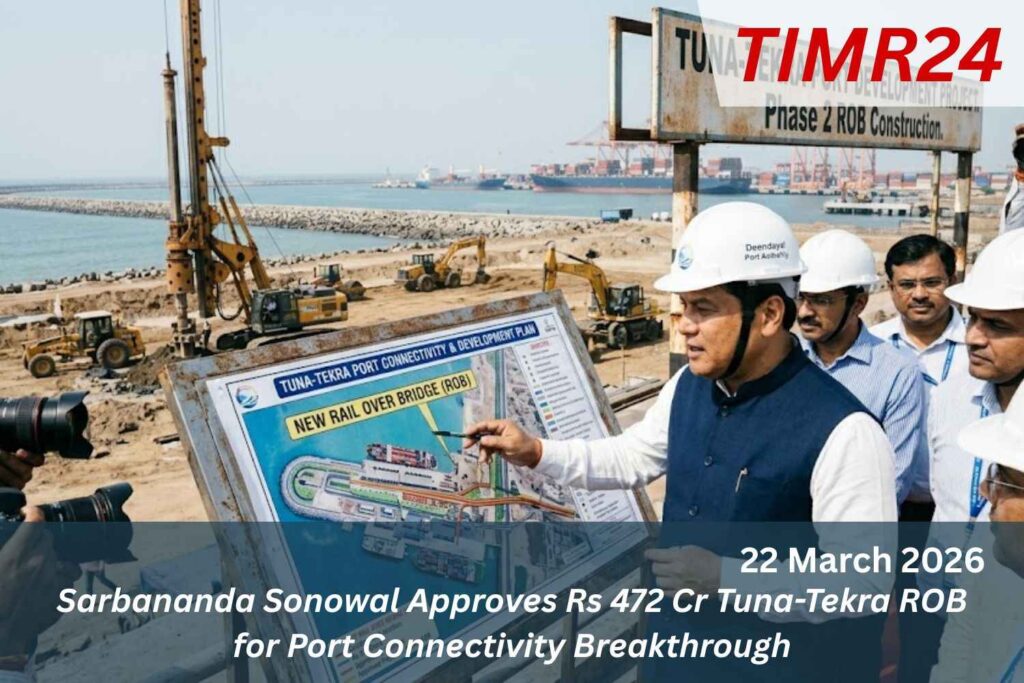
Union Minister of Ports, Shipping and Waterways Sarbananda Sonowal has sanctioned the construction of a Road Over Bridge (ROB) at Tuna-Tekra, with an estimated cost of Rs 472 crore. This project aims to enhance port connectivity and improve cargo evacuation infrastructure. The project entails constructing viaduct structures, a bridge over a creek, and includes a 10-year maintenance plan for durability. Sonowal highlighted the project’s role in strengthening port-led development and improving logistics efficiency under India’s maritime transformation. The ROB will serve as a key connection to the upcoming Mega Container Terminal and will help reduce logistics turnaround time and support.
Scalable port operations The project aligns with the government’s Maritime India Vision 2030 and Maritime Amrit Kaal Vision 2047 The Government of India, under the leadership of Union Minister for Ports, Shipping and Waterways, Sarbananda Sonowal, has taken a major step to strengthen India’s maritime infrastructure by approving a ₹472 crore Road Over Bridge (ROB) project at Tuna‑Tekra. This project is strategically designed to elevate cargo handling and logistics efficiency at one of India’s key port areas, Deendayal Port in Gujarat, bringing notable improvements to connectivity and trade facilitation.
Sarbananda Importance of the Tuna‑Tekra ROB Project
The ROB at Tuna‑Tekra is more than just a bridge; it is a critical transportation artery linking the new port infrastructure with the hinterland. It will include multiple viaduct structures, a creek‑crossing bridge, and accompanying roadways designed to facilitate the smooth passage of heavy cargo vehicles. The plan also integrates a 10‑year maintenance provision to ensure operational resilience and long‑term durability This connectivity upgrade aligns with India’s broader maritime development objectives notably the Maritime India Vision 2030 and Maritime Amrit Kaal Vision 2047 both of which aim to position.
Boosting Cargo Movement and Reducing Bottlenecks
India as a global maritime leader through modern infrastructure, enhanced trade corridors, and integrated logistics networks. One of the foremost benefits of the approved ROB project is that it will significantly reduce logistics turnaround times for freight traffic entering and leaving the port area. Ports handle vast volumes of cargo, and any delays in movement especially at rail‑road intersections can severely impact trade efficiency. By providing seamless road connectivity, the ROB will help resolve.These bottlenecks, facilitate faster cargo evacuation, and improve the overall efficiency of multimodal freight transportation This is crucial as India’s ports are under increasing pressure to handle larger volumes of international trade without causing delays. The ROB is expected to work in coordination with other major infrastructural developments such as container terminals, cargo berths, and logistics parks, collectively enhancing port performance.
Synergy with the Tuna‑Tekra Container Terminal
The ROB’s construction has been planned in synchronisation with the ongoing development of the Tuna‑Tekra Container Terminal project, which is already underway and has achieved significant physical progress. When fully operational, this Mega Container Terminal will have an annual handling capacity of around 2.19 million TEUs, and the accompanying multipurpose cargo berths will be capable of managing up to 18.33 million metric tonnes per annum.
Economic and Trade Impacts
With improved connectivity, this bridge will contribute significantly to the economic ecosystem of the region. Faster cargo movement means lower turnaround times for vessels and trucks, which reduces costs for exporters and importers. This uplift in infrastructure is a catalyst for job creation, increased trade flows, and enhanced foreign direct investment (FDI) prospects in the logistics and port development sectors.
Moreover, modern logistics infrastructure is essential for India’s PM Gati Shakti Master Plan, which aims to interlink transportation modes for efficient mobility and trade facilitation. Projects like the Tuna‑Tekra ROB exemplify how integrated infrastructure supports trade competitiveness on the global stage.
Environmental and Sustainability Considerations
By reducing congestion and idle time for freight vehicles, the ROB project also supports sustainability goals. Less waiting time for trucks means a decrease in fuel consumption and emissions, contributing to cleaner logistics operations. While this project’s primary focus is infrastructure and logistics, its environmental benefits align with broader government commitments to sustainable growth.
Challenges and Execution Timeline
Like all large infrastructure projects, the Tuna‑Tekra ROB faces challenges including timely land acquisition, civil engineering complexities, and coordination with existing rail and road networks. However, by aligning execution with the commissioning schedule of the port (India) terminal, the government aims to ensure that transport infrastructure is ready when port operations scale up. Project authorities and contractors will need to maintain rigorous standards in construction quality to minimize future maintenance challenges.
Supporting Government Policies and Vision
This approval reflects the Government of India’s unwavering commitment to building world‑class port infrastructure. Initiatives such as the Sagarmala Programme, aimed at modernising ports and enhancing coastal economic zones, reinforce the strategic need for connectivity projects like this ROB These combined efforts support economic goals like boosting export competitiveness, enhancing supply chain resilience, and creating modern logistics corridors that link Indian markets with global trade networks.
Future Prospects and Growth Path
Once completed, this project is expected to unlock numerous opportunities for clusters around the port. Industries reliant on freight transport such as manufacturing, retail exports, and agriculture will benefit from improved supply chain reliability. The efficiency gains from a modern road connection extend to ancillary services such as freight forwarding, rail‑road terminals, and value‑added logistics zones.
Over time, such infrastructure investments are likely to attract additional private sector participation, especially in port‑linked economic zones. In the longer (India) run, efficient port connectivity can translate into lower trade costs, higher export volumes, and increased integration with international shipping routes.
Q1. What is the Tuna‑Tekra ROB project?
A ₹472 crore Road Over Bridge approved to enhance port connectivity and cargo movement at Deendayal Port, Gujarat.
Q2. Who approved the project?
Union Minister Sarbananda Sonowal, Ministry of Ports, Shipping & Waterways.
Q3. Why is it important?
It reduces traffic congestion, improves cargo evacuation efficiency, and supports India’s maritime infrastructure goals.
Q4. What are the key features?
Includes viaducts, creek‑crossing bridges, road expansion, and long‑term maintenance plans.
Q5. When will it be completed?
Construction is aligned with port terminal operations; exact timelines depend on project execution progress.