


















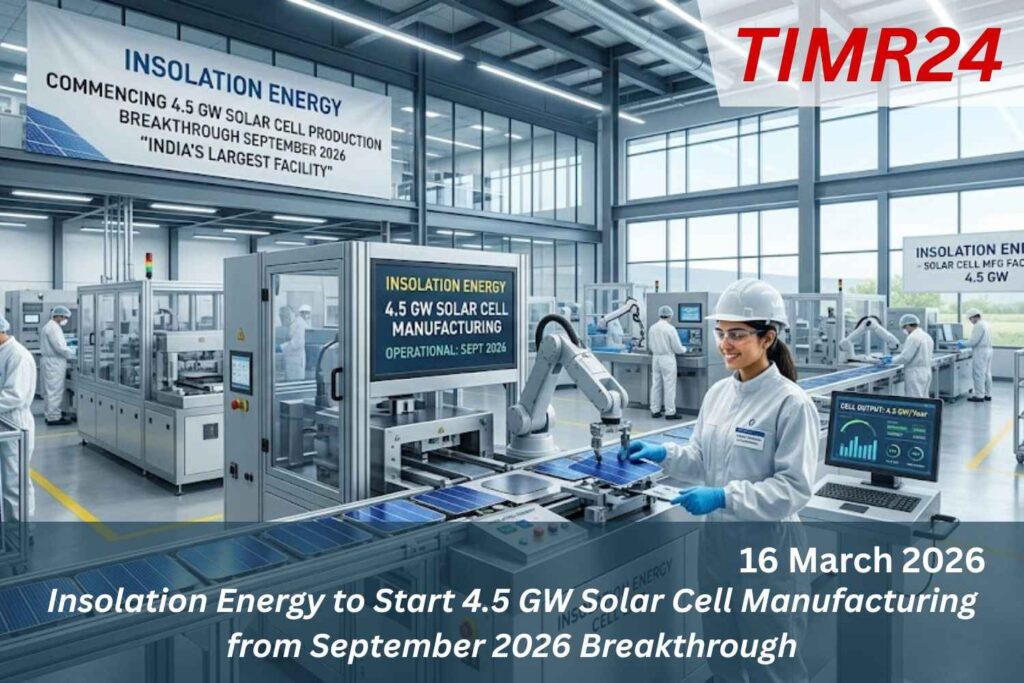
Insolation Energy plans to launch a 4.5 GW TOPCon solar cell manufacturing facility by late this year, establishing its presence among the initial domestic manufacturers in India. The facility will be situated in Neemrana, Madhya Pradesh, selected for its supportive policies and resources. Currently, the company has a solar module manufacturing capacity of 5.5 GW and aims to expand it to 7 GW by next year. Additionally, Insolation Energy will enhance its backward integration by introducing an aluminium frame manufacturing unit with an 18,000 metric tonnes capacity soon. With a focus on G12R module technology that offers better logistics efficiency and power output.
The company anticipates an industry shift towards advanced technologies like TOPCon as the availability of older mono-PERC cells decreases. These developments coincide with India’s initiatives to bolster domestic solar manufacturing amid local content requirements, signaling a move from the current 26 GW of solar cell capacity, much of which lacks advanced technology adoption Insolation Energy Limited has taken a bold step in strengthening India’s renewable energy manufacturing capabilities by announcing plans to start commercial production of a 4.5 GW solar cell facility in September 2026. This move repositions the Jaipur‑based company not just as.
A major module maker but also as a significant producer of solar cells a strategic segment critical to reducing India’s dependence on imported solar components Located in the Power and Renewable Energy Equipment Zone at Narmadapuram in Madhya Pradesh, this forthcoming facility represents one of the largest cell manufacturing projects initiated by a domestic player in recent times. It is being developed by the company’s wholly owned subsidiary, Insolation Green Energy Private Limited, and is expected to play a key role in supporting India’s ambitious renewable energy targets for the rest of this decade.
Strategic Importance in India’s Solar Ecosystem
India’s solar industry has grown rapidly, but solar cell manufacturing has historically lagged behind module production. With global supply chain disruptions and rising geopolitical tensions, there has been a strong policy push by the Government of India to expand domestic capacity under initiatives like the Approved List of Models & Manufacturers (ALMM) for solar cells. Approved lists like ALMM List‑II ensure government‑funded solar projects source materials domestically, boosting the demand for Indian‑made solar components.
The upcoming Insolation cell plant will utilize TOPCon technology, known for higher conversion efficiencies compared to traditional p‑type cells. This technology advantage positions the company to cater to both domestic and export markets while keeping pace with global technology trends in PV equipment manufacturing.
Construction and Financing
Construction work on the site has been progressing steadily, with civil works, machinery procurement, and foundational work underway. The plant is expected to be operational by late Q3 2026, aligning with the company’s roadmap toward scaling integrated solar manufacturing A key enabler of this project has been financial backing from institutions such as the Indian Renewable Energy Development Agency (IREDA), which approved a substantial loan of INR 11.34 billion to support the solar cell factory’s construction. This infusion of capital underscores investor confidence and the prioritization of domestic manufacturing in the country’s energy transition agenda.
Vertical Integration and Future Capabilities
Insolation’s broader strategy extends well beyond this single cell facility. With existing module manufacturing facilities boasting a combined capacity of over 5.5 GW across Rajasthan, the company is already a significant module producer in India supplying advanced mono‑PERC and TOPCon modules to utility, commercial, and residential segments The new cell plant is also paired with an 18,000 MT per annum aluminium frame manufacturing unit, bringing further vertical integration benefits. Aluminium frames are essential for module assembly and longevity, and having an in‑house source strengthens supply chain resilience and cost efficiencies.
According to industry reports, the company plans to leverage this expanded manufacturing ecosystem to scale even further exploring potential future investments in ingot and wafer (India) production and possibly even battery energy storage systems (BESS) as part of an end‑to‑end clean tech portfolio.
Market Impact and Industry Context
The announcement of this plant comes amid a broader period of solar manufacturing expansion in India, with other players also scaling up cell and module capacities. For example, several companies are planning or executing gigawatt‑scale solar cell facilities to meet the growing demand for PV projects across India and abroad. This trend aligns with government priorities to boost energy independence and create jobs in high‑tech manufacturing Insolation’s move also enhances its competitiveness vis‑à‑vis its peers.
With demand rising for green energy installations across sectors such as utilities, commercial rooftops, and rural electrification programs, having cell (India) manufacturing capability allows the company to capture more value throughout the supply chain from silicone processing to finished solar products. This integration often results in lower costs, higher quality control, and improved supply certainty.
Policy and Renewable Goals in India
Government policies play an essential role in bolstering such manufacturing investments. Beyond ALMM, reforms aimed at incentivizing “Make in India” initiatives for clean energy components have attracted both public and private investments into PV manufacturing. These policies aim not only to reduce import dependence but also to establish India as an exporter of solar components, competing with global suppliers.
Q1. What is the 4.5 GW solar cell plant by Insolation Energy?
This is a new solar cell manufacturing facility being developed by Insolation Energy Limited with a capacity of 4.5 GW, scheduled to start production in September 2026 to enhance domestic PV cell output.
Q2. Where is the plant located?
The facility is under construction in Narmadapuram, Madhya Pradesh, India, strategically positioned in the Power & Renewable Energy Equipment Zone to support India’s clean manufacturing goals.
Q3. What technology will the cells use?
The plant will focus on TOPCon (Tunnel Oxide Passivated Contact) technology, which offers higher efficiency levels suitable for advanced solar modules.
Q4. Why does this project matter for India’s energy landscape?
With national targets to strengthen local manufacturing and reduce reliance on imports, this facility contributes to India’s solar capacity expansion and aligns with policies like the ALMM List‑II for solar cells.
Q5. What is Insolation Energy’s broader strategy?
The company aims for vertical integration in the solar value chain manufacturing modules, cells, and aluminium frames to serve domestic and global markets competitively.