



















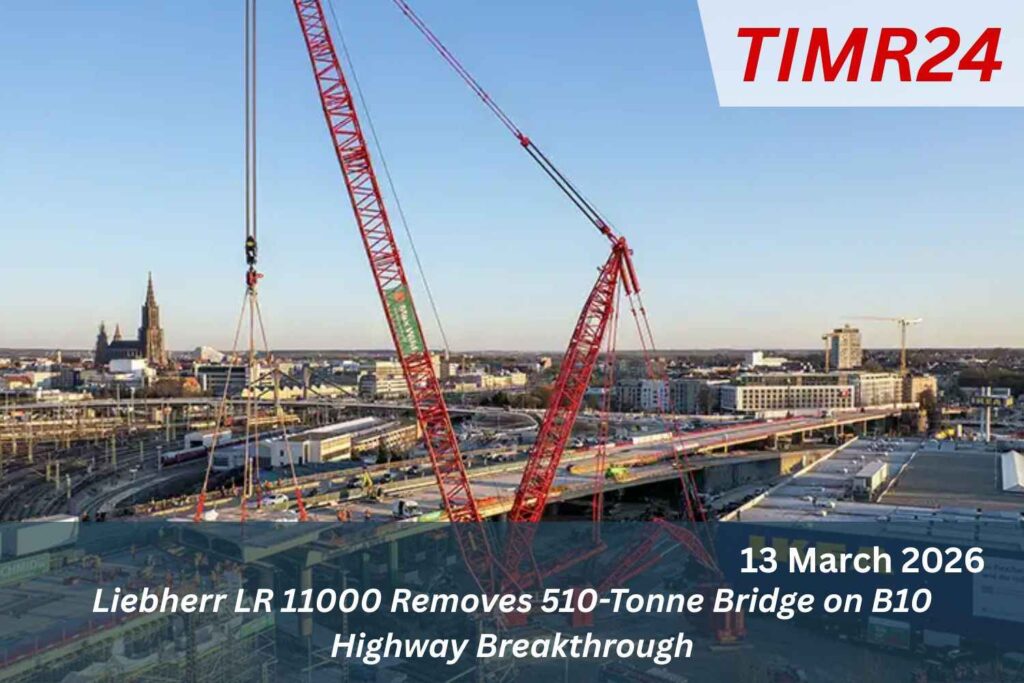
A Liebherr LR 11000 crawler crane was utilized to dismantle a two-lane prestressed concrete bridge on the B10 federal highway in Ulm, Germany, due to stringent time constraints necessitating a railway closure. The removal, after three years of planning, employed a method of segmenting and lifting the bridge, as conventional demolition like blasting was unsuitable. Emil Egger AG managed the operation, successfully removing 52 sections, with sections weighing up to 510 tonnes. The crane was configured in two phases with an 84-metre main boom for initial lifts, extending to 128 metres for further sections, supported by a maximum ballast of 750 tonnes.
Removing Additional Structures Completion
The project required precise weight assessments for safe operations, enhanced by tools such as the V-Frame. A Liebherr LTM 1650-8.1 crane assisted in setting up and removing additional structures. Completion of the bridge was anticipated for autumn next year, with plans for further dismantling of the remaining segments after that A remarkable heavy-engineering operation recently took place in southern Germany where the massive Liebherr LR 11000 crawler crane successfully dismantled sections of a deteriorating highway bridge along the B10 Highway in Ulm, a historic city located on the banks of the Danube River. The project involved lifting bridge components weighing as much.
As 510 tonnes, making it one of the most technically demanding crane operations carried out in Europe in recent years. This large-scale infrastructure activity highlights how modern heavy-lift cranes and precision engineering are transforming the way aging bridges are dismantled and replaced while minimizing disruption to critical transportation and railway networks The old prestressed concrete bridge had served traffic for decades but had reached the end of its operational life due to structural deterioration. The bridge spanned a wide rail corridor underneath, meaning that conventional demolition methods such as controlled blasting or mechanical excavation were not viable.
Damaging Railway Infrastructure
Because multiple railway lines passed beneath the bridge, engineers needed a solution that would remove the structure safely without damaging railway infrastructure or overhead electrical systems. As a result, project planners developed a strategy that involved cutting the bridge into manageable segments and lifting each piece using the powerful capabilities of the crawler crane. According to project details released by Liebherr, the bridge dismantling process required several years of planning and coordination between engineering teams, logistics providers, and construction specialists The heavy lifting operation was carried out by the Swiss logistics and crane.
Specialist Emil Egger AG, which transported the massive crawler crane to Ulm specifically for this project. Deploying such a large crane is a logistical challenge in itself. More than forty heavy transport vehicles were required to move the crane components to the site, and assembly alone took nearly four days. Once erected, the crane stood as a towering structure dominating the skyline near the famous Ulm Minster cathedral, one of the tallest church towers in the world. After assembly was completed, the crane began operating continuously around the clock for approximately a week to complete the dismantling process The Liebherr LR 11000 is among the most powerful.
Extremely Heavy Lifting Operations
Crawler cranes available for infrastructure and industrial construction projects. With a maximum lifting capacity of around 1,000 tonnes and an impressive boom length that can extend well beyond 100 meters, the crane is designed for extremely heavy lifting operations such as bridge installation, wind turbine assembly, and large industrial plant construction. Its sophisticated control systems and flexible ballast configurations allow operators to adjust lifting capacity depending on load distance and project requirements. These capabilities made it the ideal machine for handling the complex bridge dismantling operation in Ulm, where both lifting weight and precision were critical.
One of the biggest technical challenges during the project involved determining the precise weight of each bridge segment before lifting it. Engineers needed extremely accurate calculations because even minor deviations in weight could affect crane stability and lifting performance. To address this challenge, workers first attached the crane hook to the bridge segment and then used specialized diamond wire saws to cut through the thick concrete structure. These saws slowly sliced through the concrete over several hours, creating sections roughly 17 meters wide and more than two meters high. Only after the segment was completely separated from the structure could the crane safely lift it away from the bridge deck.
The dismantling process was divided into two major lifting phases to ensure maximum efficiency and safety. During the first phase, the crawler crane operated with an 84-meter lattice boom configuration to lift the heaviest bridge segments located close to the crane’s position. In the second phase, the boom was extended to approximately 128 meters, allowing the crane to reach segments located further away. This flexibility in boom configuration is one of the defining advantages of large crawler cranes, enabling them to adapt to complex project geometries without relocating the entire machine Another key technological feature used during the operation was the crane’s adjustable ballast system.
Heaviest Bridge Segments Located
The crane operated with up to 750 tonnes of ballast to maintain stability during heavy lifts. A large portion of this ballast was part of the derrick counterweight system, which helps balance the crane during lifting operations. Engineers used an adjustable V-frame system that allows the counterweight radius to change depending on the load conditions. This advanced system significantly improved efficiency because it eliminated the need for time-consuming reballasting using auxiliary cranes. Instead, the crane could quickly adjust its configuration while remaining in position, saving both time and operational costs during the dismantling process.
In addition to the main crawler crane, another powerful mobile crane, the Liebherr LTM 1650-8.1, was also deployed at the site to support the operation. Initially, the mobile crane helped assemble the large crawler crane. After the main crane began lifting bridge sections, the mobile crane moved to another part of the site to dismantle an access ramp connected to the old bridge. The ramp segments weighed up to 110 tonnes and were also cut into pieces before being lifted away. This coordinated use of multiple cranes allowed construction crews to complete the project faster and more efficiently The dismantling process required a carefully coordinated sequence of actions between crane operators.
Cutting specialists, engineers, and demolition crews. Each bridge section had to be lifted and moved to a designated area where excavators could break down the concrete for recycling and disposal. This systematic approach ensured that the bridge removal could (India) proceed smoothly without causing unnecessary delays or safety risks Another critical factor behind the success of the project was precise scheduling. Because the bridge crossed several railway lines, authorities had to temporarily close the tracks during the lifting operations. Railway shutdown windows are extremely limited in Europe, meaning that the entire dismantling operation had to be completed within a strict time frame.
Another Critical Factor Behind The Success
The powerful lifting capacity and reliability of the crawler crane made it possible to remove large sections quickly, minimizing the duration of railway disruptions The project in Ulm is part of a broader effort across Europe to modernize aging transportation infrastructure. Many bridges built in the mid-20th century are now reaching the end of their service life and must be replaced with stronger, more resilient structures. Heavy lifting cranes like the LR 11000 are playing an increasingly important role in these modernization projects because they allow engineers to remove and install large structural components quickly and safely Once the old bridge structure was fully dismantled.
Construction teams began preparing the site for the installation of a new bridge that will provide improved traffic capacity and safety for motorists. The replacement bridge is expected to be completed in stages, with the first phase scheduled for completion in the coming years. When construction of the second carriageway begins, the same heavy-lifting cranes may return to assist with dismantling the remaining parts of the old structure Large-scale infrastructure projects such as the bridge removal in Ulm demonstrate the remarkable capabilities of modern engineering equipment.
The combination of advanced crane technology, precise engineering planning, and highly skilled operators allows construction teams to tackle projects that (India) would have been impossible or extremely dangerous only a few decades ago. As cities around the world continue to upgrade transportation networks, heavy crawler cranes like the LR 11000 will remain essential tools in building and maintaining the infrastructure that supports modern economies.
Q1. What crane was used to remove the bridge on the B10 highway?
The project used the powerful Liebherr LR 11000 crawler crane, capable of lifting extremely heavy infrastructure components.
Q2. How heavy were the bridge sections lifted during the operation?
Some of the bridge segments weighed up to 510 tonnes, making them among the heaviest lifts in European bridge dismantling projects.
Q3. Why wasn’t the bridge demolished using explosives?
The bridge crossed several railway lines, so controlled lifting was required to prevent damage to tracks and overhead power systems.
Q4. Which company operated the crawler crane during the project?
The crane operations were carried out by Swiss heavy-lift specialist Emil Egger AG.
Q5. What will happen after the bridge dismantling is complete?
A new modern bridge will be constructed to replace the aging structure and improve transportation capacity in the region.