















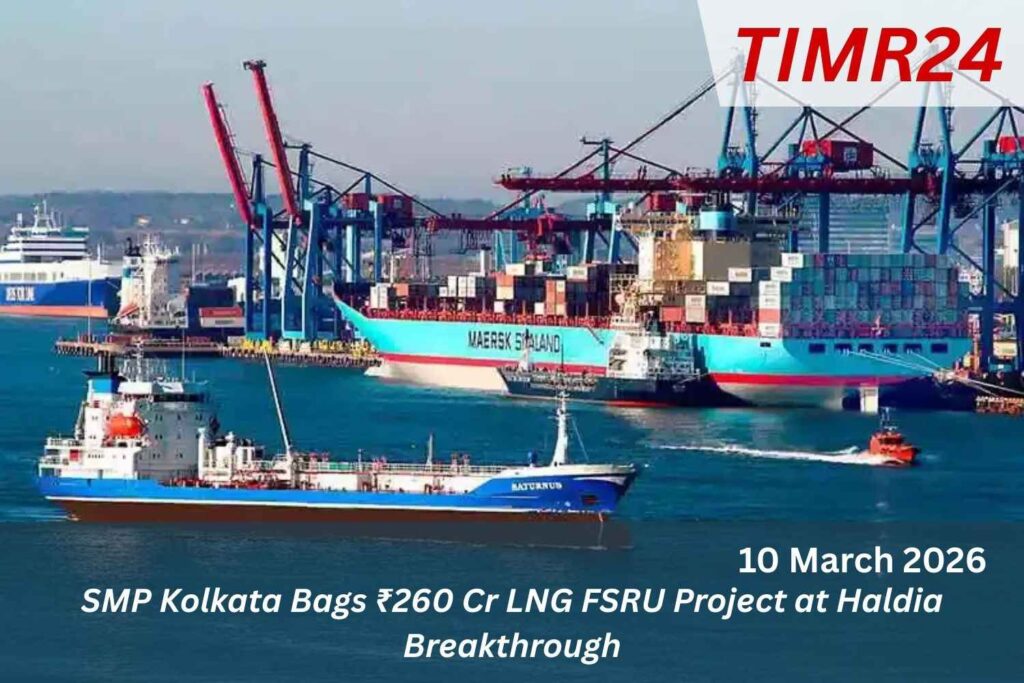
Syama Prasad Mookerjee Port (SMPK) has signed a licence agreement with East Horizon Pvt Limited to establish a Floating Storage and Regasification Unit (FSRU) at the Haldia Dock Complex, involving an investment of approximately Rs 260 crore. This project aims to enhance LNG handling capacity in eastern India, improve energy infrastructure, and support cleaner fuel supply chains, ultimately promoting natural gas usage in the region In a major stride for India’s maritime and energy infrastructure, Syama Prasad Mookerjee Port, Kolkata (SMPK) has signed a ₹260 crore licence agreement with East Horizon Pvt Ltd to build a Floating Storage and Regasification Unit (FSRU) at the Haldia Dock Complex.
This landmark project strengthens LNG handling facilities, aids the national gas supply chain, and aligns with India’s strategic energy goals, particularly in the eastern region An FSRU is a specialised offshore terminal vessel that receives Liquefied Natural Gas (LNG) from carriers, stores it in liquid form, and regasifies it into natural gas for delivery into pipelines connected to onshore networks. As a cleaner fuel alternative to coal and oil, LNG supports lower carbon emissions, making such facilities crucial for India’s energy transition The SMPK‑East Horizon agreement, signed on 6 March 2026, marks a critical step in enhancing India’s LNG infrastructure footprint.
Especially in West Bengal and the broader eastern corridor. While specific technical capacities of the FSRU were not publicly detailed by the port, the investment underscores both public and private sector confidence in expanding natural gas logistics and import capabilities at India’s riverine major ports This installation will enable the import, storage, and regasification of LNG, feeding cleaner fuel into the downstream pipeline network, which is expected to tie into the expanding GAIL gas distribution system. The project reinforces SMPK’s role as an energy gateway for eastern India, supports industrial growth, and helps reduce carbon intensity in regional power.
Historical Context & Future Potential
India’s focus on expanding natural gas infrastructure has seen initiatives such as small and large LNG terminal proposals at major ports. In 2025, SMP Kolkata had previously awarded a 30‑year land and waterfront licence to a consortium of Invenire Petrodyne Limited and Excelerate Global Operations LLC to develop a floating LNG terminal at Haldia, with provisions to expand capacity up to 3 million metric tonnes per annum (MMTPA) While that earlier licence focused more on land allotment and long‑term waterfront rights with phased commissioning expected around 2027, the recent ₹260 cr agreement with East Horizon appears to represent a more defined investment for.
Operationalisation and commercial deployment of regasification capacity. These investments reflect how India views LNG infrastructure not just as an import (India) terminal but as an integrated component of energy distribution, industrial decarbonisation, and port‑led economic expansion.
Strategic Importance
The Haldia FSRU project carries multifaceted significance:
Energy Security: Increasing natural gas imports and regasification capacity reduces dependence on traditional fossil fuels, particularly coal, and enhances national energy resilience.
Cleaner Energy Integration: Natural gas emits significantly less particulate matter and greenhouse gases than coal; this project supports India’s commitment to cleaner energy pathways under its climate targets.
Regional Industrial Growth: Eastern India’s industries, power plants, and city gas distributors will be able to source LNG closer to demand centres, reducing logistics costs.
Maritime and Trade Synergies: As part of SMPK’s broader infrastructure ecosystem, the Haldia FSRU project complements port mechanisation, cargo growth, and future pipeline distribution plans.
What Is an FSRU?
A Floating Storage and Regasification Unit (FSRU) differs from traditional onshore LNG terminals by performing regasification onboard or adjacent to the vessel. This reduces the need for extensive onshore construction, lowers capital expenditure, and enables quicker (India) deployment of LNG infrastructure. The facility typically receives LNG from carriers, warms the liquid back into gas, and then supplies it into the onshore pipeline or distribution network This flexibility makes FSRUs ideal for emerging markets or regions requiring rapid access to LNG imports without building large, fixed regasification plants.
Q1. What is the SMP Kolkata ₹260 Cr LNG FSRU project at Haldia?
The project involves a ₹260 crore agreement between Syama Prasad Mookerjee Port, Kolkata and East Horizon Pvt Ltd to establish a floating storage and regasification unit (FSRU) for LNG at Haldia Dock Complex, enhancing LNG imports and distribution in eastern India.
Q2. What exactly is an FSRU?
A Floating Storage and Regasification Unit (FSRU) is a vessel that receives liquefied natural gas, stores it, and regasifies it into natural gas for pipeline delivery, offering a flexible LNG import solution without large onshore infrastructure.
Q3. Why is this project significant for India?
It strengthens LNG infrastructure, supports cleaner energy usage, enhances energy security, and fuels industrial growth in the eastern region, aligning with India’s energy transition goals.
Q4. When will the Haldia FSRU be operational?
While a specific timeline for commissioning under the ₹260 cr investment hasn’t been disclosed, similar floating LNG terminals at Haldia target operational readiness by 2027 in related agreements.
Q5. Who are the main stakeholders in the project?
The primary stakeholders are SMP Kolkata as the port authority and East Horizon Pvt Ltd as the developer. The facility ties into broader infrastructure such as gas pipelines and distribution systems for regional energy use.