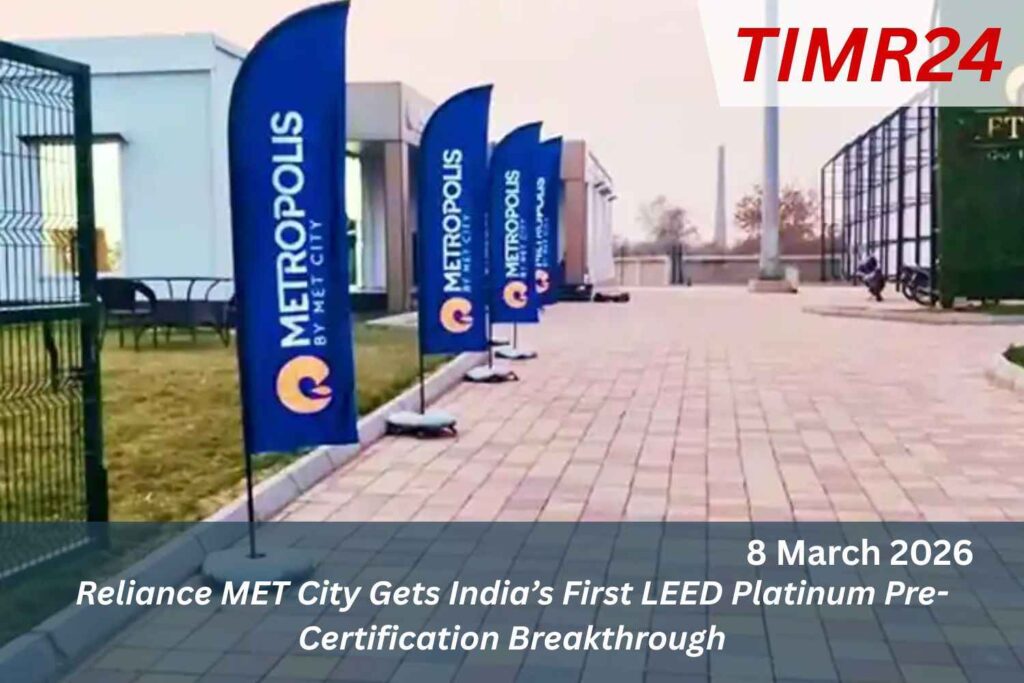
Metropolis by Reliance MET City in Haryana is the first project in India to receive LEED Platinum Pre-Certification under the LEED for Cities: Plan and Design system, confirmed by Green Business Certification Inc. (GBCI). LEED, developed by the U.S. Green Building Council, provides a framework for evaluating sustainability in large-scale developments. CEO Shrivallabh Goyal stated that this achievement reflects their commitment to creating a sustainable and resilient urban ecosystem, aiming to set new standards in responsible urban development and livability India’s sustainable urban development journey reached a significant milestone as Reliance.
A New Benchmark for Sustainable Industrial Townships
MET City secured the country’s first LEED Platinum Pre-Certification under the LEED for Cities: Plan & Design rating system. The recognition highlights the township’s strong focus on sustainable planning, efficient infrastructure, and environmentally responsible urban growth. Developed by Reliance Industries Limited, MET City is envisioned as a next-generation integrated industrial township that aligns with global sustainability benchmarks This certification has been awarded under the globally recognized LEED framework developed by the U.S. Green Building Council. The LEED (Leadership in Energy and Environmental Design) system evaluates projects based on sustainability.
Parameters such as energy efficiency, water conservation, mobility planning, environmental quality, and smart infrastructure. Achieving Platinum pre-certification, which is the highest level of recognition, signals that the project’s planning and design phase already meets strict global standards for sustainable cities The township’s design integrates environmental protection with industrial growth, showing how modern cities can balance economic expansion with climate responsibility. MET City’s master plan emphasizes efficient land use, renewable energy readiness, sustainable transport networks, and green infrastructure that collectively aim to reduce environmental impact.
While improving quality of life for workers and residents. The achievement positions Reliance MET City as one of the most forward-looking industrial ecosystems in India. Spread across thousands of acres in Haryana, the project is designed to accommodate global manufacturing companies, logistics hubs, residential areas, and commercial infrastructure within a well-planned urban environment Unlike traditional industrial zones that focus mainly on factories and logistics, MET City has been planned as a holistic urban ecosystem. The township includes green corridors, efficient waste management systems, modern water recycling infrastructure, and pedestrian-friendly mobility networks.
These features are designed to reduce environmental footprint while ensuring operational efficiency for businesses The LEED for Cities: Plan & Design certification specifically evaluates how a city is structured before construction begins. It examines how the planning framework can reduce emissions, improve climate resilience, and create healthier communities. In this context, MET City’s recognition demonstrates that sustainability has been integrated from the earliest stages of development rather than being added later The certification also reflects India’s growing emphasis on sustainable infrastructure development. With rapid urbanization and industrial expansion.
Smart Infrastructure and Green Urban Planning
Projects like MET City show how cities can adopt international environmental standards while still supporting economic growth. One of the key reasons MET City received the Platinum rating is its strong focus on smart infrastructure and climate-conscious planning. The township integrates advanced infrastructure systems that support both sustainability and operational efficiency The development plan prioritizes renewable energy integration, advanced water management systems, and efficient waste processing. Green spaces and urban forests are also part of the master plan, helping to improve air quality and provide natural cooling for the city.
These features contribute to reducing the overall environmental impact of the township Transportation planning is another major highlight. The township is designed with dedicated pedestrian paths, cycling tracks, and efficient road networks to reduce congestion and emissions. Public transportation connectivity is also a key focus, ensuring easy access for workers commuting to industrial units within the city Water management plays an equally important role in the township’s design. Rainwater harvesting systems, wastewater recycling, and efficient distribution networks have been incorporated to ensure sustainable water usage. Such systems not only conserve.
Boosting India’s Sustainable Development Vision
Resources but also make the city more resilient during periods of water scarcity. The recognition for MET City also supports India’s broader goals related to sustainable urbanization and climate action. As cities continue to expand rapidly across the country, sustainable planning frameworks are becoming increasingly important for managing environmental challenges Projects like MET City demonstrate that industrial growth and environmental responsibility can coexist when sustainability is embedded in urban planning. By adopting internationally recognized standards such as LEED, Indian developments can attract global investors who prioritize sustainability and environmental governance.
The project also reflects a shift in the way industrial cities are being planned. Instead of focusing only on manufacturing infrastructure, developers are now creating (India) integrated urban ecosystems that include residential zones, commercial hubs, and green recreational spaces. This approach improves the quality of life for workers while supporting long-term economic productivity For multinational companies seeking sustainable industrial locations, a certified green township like MET City offers an attractive environment that aligns with global ESG goals.
Strengthening India’s Position in Green Infrastructure
The Platinum pre-certification achieved by MET City reinforces India’s growing leadership in green infrastructure development. Over the past decade, the country has emerged as one of the world’s fastest-growing markets for LEED-certified buildings and sustainable projects Organizations such as the U.S. Green Building Council have collaborated with developers and policymakers to promote green building standards across India. The adoption of these frameworks has helped cities reduce energy consumption, manage water resources more effectively, and improve environmental quality.
MET City’s achievement also highlights the role of large industrial developers in driving sustainable transformation. By integrating sustainability at the city planning level, developers can influence how industries operate, how infrastructure is built, and how communities interact with the environment This milestone is expected to inspire other developers to adopt similar standards while planning new townships and industrial corridors across the country.
Future Impact on Urban Development
The success of MET City could shape the future of urban development in India. As climate change and resource constraints become more pressing challenges, cities must adopt smarter and more sustainable planning models Industrial townships like MET City can serve as prototypes for future developments that combine economic growth with environmental sustainability. By integrating green infrastructure, renewable energy readiness, and efficient transport systems, such cities can significantly reduce carbon emissions and resource consumption.
The LEED Platinum recognition also provides global visibility to the project, positioning it as an example of sustainable urban planning for other emerging (India) economies. If similar models are replicated across India’s industrial corridors, the country could significantly accelerate its transition toward sustainable urban ecosystems.