













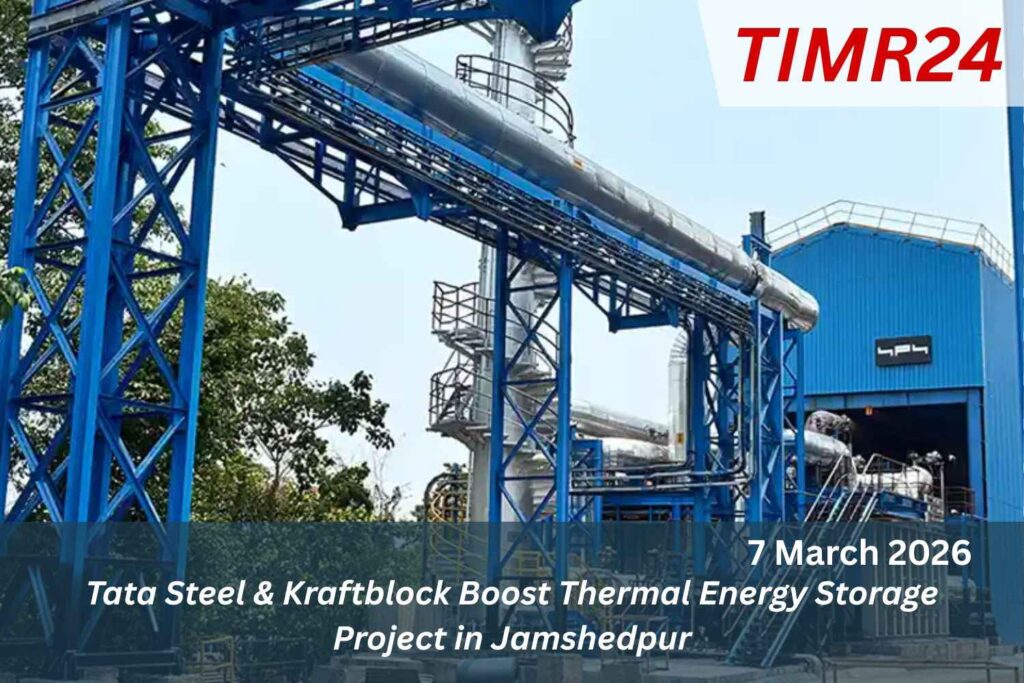
Tata Steel, in collaboration with Kraftblock GmbH, has successfully operated a thermal energy storage system at its Jamshedpur Sinter Plant #3 for nearly a year. This system recovers high-temperature waste heat from the sintering process, stores it, and utilizes it to heat process water, leading to a reduction of 22,000 t-CO2 in annual carbon emissions. The pilot, which started a year ago, is key to Tata Steel’s commitment to cleaner steel production by enhancing energy efficiency. Executives from both Tata Steel and Kraftblock highlighted the project’s scalability and potential benefits for energy and cost efficiency in the steel industry India’s industrial sector is rapidly moving toward.
Project Demonstrates How Innovative
Sustainable energy solutions, and the collaboration between Tata Steel and Kraftblock marks an important milestone in this transition. The companies are strengthening their thermal energy storage initiative at Tata Steel’s facility in Jamshedpur. This project demonstrates how innovative technology can help heavy industries reduce energy waste, lower emissions, and move toward cleaner production processes while maintaining operational efficiency Thermal energy storage has become a critical technology for energy-intensive industries such as steel manufacturing. Large amounts of heat are generated during production processes, and much of this energy is traditionally lost.
By implementing advanced storage systems, industries can capture this heat, store it, and reuse it later. This significantly improves overall energy efficiency and reduces dependence on fossil fuels The collaboration between Tata Steel and Kraftblock focuses on integrating Kraftblock’s high-temperature thermal energy storage system within the steel manufacturing process. Kraftblock, a German technology company known for developing modular heat storage solutions, has created systems capable of storing heat at extremely high temperatures for long durations. When integrated into an industrial plant, the stored heat can be reused in different production stages.
Kraftblock System Stores It In Specially Designed
Thereby reducing energy costs and improving sustainability At the Tata Steel plant in Jamshedpur, the project aims to capture surplus heat produced during steel manufacturing. Instead of allowing this heat to dissipate into the atmosphere, the Kraftblock system stores it in specially designed thermal storage modules. These modules can hold heat for extended periods without significant energy loss. Later, the stored heat can be reused for other industrial processes such as reheating furnaces, power generation support, or auxiliary heating systems This initiative aligns with Tata Steel’s long-term strategy of reducing carbon emissions and increasing energy efficiency across its operations.
Steel manufacturing is one of the most energy-intensive industries in the world, and innovations such as thermal energy storage can play a crucial role in achieving sustainability goals. By capturing and reusing waste heat, the company can significantly lower fuel consumption and reduce its environmental footprint The partnership also highlights the growing role of global technology collaboration in advancing industrial sustainability. Kraftblock’s technology has already been tested in several European industrial projects, and the collaboration with Tata Steel represents one of its notable implementations in India. This demonstrates how international partnerships can accelerate.
The adoption of advanced energy solutions in emerging industrial markets Another important aspect of the project is its potential impact on India’s broader energy transition. As the country continues to expand industrial production, energy demand is increasing rapidly. Technologies that improve energy efficiency in manufacturing can help reduce overall energy consumption at a national level. Thermal energy storage is particularly valuable because it allows industries to manage heat energy more effectively without relying on additional fuel sources.
Support Environmental Goals While Maintaining
The project also contributes to India’s sustainability commitments and industrial modernization initiatives. With the government encouraging industries to adopt cleaner technologies, projects like this serve as practical examples of how innovation can support environmental goals while maintaining economic growth. Industrial decarbonization is a key challenge for many sectors, and energy storage solutions can play a vital role in addressing it From a technological perspective, Kraftblock’s system uses advanced materials designed to withstand extremely high temperatures. These materials allow heat to be stored safely and efficiently for long periods.
The modular design of the system makes it suitable for different industrial environments, enabling companies to scale the technology based on their energy requirements The implementation of this technology at the Jamshedpur plant is also expected to generate (India) valuable operational data. This information will help engineers optimize the performance of the storage system and explore additional applications within the steel manufacturing process. Over time, such data can support the development of more advanced energy management strategies across industrial facilities Another important benefit of thermal energy storage is its compatibility with renewable energy sources.
Commitment To Technological Innovation
As industries increasingly adopt renewable power such as solar and wind, managing energy supply becomes more complex due to variability in generation. Thermal storage systems can help balance energy usage by storing excess heat or energy when supply is high and using it later when demand increases For Tata Steel, the project reinforces its commitment to technological innovation and sustainability leadership within the global steel industry. The company has been investing in multiple initiatives aimed at reducing emissions, improving resource efficiency, and adopting advanced manufacturing technologies. The collaboration with Kraftblock adds.
Another important component to this strategy by focusing specifically on energy optimization The Jamshedpur facility itself holds historical significance in India’s industrial development. Established as one of the country’s earliest planned industrial cities, Jamshedpur has (India) long been associated with steel manufacturing and technological progress. Introducing cutting-edge energy storage solutions at this site represents the continuation of that legacy while adapting to modern sustainability challenges In addition to environmental benefits, the project may also offer economic advantages. Energy efficiency improvements can reduce operational costs over time, making industrial production more competitive.
By lowering fuel consumption and maximizing the use of existing energy resources, companies can improve profitability while supporting environmental objectives The success of this project could also encourage other industries to explore similar technologies. Thermal energy storage is not limited to steel manufacturing; it can be applied in sectors such as cement, chemicals, glass production, and power generation. If widely adopted, such systems could significantly improve energy efficiency across multiple industries Moreover, projects like this strengthen India’s position as a growing hub for industrial innovation. By adopting advanced technologies and collaborating with global partners.
Kraftblock Could Expand Into Additional Projects
Indian companies can demonstrate leadership in sustainable manufacturing practices. This not only benefits the environment but also enhances the country’s reputation in international markets the partnership between Tata Steel and Kraftblock could expand into additional projects and technology deployments. As the initial implementation proves its effectiveness, similar systems may be introduced in other facilities or adapted for different industrial processes. Continuous improvement and innovation will be key to maximizing the benefits of thermal energy storage.
Overall, the expansion of the thermal energy storage project in Jamshedpur represents a forward-looking approach to industrial energy management. By capturing and reusing waste heat, Tata Steel and Kraftblock are showing how modern technology can transform (India) traditional manufacturing practices into more efficient and sustainable systems. As industries worldwide seek solutions to reduce emissions and improve resource efficiency, such collaborations will become increasingly important in shaping the future of industrial energy use.
Q1. What is the Tata Steel Kraftblock project about?
It focuses on implementing thermal energy storage technology to capture and reuse industrial waste heat at Tata Steel’s Jamshedpur plant.
Q2. What is thermal energy storage?
Thermal energy storage is a technology that stores heat generated during industrial processes so it can be reused later.
Q3. Why is the project important for the steel industry?
Steel production consumes large amounts of energy. Reusing waste heat helps reduce fuel use, costs, and carbon emissions.
Q4. Where is the project being implemented?
The initiative is being implemented at Tata Steel’s manufacturing facility in Jamshedpur, Jharkhand.
Q5. How does the project support sustainability?
By capturing waste heat and reusing it, the system improves energy efficiency and reduces environmental impact.