






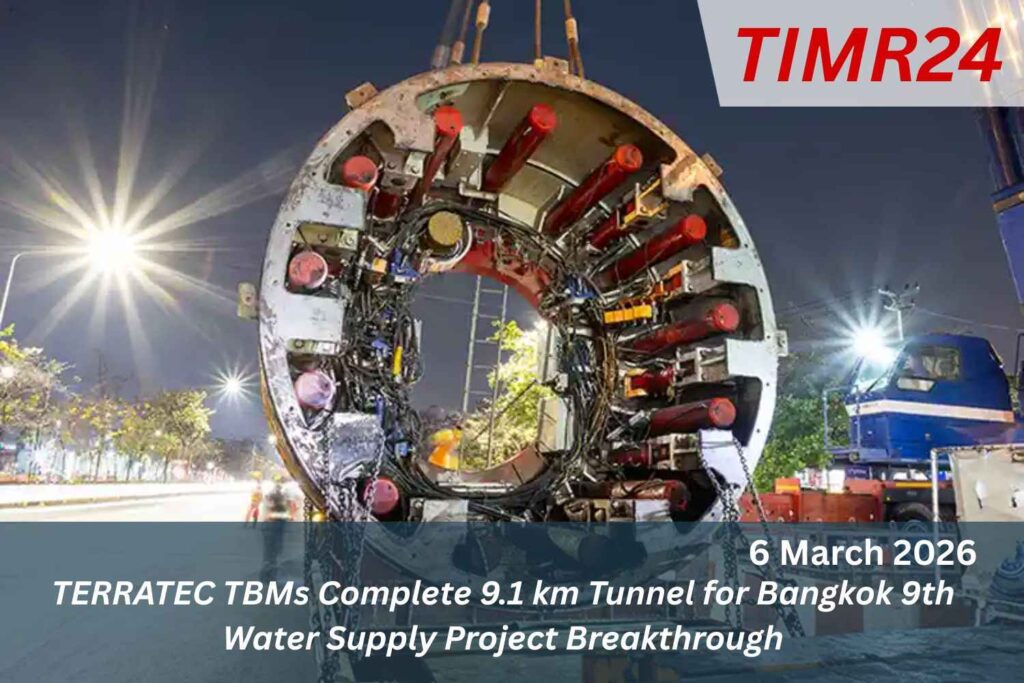
TERRATEC’s earth pressure balance tunnel boring machines (TBMs) completed the excavation of a 9.1 km water transmission tunnel for Bangkok’s 9th Water Supply Improvement Project. The final breakthroughs occurred in December 2025 at Shaft 9A-5 and Shaft 9B-3, following drives of 2,250 metres and 3,120 metres, respectively. The project, executed by the Italianthai Nawarat joint venture, involved tunnelling at depths of 27 to 34 metres through silty and clayey sand strata, necessitating careful face pressure control. Despite challenges, tunnelling was efficient, achieving an average advance rate of 10–12 rings per day. More than 4,500 segmental rings were installed, and nearly 90,000m³ of material.
Excavated, with no major incidents reported. Steel liner installation is currently in progress and expected to be completed four months post-breakthrough, contributing to the Mahasawat water treatment plant’s capacity and enhancing Bangkok’s water supply resilience Urban infrastructure across Asia is evolving rapidly as cities expand and populations grow. One of the most critical aspects of urban development is the availability of reliable water supply systems. In this context, a major milestone has been achieved in Bangkok, the capital of Thailand. Advanced tunnelling technology deployed by TERRATEC has successfully completed a 9.1-kilometre underground tunnel for the Bangkok 9th Water Supply Project.
Project Overview And Infrastructure Significance
This achievement represents an important step toward strengthening the city’s water infrastructure. The project has been designed to increase the capacity and reliability of Bangkok’s water distribution network while ensuring long-term sustainability. As urban populations continue to rise, such infrastructure initiatives play a crucial role in ensuring that essential services like water supply remain efficient, resilient, and future-ready The completion of the tunnel highlights the growing role of modern tunnel boring machines (TBMs) in delivering complex underground infrastructure projects in densely populated metropolitan areas The Bangkok 9th Water Supply Project is part of a larger initiative aimed at.
Improving water management and distribution across the city. With millions of residents depending on the metropolitan water network every day, upgrading infrastructure has become a strategic priority for local authorities The 9.1 km tunnel forms a major underground conduit designed to transport treated water across key parts of the city. By shifting critical water pipelines underground, the project helps protect the system from external disruptions while also reducing the risk of leaks, contamination, and surface damage Urban water systems must cope with multiple challenges including population growth, climate change, and aging infrastructure.
Role of TERRATEC Tunnel Boring Machines
Projects like this not only expand supply capacity but also enhance operational efficiency and resilience. The Bangkok 9th Water Supply Project therefore serves as a long-term investment in the city’s sustainability. A key factor behind the success of the tunnel construction was the deployment of advanced TBM technology developed by TERRATEC. Tunnel Boring Machines are specialized equipment designed to excavate tunnels through various geological conditions while maintaining high levels of safety and precision Unlike traditional excavation methods, TBMs allow continuous tunnelling operations with minimal surface disruption.
This makes them particularly suitable for projects located beneath densely populated urban environments like Bangkok The machines used in the project were designed to handle complex ground conditions including soft soil layers and varying underground pressures. Their advanced cutting heads, automated control systems, and robust structural components ensured steady progress throughout the tunnelling process By using TBM technology, engineers were able to maintain consistent tunnel alignment, improve structural integrity, and significantly reduce construction risks. This demonstrates how modern engineering solutions are transforming the way underground infrastructure is built across major global cities.
Engineering Challenges And Solutions
Constructing a 9.1 km tunnel beneath a busy metropolitan area presents numerous engineering challenges. The ground conditions beneath Bangkok consist of varying layers of clay, sand, and sediment, which can complicate tunnelling operations To address these challenges, engineers used advanced monitoring systems that continuously tracked ground pressure, alignment accuracy, and structural stability during excavation. These systems ensured that the tunnel remained safe and stable throughout the construction process Another important consideration was minimizing disruption to the city above. Because the project runs beneath developed urban areas.
Maintaining surface stability was critical. TBM technology helped achieve this by providing controlled excavation that prevents ground settlement In addition, careful planning and coordination among contractors, engineers, and city authorities ensured smooth project execution. The use of digital monitoring tools and precision engineering allowed the project team to maintain high standards of safety and efficiency.
Impact on Bangkok’s Water Supply System
The completion of the tunnel is expected to significantly strengthen Bangkok’s water distribution infrastructure. As the city continues to grow, demand for clean and reliable water is increasing steadily The new underground tunnel will enable the transport of larger volumes of treated water across different areas of the city. This will help improve supply reliability, reduce pressure fluctuations in pipelines, and ensure consistent service to residential and commercial areas Additionally, placing key pipelines underground offers better protection against environmental factors such as flooding, temperature variations, and accidental damage from construction activities.
Environmental And Urban Benefits
Beyond improving water supply capacity, the project also delivers environmental and urban planning benefits. Underground water infrastructure reduces the need for extensive surface construction, helping preserve valuable urban space The tunnelling process itself was designed to minimize environmental impact. By using TBMs, engineers were able to control excavation debris and limit disturbances to surrounding areas Improved water distribution systems also help reduce water losses caused by leaks in older pipelines. Efficient water management supports sustainability goals and helps cities adapt to changing environmental conditions.
International Collaboration in Infrastructure Development
Furthermore, modern underground infrastructure makes cities more resilient to extreme weather events, which are becoming increasingly common due to climate change. Large infrastructure projects like the Bangkok 9th Water Supply Project often involve collaboration between international engineering companies, local contractors, and government agencies The participation of TERRATEC demonstrates how global expertise can support local infrastructure development. Advanced technologies developed by international firms are helping cities across Asia deliver projects faster and more efficiently Such collaborations also promote knowledge sharing.
Technology transfer, and skill development within local engineering communities As cities continue to expand, partnerships between governments and specialized (India) infrastructure companies will remain essential for delivering complex projects that require advanced technical expertise.
Future Outlook for Underground Infrastructure
The successful completion of the 9.1 km tunnel marks another milestone in the evolution of underground infrastructure development. Across the world, cities are increasingly turning to tunnelling solutions to build water pipelines, metro systems, transportation corridors, (India) and utility networks Underground construction helps optimize land use in crowded cities while improving the reliability and resilience of essential infrastructure systems For Bangkok, the completion of this tunnel is only one step in a broader effort to modernize its water infrastructure. Continued investment in advanced engineering technologies will play a crucial role in meeting future demand and ensuring sustainable urban growth.
Q1. What is the Bangkok 9th Water Supply Project?
It is a major infrastructure initiative aimed at improving Bangkok’s water distribution capacity and reliability through advanced underground pipeline systems.
Q2. How long is the tunnel completed by TERRATEC TBMs?
The tunnel constructed for the project measures approximately 9.1 kilometers in length.
Q3. Why are Tunnel Boring Machines used for such projects?
TBMs allow safe, precise, and efficient tunnelling with minimal surface disruption, making them ideal for urban infrastructure projects.
Q4. How will the project benefit Bangkok residents?
It will improve water supply reliability, increase distribution capacity, and reduce the risk of infrastructure failures.
Q5. Who developed the tunnelling technology used in the project?
The tunnel was excavated using advanced TBM systems developed by TERRATEC.