












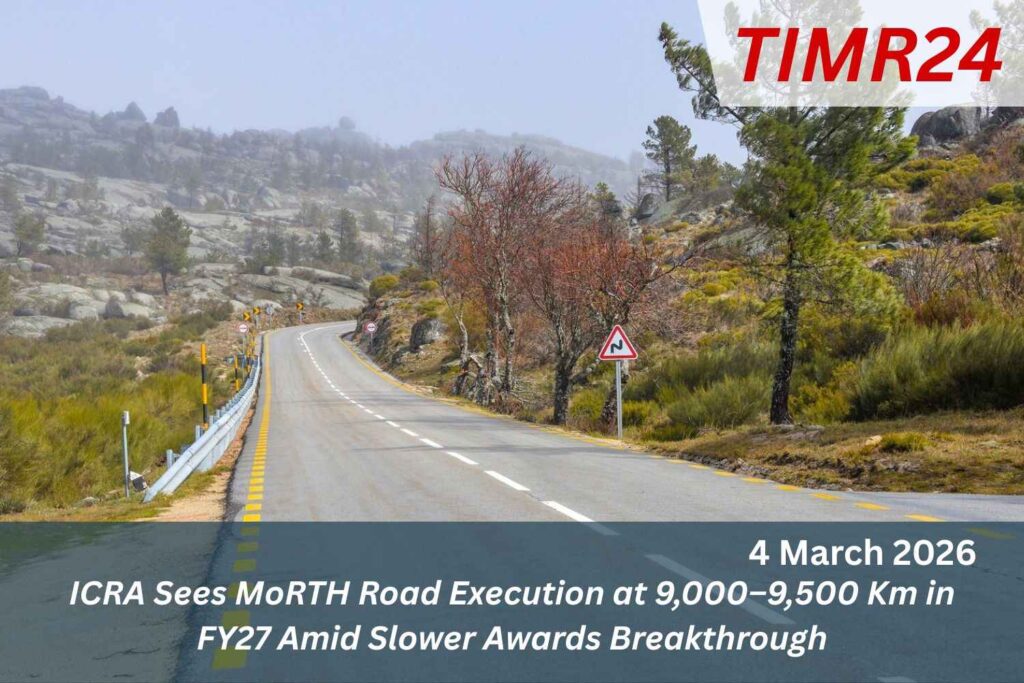
ICRA predicts a decline in road execution by the Ministry of Road Transport and Highways (MoRTH) to 9,500-10,000 km in FY2025-26 and 9,000-9,500 km in FY2026-27, attributing this to reduced project awards over the past three years. For FY2025-26, road awards are anticipated at 7,250-7,750 km, slightly lower than previous years. Year-over-year execution dropped 3% to 4,612 km as of 8M FY2025-26. Challenges include a shrinking order book and delays caused by weather disruptions. Despite these issues, the focus on expressways may foster lane-km growth. Competitive bidding remains high for MoRTH projects, with discounts on awards increasing amid fewer opportunities.
Recalibration As Leading Credit Rating
Toll collections are projected to grow 6-9% in FY2025-26, although muted rate hikes may impact growth in FY2026-27, despite improved traffic due to economic conditions India’s road infrastructure sector is entering a phase of recalibration as leading credit rating agency ICRA projects that road construction under the Ministry of Road Transport and Highways (MoRTH) could moderate to around 9,000–9,500 kilometres in FY27. This outlook reflects a slowdown in fresh project awards, which has created a gap between awarded projects and on-ground execution momentum. While India has witnessed record-breaking highway construction in recent years.
Including peak execution levels in FY21 and FY22, the pace is now expected to stabilize rather than accelerate. The moderation is not necessarily a sign of sectoral weakness, but rather a transition toward consolidation, improved asset quality, and financial discipline within the road construction ecosystem Over the past decade, India’s highway development strategy has been driven by ambitious programs such as Bharatmala, economic corridor expansion, and expressway connectivity improvements. Agencies like the National Highways Authority of India (NHAI) have played a central role in awarding and executing large-scale projects. However, FY24 and FY25 saw a visible decline in new project.
Cautious Approach Toward Public-Private
Awards due to factors such as land acquisition challenges, environmental clearances, funding considerations, and a more cautious approach toward public-private partnership (PPP) models. This reduced awarding activity is now expected to reflect in execution numbers by FY27 because construction activity typically follows awards with a lag of 12–24 months The projected execution of 9,000–9,500 km remains substantial by global standards. Even at this moderated level, India would continue to rank among the fastest highway builders worldwide. However, compared to the peak construction levels of over 10,000 km annually achieved in certain recent fiscal years.
The expected figures indicate normalization. ICRA’s outlook suggests that while the pipeline of under-construction projects remains healthy, replenishment through new awards must accelerate to sustain higher execution levels beyond FY27. Without a robust inflow of fresh contracts, engineering, procurement and construction (EPC) players could face pressure on order book growth in the medium term Financial discipline has become a key theme in the road sector. In earlier expansion phases, aggressive bidding, thin margins, and stretched working capital cycles created stress for several contractors. The current moderation phase allows developers and EPC contractors to.
Bundles And Infrastructure Investment Trusts
Focus on balance sheet repair, margin improvement, and project completion efficiency. Rating agencies have noted improved credit metrics among larger road developers, supported by monetization initiatives such as toll-operate-transfer (TOT) bundles and infrastructure investment trusts (InvITs). These mechanisms have allowed sponsors to recycle capital and reduce leverage, strengthening the sector’s financial profile Government policy continues to support long-term highway expansion, but there is a visible shift toward quality over quantity. Instead of focusing solely on the number of kilometres constructed, authorities are emphasizing expressways, access-controlled corridors, and multimodal integration.
Strategic corridors connecting ports, logistics hubs, and industrial clusters are gaining priority, aligning road development with broader economic growth objectives. This integrated approach ensures that highway infrastructure not only expands geographically but also enhances freight efficiency, travel time reduction, and fuel savings Another factor influencing execution trends is funding allocation. While budgetary support for highways remains strong, fiscal prudence and competing infrastructure priorities such as railways and urban transit require balanced capital distribution. Innovative financing structures, including hybrid annuity models (HAM), have gained prominence.
Project Awards Under HAM And EPC Modes
Reducing traffic risk for private developers while maintaining government oversight. However, moderation in project awards under HAM and EPC modes has contributed to the projected execution slowdown in FY27 Contractors operating in the road segment may experience mixed impacts. Large, diversified infrastructure players with healthy order books and exposure to multiple segments such as railways, metros, and urban infrastructure are likely to remain resilient. Mid-sized EPC contractors heavily dependent on highway projects could see slower revenue growth if award activity does not revive soon. Nonetheless, improved payment cycles and reduced.
Competitive intensity may partially offset the impact of lower volumes From a macroeconomic perspective, road construction remains a powerful multiplier for employment and economic activity. Even at 9,000–9,500 km annually, the sector generates significant demand (Solar) for cement, steel, aggregates, construction equipment, and logistics services. Rural connectivity and expressway expansion enhance market access, stimulate industrial investment, and strengthen supply chains. Therefore, the projected moderation should be viewed within the broader context of sustained infrastructure momentum rather than contraction.