







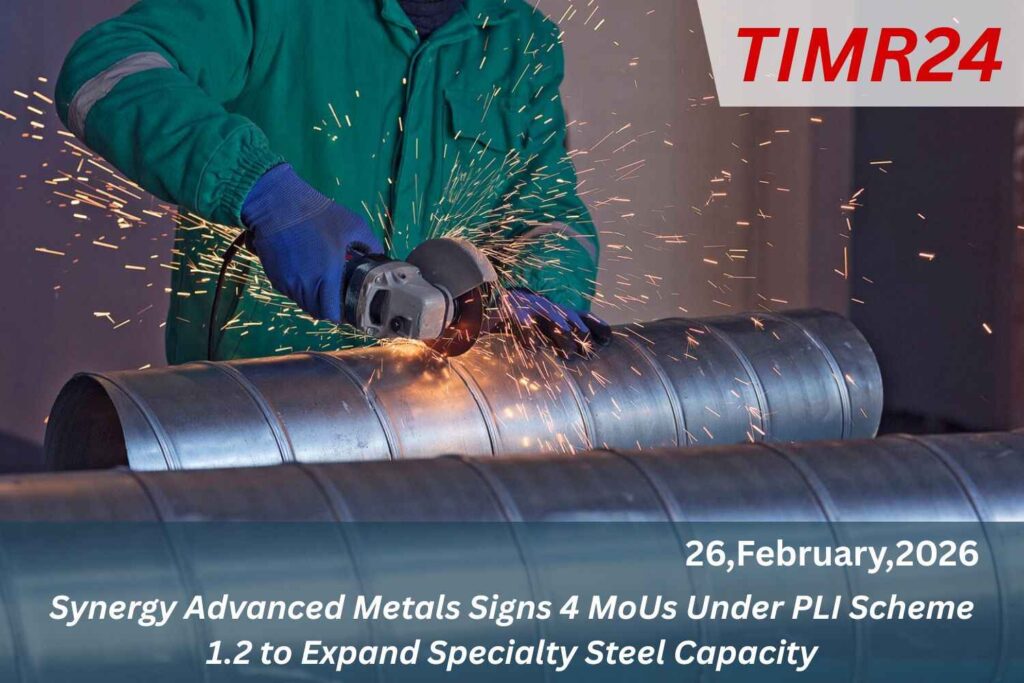
Synergy Advanced Metals Limited has signed four memoranda of understanding with the Ministry of Steel to engage in the Production-Linked Incentive (PLI) scheme for specialty steel, following an assessment by MECON Limited. Overall, 85 MoUs have been signed with 55 companies under PLI Scheme 1.2, amounting to Rs 11,887 crore in investments and aiming to increase specialty steel capacity by 8.7 million tonnes by FY2031. This production expansion will enhance domestic capabilities in various types of steel and supports the government’s goals of reducing import reliance and fostering value-added manufacturing.
Strategic Memorandums Of Understanding
India’s manufacturing ecosystem continues to gain momentum as Synergy Advanced Metals announces the signing of four strategic Memorandums of Understanding under the Production Linked Incentive Scheme 1.2. The move signals a strong commitment toward expanding specialty steel production capacity and aligns with the national objective of strengthening domestic manufacturing capabilities. With specialty steel being a high-value segment critical to sectors such as infrastructure, defence, automotive, railways, and capital goods, this expansion represents a significant step in enhancing India’s industrial competitiveness.
The Production Linked Incentive framework, introduced by the Government of India, is designed to encourage companies to increase manufacturing output by offering performance-based incentives. Under the updated PLI Scheme 1.2 for specialty steel, the government aims to reduce dependency on imports, promote value-added steel production, and position India as a global supplier of advanced steel grades. Synergy Advanced Metals’ participation under this scheme reinforces investor confidence and highlights the growing attractiveness of India’s industrial policy environment Specialty steel differs from conventional steel in terms of composition and performance characteristics.
National Infrastructure Pipeline
It includes coated steel, alloy steel, high-strength steel, and corrosion-resistant grades that are used in demanding applications. As India undertakes massive infrastructure development under initiatives such as Make in India and National Infrastructure Pipeline, the demand for high-quality steel continues to rise. By signing four MoUs, Synergy Advanced Metals plans to invest in advanced production technologies, modern rolling mills, and downstream value-added facilities that will cater to both domestic and export markets The expansion under PLI Scheme 1.2 is expected to significantly enhance production capacity, improve operational efficiency, and introduce new specialty.
Steel grades tailored for emerging industries. With the automotive sector transitioning toward electric mobility and lightweight materials, and the defence sector focusing on indigenization, specialty steel has become a strategic material. The government’s push toward self-reliance under the broader vision of Atmanirbhar Bharat further amplifies the importance of local manufacturing players stepping up capacity and technological capabilities From an economic standpoint, the signing of these MoUs is likely to generate employment opportunities across multiple levels, including skilled technical roles, plant operations, logistics, and supply chain management.
Meeting Both Domestic Consumption
Large-scale steel projects also create indirect employment in mining, transportation, and allied industries. As India aims to increase its steel production capacity substantially in the coming years, private sector investments such as this will play a crucial role in meeting both domestic consumption and export demand India is already one of the world’s largest steel producers, and policy support from the Ministry of Steel has helped accelerate growth in the specialty segment. The PLI Scheme 1.2 focuses specifically on high-grade specialty steel products that were traditionally imported. By incentivizing domestic production, the scheme not only improves trade balance but also enhances.
Technological sophistication within the industry. Synergy Advanced Metals’ move demonstrates how industry players are responding proactively to this opportunity Technological modernization will be a core component of this expansion. Specialty steel production requires precision metallurgy, advanced heat treatment processes, and strict quality control systems. Investments are expected to include automation, digital monitoring systems, and energy-efficient production techniques. Sustainability is another critical factor, as steel manufacturing is energy-intensive. Companies expanding under the PLI framework are increasingly focusing on reducing carbon emissions and adopting cleaner.
Expanding Specialty Steel Capacity Indian
Production practices to align with global environmental standards The global steel market is becoming increasingly competitive, with countries focusing on value-added products rather than bulk commodity steel. By expanding specialty steel capacity, Indian manufacturers can tap into higher-margin export markets. This strategic shift supports India’s ambition to become a preferred supplier for sectors such as renewable energy, aerospace, shipbuilding, and advanced engineering. With global supply chains undergoing restructuring, India’s ability to offer reliable, high-quality specialty steel can significantly enhance its export footprint Financially.
The PLI incentives reduce investment risks for manufacturers by ensuring performance-based returns linked to incremental production. This encourages long-term capital expenditure and fosters innovation. For Synergy Advanced Metals, signing four MoUs indicates a phased and structured expansion plan, potentially covering different product categories or manufacturing locations. Such diversification strengthens resilience against market fluctuations and ensures balanced growth Another important dimension is import substitution. Historically, India imported significant quantities of specialty steel grades due to limited domestic production.
Scheme Have Already Transformed Sectors
With expanded local capacity, dependence on imports can be reduced, foreign exchange savings can be achieved, and supply chain security can be strengthened. This is particularly important for critical sectors such as defence and infrastructure, where uninterrupted supply is (India) essential In the broader policy landscape, initiatives under PLI Scheme have already transformed sectors like electronics and pharmaceuticals. The extension and refinement of the scheme for specialty steel reflect the government’s strategic focus on core industrial materials. By collaborating with private players through MoUs, policymakers and industry leaders are creating a roadmap for sustainable industrial expansion.
Market analysts believe that specialty steel demand in India will continue to grow steadily, driven by urbanization, industrialization, and government-led capital expenditure. Mega infrastructure projects, high-speed rail corridors, smart cities, and renewable energy installations require specialized steel grades with superior performance characteristics. As domestic production scales up, pricing stability and quality assurance are expected to improve Synergy Advanced Metals’ decision to sign four MoUs under PLI Scheme 1.2 marks a pivotal development in India’s specialty steel journey.
The expansion not only strengthens the company’s production capabilities but also contributes to national objectives of self-reliance, export growth, and technological advancement. Supported by policy frameworks from the Government of India and guided by strategic initiatives (India) such as Make in India and Atmanirbhar Bharat, the specialty steel sector is poised for a new phase of growth. As investments materialize and production capacity increases, India’s position in the global steel value chain is likely to become stronger and more competitive in the years ahead.
Q1. What did Synergy Advanced Metals announce?
It signed four MoUs under PLI Scheme 1.2 to expand specialty steel capacity.
Q2. What is PLI Scheme 1.2?
An incentive scheme by the Government of India to boost specialty steel manufacturing.
Q3. Why is specialty steel important?
It is used in defence, automotive, infrastructure, and high-end engineering sectors.
Q4. What will be the impact of these MoUs?
Capacity expansion, job creation, and reduced steel imports.
Q5. How does this benefit India?
Strengthens domestic manufacturing and supports the Make in India initiative.