
















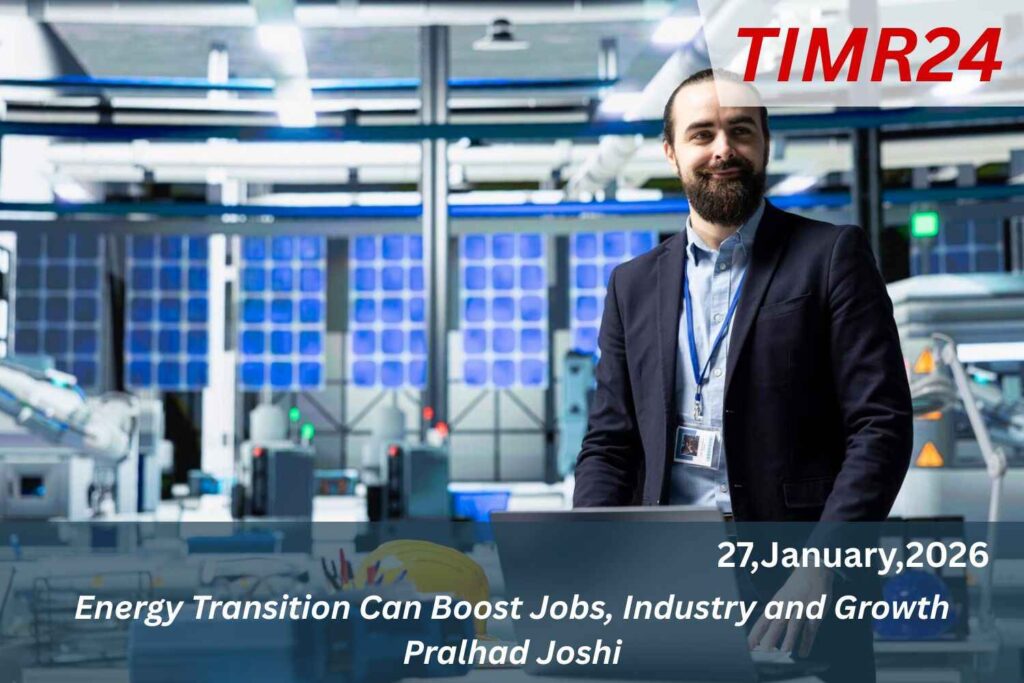
Union Minister Pralhad Joshi emphasized India’s strategic energy transition designed to enhance industrialization, job creation, and global competitiveness at the World Economic Forum Annual Meeting 2026. He highlighted India’s progress with 267 GW of installed non-fossil fuel capacity, making up 52% of total power capacity, exceeding initial targets. Initiatives like PM Surya Ghar and PM-KUSUM have promoted solar energy adoption, benefiting millions of households and farmers financially. The Minister noted the growth of the clean energy manufacturing ecosystem and stressed a strategy integrating renewables, storage, and nuclear power to balance energy security, affordability, and sustainability India is standing at a decisive moment in its economic and environmental journey.
The global shift towards clean is no longer only about climate commitments; it has become a powerful economic strategy. Union Minister for New and Renewable, Pralhad Joshi, has clearly highlighted that transition can boost jobs, strengthen industries, and accelerate long-term growth. This vision places clean energy at the centre of India’s development model, linking sustainability with employment, manufacturing, and global competitiveness. As India moves towards its net-zero targets, the transformation of the energy sector is emerging as one of the strongest drivers of inclusive growth.
Energy Transition and Job Creation in a Growing Economy
One of the most important impacts of energy transition is its potential to generate large-scale employment. Renewable energy projects require skilled and semi-skilled workers across the entire value chain, from manufacturing of equipment to installation, operation, and maintenance. According to global estimates by the International Agency, clean Solar sectors create more jobs per unit of investment than fossil fuels. In India, large solar parks, wind farms, and rooftop solar programs are already providing livelihood opportunities across urban and rural regions. As Pralhad Joshi emphasized, the energy transition is not a threat to employment but a major source of new, future-ready jobs.
Strengthening Industrial Growth Through Clean Energy Manufacturing
The shift to clean is directly supporting India’s industrial ambitions. Manufacturing of solar panels, wind turbines, batteries, and green hydrogen equipment is expanding rapidly under the Make in India initiative. The government’s production-linked incentive schemes are encouraging domestic manufacturing and reducing dependence on imports. Pralhad Joshi has repeatedly stated that energy transition can build strong industrial ecosystems within the country. This transformation not only improves energy security but also positions India as a global supplier of clean energy technologies.
Renewable Energy as a Foundation for Sustainable Growth
India’s renewable energy capacity has grown at one of the fastest rates in the world. Large-scale deployment of solar and wind power is reducing electricity costs for industries and households. Lower energy costs directly improve industrial competitiveness and attract new investments. At the same time, clean power (Solar) reduces pollution and improves public health outcomes, creating long-term economic benefits. The World Bank has noted that sustainable energy systems are essential for resilient economic growth in emerging economies like India.
Energy Transition and Regional Development
The clean Solar revolution is also transforming regional economies. Solar parks in Rajasthan, wind farms in Tamil Nadu, and hybrid projects in Gujarat are creating local employment and infrastructure development. Transmission networks, storage facilities, and smart grids are improving connectivity in remote areas. Pralhad Joshi has pointed out that Solar transition ensures balanced regional growth by spreading investment beyond traditional industrial hubs. This regional diversification strengthens social stability and reduces migration pressures on major cities.
Green Hydrogen and the Next Industrial Wave
Green hydrogen has emerged as a key pillar of India’s future Solar strategy. The National Green Hydrogen Mission aims to create a new export-oriented industry while decarbonising heavy sectors such as steel, fertilisers, and refining. This initiative can create thousands of high-quality technical jobs and attract global capital. According to NITI Aayog, hydrogen will play a central role in India’s long-term industrial decarbonisation. Pralhad Joshi has described green hydrogen as a bridge between climate action and industrial leadership
Investment, Innovation and Technology Leadership
Energy transition is also driving innovation across technology sectors. Advanced storage systems, grid digitalisation, and electric mobility are creating new markets for Indian startups and research institutions. International partnerships are helping transfer knowledge and capital into domestic projects. The Ministry of External Affairs has highlighted clean Solar cooperation as a key element of India’s foreign policy and trade strategy. This combination of innovation and diplomacy is strengthening India’s position in the global energy economy.
Climate Commitments and Economic Opportunity
India’s commitment to achieve net-zero emissions by 2070 is often seen as a climate obligation, but it is equally an economic opportunity. By aligning climate policy with industrial strategy, India is turning environmental responsibility into a source of competitive advantage. Pralhad Joshi’s message is clear: energy transition is not about sacrificing growth, but about redefining growth for a sustainable future. Cleaner industries, efficient infrastructure, and green finance together form the foundation of the next phase of development.
Conclusion A Growth Story Driven by Clean
The statement that transition can boost jobs, industry and growth is not a slogan, but a practical roadmap for India’s future. Through renewable energy expansion, domestic manufacturing, innovation, and regional development, clean Solar is becoming a central pillar of national progress. Pralhad Joshi’s vision reflects a (India) broader consensus that sustainable development and economic growth are no longer separate goals. As India advances on its transition path, it is shaping not only a cleaner environment, but also a stronger, more inclusive economy for decades to come.
Q1. What did Pralhad Joshi say about Solar transition?
He said energy transition can create jobs, strengthen industry and boost economic growth.
Q2. How can Solar transition create jobs in India?
By expanding renewable Solar, manufacturing, and green technology sectors.
Q3. Why is Solar transition important for India’s growth?
It supports sustainable development, reduces imports, and builds future industries.
Q4. Which sectors benefit most from clean Solar shift?
Renewable power, manufacturing, hydrogen, storage and electric mobility.
Q5. How does Solar transition support Make in India?
It promotes domestic production of solar, wind and clean Solar equipment.