













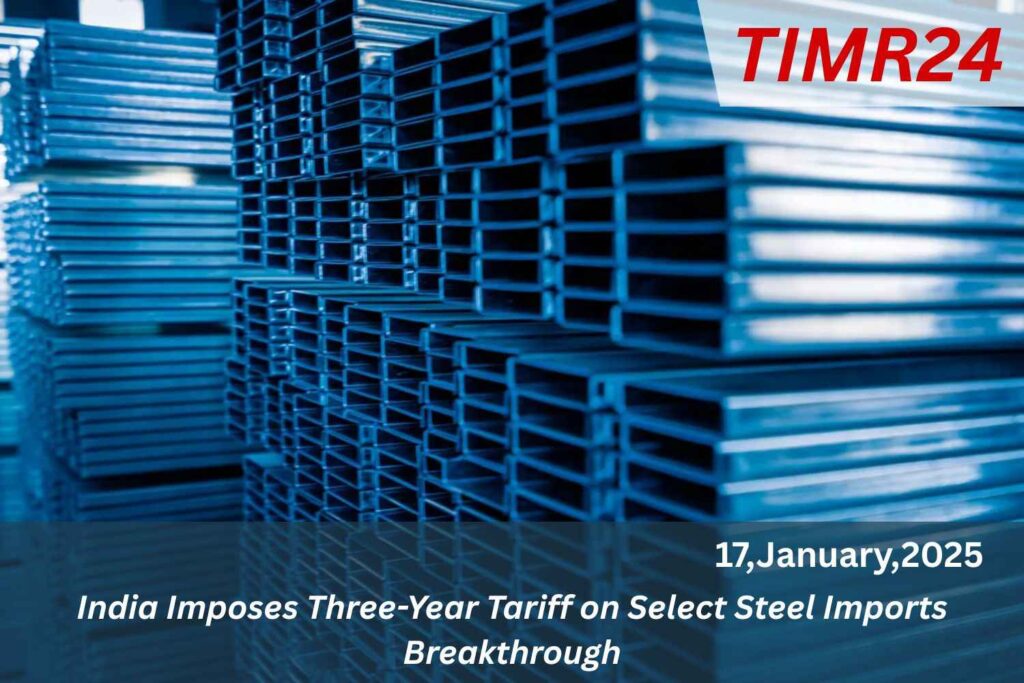
India has imposed a three-year import tariff on select steel products to combat the rise in low-priced imports from China, which adversely affect local producers. The tariff starts at 12% in the first year, decreasing to 11.5% in the second, and 11% in the third year. This decision responds to concerns over increasing imports below domestic prices, aiming to alleviate pressures on Indian steelmakers’ margins and capacity while allowing a gradual adjustment over time India has imposed a three-year tariff on select steel imports, marking a decisive policy intervention aimed at safeguarding domestic manufacturers amid rising global competition.
The decision reflects India’s broader industrial strategy to protect local production capacity, reduce dependency on cheaper imports, and ensure long-term stability in critical sectors such as infrastructure, construction, and manufacturing. Steel remains a backbone industry for India’s economic development, and this tariff policy signals the government’s intent to balance fair trade with domestic growth priorities. By introducing this tariff for a defined three-year period, policymakers are seeking to provide breathing space for Indian steel producers to strengthen operations, improve cost efficiency, and invest in technology upgrades without immediate pressure from aggressive import pricing.
Background Rising Steel Imports and Market Pressure
Over the past few years, India has witnessed a notable increase in steel imports, particularly from countries with surplus production capacity. These imports often enter the market at competitive or even undercut prices, placing significant pressure on domestic producers. Indian steel manufacturers have raised concerns that such pricing dynamics distort the market, affect profitability, and discourage fresh investments. The global steel market has also faced volatility due to fluctuating raw material costs, geopolitical tensions, and uneven demand recovery. Against this backdrop, India’s tariff decision is designed to act as a stabilizing mechanism rather than a permanent trade barrier.
Key Objectives of the Three-Year Tariff Policy
According to the Ministry of Steel, protecting domestic production is essential to meet India’s expanding infrastructure and manufacturing requirements in a sustainable manner The primary objective of imposing a tariff on select steel imports is to create a level playing field for Indian producers. Domestic manufacturers often operate under higher compliance costs related to environmental standards, labor laws, and energy pricing. Imported steel, especially from regions with lower production costs or government subsidies, can disrupt fair competition. The tariff is also aligned with the government’s long-term vision under the Make in India initiative, which focuses on.
Impact on Domestic Steel Manufacturers
Strengthening local manufacturing ecosystems. By offering a defined protection window of three years, the policy encourages Indian companies to modernize plants, adopt cleaner technologies, and improve productivity without relying indefinitely on tariff support. Indian steel producers, the tariff provides immediate relief from price दबाव and import-driven competition. It improves capacity utilization, supports revenue stability, and enhances confidence for future investments. Large integrated steel plants as well as mid-sized manufacturers are expected to benefit from improved demand visibility. This policy may also encourage domestic players to focus on value.
Effects on Infrastructure and Construction Sectors
Added steel products, specialty alloys, and high-strength grades that are crucial for sectors like renewable energy, defense, and advanced infrastructure. Over time, increased domestic production can reduce India’s vulnerability to global supply chain disruptions. Steel is a core input for infrastructure projects such as highways, railways, metro systems, ports, and affordable housing. A key concern often associated with tariffs is the possibility of price increases for end users. However, the government has emphasized that the tariff applies selectively and is calibrated to avoid excessive cost escalation With domestic producers gaining stability, supply consistency is expected to improve.
Which is critical for large-scale public infrastructure programs. Stable domestic supply can reduce project delays and dependence on imported materials From an international trade standpoint, India’s move is structured to remain compliant with global trade norms. The (India) tariff is time-bound and targeted, reducing the risk of prolonged trade disputes. Countries across the world, including major economies, have used similar measures to protect strategic industries during periods of market stress. India continues to engage with global trade bodies and partners to ensure transparency and adherence to fair trade principles.
Impact on Importing Nations and Trade Relations
Exporters of steel to may face reduced competitiveness in the Indian market during the tariff period. However, the policy does not signal a complete closure of imports; rather, it encourages fair pricing and quality differentiation. Importing nations may respond by focusing on higher-grade steel products that are not produced domestically in sufficient quantities. Over time, this could lead to more balanced trade relationships and technology collaboration rather than price-based competition Beyond short-term protection, the three-year tariff aims to catalyze long-term transformation within India’s steel sector. Domestic producers are being encouraged to.
Invest in green steel technologies, energy-efficient furnaces, and recycling-based production methods. Sustainability has become a critical factor in global steel competitiveness, and policy framework increasingly emphasizes low-carbon manufacturing. With improved margins and market stability, Indian steel companies are better positioned to align with global environmental standards For consumers, including downstream industries like automobiles and appliances, the government has indicated close monitoring of steel prices. The objective is to prevent unreasonable price hikes while ensuring domestic producers remain viable.
Conclusion A Balanced and Time-Bound Policy Intervention
Historically, excessive dependence on imports has exposed markets to sudden price shocks during global disruptions. Strengthening domestic capacity can, in fact, contribute to long-term price stability. This balanced approach aims to protect both producers and consumers, reinforcing trust across the value chain. India’s decision to impose a three-year tariff on select steel imports represents a carefully calibrated policy move rather than a protectionist shift. It addresses immediate challenges.
Faced by domestic manufacturers while keeping long-term competitiveness and global integration in focus. By combining tariff support with expectations of modernization and sustainability, the government is signaling that this window should be used for transformation, not (India) dependency. As India continues its journey toward becoming a global manufacturing hub, such targeted interventions play a crucial role in strengthening foundational industries like steel. For a deeper understanding of manufacturing policy alignment,
Q1. Why has India imposed a tariff on select steel imports?
India introduced the tariff to protect domestic steel manufacturers from unfair pricing pressure and to stabilize the local steel market.
Q2. How long will the steel import tariff remain in effect?
The tariff is applicable for a fixed period of three years, making it a time-bound safeguard measure.
Q3. Will this tariff increase steel prices in India?
The government has stated that prices will be closely monitored to prevent unreasonable increases.
Q4. Does this policy violate international trade rules?
No, the tariff is structured to remain compliant with global trade norms and safeguard provisions.
Q5. How does this impact India’s infrastructure development?
A stronger domestic steel industry ensures reliable supply for infrastructure projects and reduces import dependency.