



















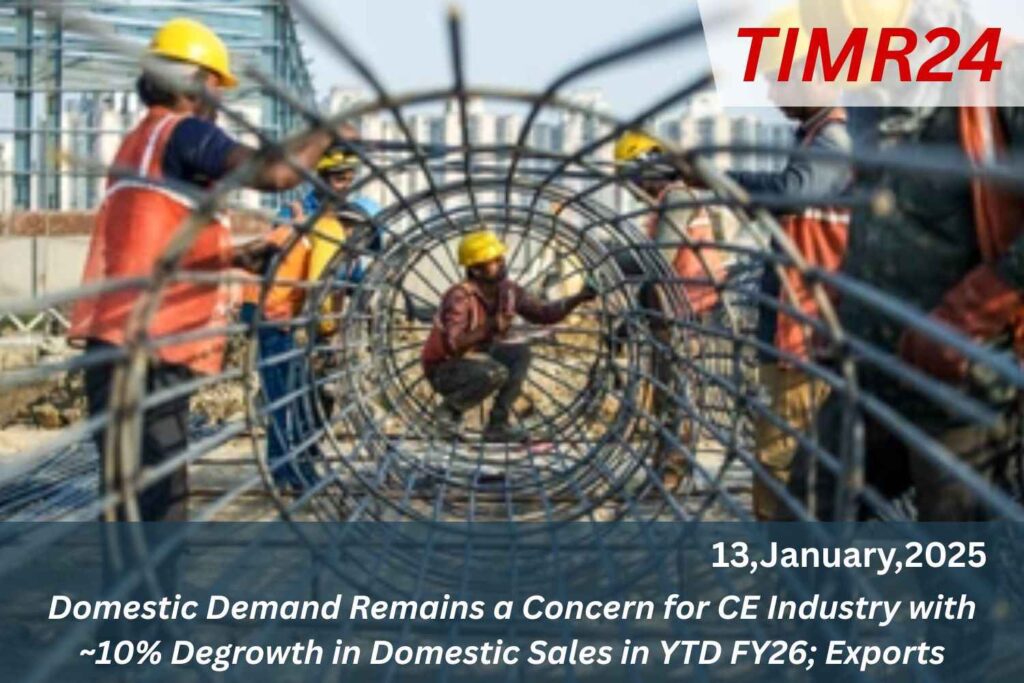
The Indian Construction Equipment (CE) industry faced subdued Domestic demand in FY 2025-26, with sales declining by approximately 10% to 81,566 units, attributed to slower infrastructure activity and financial challenges. In contrast, exports surged by 28%, indicating strong international competitiveness. Despite a 9% year-over-year decline in total CE sales, the industry’s performance benefited from robust overseas demand. Industry leaders stress that recovery hinges on faster project contract awards and execution, along with government support for supply chain migration. Optimism remains for domestic demand revival as the government’s focus on.
ICEMA Industry Analysis
Infrastructure development persists, particularly in rural areas. Comprehensive insights have been provided by the ICEMA Industry Analysis & Insights Panel, based on data from major industry players The Indian Construction Equipment (CE) industry is navigating a complex landscape in the 2025-26 financial year, characterized by a stark divergence between domestic struggles and international success From April to December 2025, domestic sales fell to 81,566 units from 89,244 units in the same period of the previous year. This contraction is a point of concern for stakeholders who view the CE industry as a barometer for the nation’s infrastructure health When infrastructure execution hits a snag.
The demand for earthmoving and road construction machinery naturally cools, leading to the “muted” demand described by industry leaders like Deepak Shetty, President of ICEMA Beyond project delays, the industry is also grappling with the transition to CEV Stage V (India) emission standards. While these norms align India with global environmental benchmarks, they have also resulted in higher equipment costs, causing some domestic buyers to defer purchase decisions. However, this technical upgrade has simultaneously bolstered India’s export potential. By manufacturing machines that meet stringent international emission norms, Indian OEMs have become competitive in global markets.
Several structural and cyclical factors are converging to keep domestic CE demand subdued. Urban consumers, who drive a disproportionate share of premium electronics purchases, are facing higher EMIs and tighter personal budgets, while rural demand has been uneven due to weather-related income volatility. Additionally, the rapid technology upgrades seen in earlier years have slowed; for instance, smartphone users who upgraded to 5G devices in FY24 and FY25 are now less inclined to replace them so soon report higher inventory days, forcing brands to run promotions that erode margins. This is particularly relevant for companies already navigating cost pressures from imported components.
Domestic Plus Exports
This is reflected in the stellar export performance, where shipments grew by 28% to reach 12,469 units. This “cushioning effect” from exports has limited the overall industry decline to a more manageable 5% when total volume (domestic plus exports) is considered Segment-wise data reveals that the pain is felt across the board. The earthmoving equipment segment, which holds the lion’s share of the market, saw a 9% decline in Q3 FY26. Material handling and concrete equipment also faced double-digit or near-double-digit drops where equipment sold for the domestic market is shipped abroad without OEM or financier knowledge.
This trend not only skews data but also poses a financial risk regarding loan repayments. Despite these hurdles, the industry remains optimistic about a turnaround in the latter half of 2026. The upcoming Union Budget is expected to act as a catalyst, with potential incentive (India) packages aimed at indigenizing high-value machinery like tunnel boring machines and cranes, which would further reduce import reliance and strengthen the domestic ecosystem.
Q1. What does ICEMA say about FY26 domestic CE demand?
ICEMA reports around 10% year-to-date degrowth in domestic consumer electronics sales, reflecting cautious urban and rural spending.
Q2. Why are exports growing while domestic sales fall?
Global brands are sourcing more from India due to competitive costs, PLI incentives and supply-chain diversification.
Q3. Which segments are most affected?
Large appliances and entry-level smartphones saw softer domestic offtake, while wearables and premium devices performed better.
Q4. How does this impact Indian manufacturers?
Export-led growth is cushioning revenue, but working capital cycles and domestic inventory need careful management.
Q5. What is the outlook for the rest of FY26?
ICEMA expects gradual domestic recovery with festive demand and continued strong exports.