


















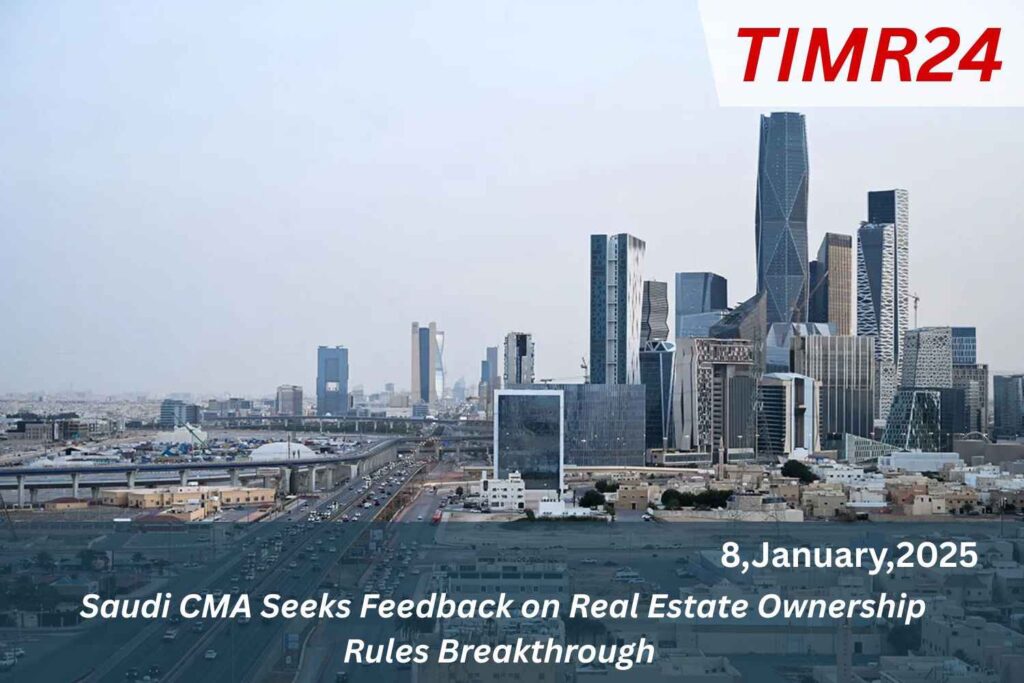
Capital Market Authority (CMA) initiated a public consultation on proposed rules for real estate ownership by listed companies, investment funds, and special purpose entities, particularly in Makkah and Madinah. Stakeholders have 15 days to provide feedback, closing on January 14, 2026. The draft regulations aim to enhance market efficiency, improve investor appeal, and strengthen competitiveness. It delineates the categories of entities and sets conditions for non-Saudi ownership, while maintaining existing regulatory obligations. The CMA’s approach seeks clarity and aligns with the new Non-Saudi Real Estate Ownership Law effective in 2026.
Property Markets By Seeking Public
Potentially stimulating investment and increasing international participation in Saudi Arabia’s capital markets Saudi Arabia’s Capital Market Authority (CMA) has taken another significant step in strengthening the Kingdom’s financial and property markets by seeking public feedback on proposed amendments to real estate ownership rules. This initiative reflects the regulator’s broader objective of aligning Saudi Arabia’s capital market framework with global best practices while supporting the goals of Vision 2030. By opening the draft rules for consultation, the CMA aims to ensure that regulatory changes are practical, transparent, and supportive of both domestic and foreign investment in the real estate sector.
The consultation process signals a growing emphasis on participatory regulation in Saudi Arabia, where stakeholders such as investors, developers, asset managers, and legal experts are encouraged to share insights before final rules are enforced. This approach not only improves regulatory quality but also builds confidence among market participants who seek predictability and fairness in ownership structures. The proposed framework focuses on clarifying ownership eligibility, improving disclosure standards, and strengthening governance mechanisms linked to real estate assets listed or regulated under capital market laws.
Economic Diversification Mega project
A key driver behind the CMA’s move is the rapid expansion of Saudi Arabia’s real estate sector, which has become a cornerstone of economic diversification. Mega projects, urban redevelopment, and increased institutional participation have transformed real estate into a sophisticated investment class. As a result, regulators are under pressure to ensure that ownership rules remain robust enough to protect investors while remaining flexible enough to attract long-term capital. The CMA’s draft amendments aim to strike this balance by refining existing provisions rather than imposing abrupt structural changes Another important aspect of the proposed rules relates to foreign ownership and institutional access.
Saudi Arabia has gradually liberalized foreign investment policies, and real estate has emerged as a key area of interest for international funds. By reviewing ownership regulations, the CMA seeks to eliminate ambiguities that may discourage cross-border participation. Clearer rules on eligibility, ownership limits, and compliance obligations can reduce legal uncertainty and enhance the Kingdom’s attractiveness as a regional investment hub. This aligns closely with broader reforms discussed in related regulatory updates published on our platform.
Oversight Mechanisms Are Expected
The CMA is focused on ensuring that real estate ownership structures do not create systemic risks or expose investors to hidden liabilities. Enhanced disclosure requirements, clearer segregation of assets, and stronger oversight mechanisms are expected to improve market discipline. These measures are particularly relevant for real estate investment vehicles that pool capital from multiple investors, as they help ensure that ownership rights are well-defined and enforceable From a policy perspective, the CMA’s initiative reflects Saudi Arabia’s transition toward a more mature regulatory environment. Instead of reactive regulation, authorities are increasingly adopting.
Forward-looking frameworks that anticipate market evolution. Seeking feedback allows regulators to identify potential implementation challenges early and adjust rules accordingly. This reduces compliance costs over the long term and supports sustainable market growth. It also reinforces the Kingdom’s reputation as a jurisdiction that values regulatory dialogue rather than unilateral decision-making Market participants are expected to closely examine how the proposed rules may affect existing ownership arrangements. Developers, fund managers, and investors will likely assess whether any transitional provisions are required to protect current holdings.
Regulator Minimize Disruption Once
The CMA’s consultation process provides a valuable opportunity to highlight practical concerns, such as documentation requirements, valuation standards, or reporting timelines. By addressing these issues at the draft stage, the regulator can minimize disruption once the (India) rules are finalized The broader economic implications of the proposed ownership rules are also noteworthy. Real estate plays a vital role in job creation, infrastructure development, and urban planning. Well-designed ownership regulations can facilitate efficient capital allocation, enabling projects to secure funding more easily while maintaining investor protection.
This supports national development goals and complements initiatives aimed at expanding housing supply and commercial infrastructure across the Kingdom. Related discussions on real estate-driven growth can be found in Saudi Arabia’s approach mirrors trends seen in other leading markets, where regulators increasingly rely on public consultation to refine complex rules. By benchmarking against global standards, the CMA ensures that its regulatory framework remains competitive and credible. This is particularly important as Saudi Arabia seeks greater inclusion in global indices and aims to attract institutional capital that prioritizes regulatory stability.
Volatility Enhance Investor Confidence
The consultation on real estate ownership rules also underscores the CMA’s commitment to risk management. Real estate markets can be vulnerable to speculative cycles, and ownership structures that lack transparency may amplify financial risks. By tightening regulatory oversight while maintaining market openness, the CMA aims to reduce volatility and enhance investor confidence. This proactive stance supports long-term market resilience and aligns with international regulatory principles promoted by global financial institutions such as the International Organization of Securities Commissions As the feedback window progresses, stakeholders are expected.
Engage Viewpoints Highlights
Contribute diverse perspectives that reflect the complexity of the real estate ecosystem. Legal experts may focus on compliance clarity, investors on return predictability, and developers on operational feasibility. The CMA’s willingness to engage with these viewpoints highlights a regulatory philosophy centered on collaboration rather than control. Once finalized, the updated ownership rules are likely to serve as a reference point for future reforms across other asset classes the Saudi CMA’s decision to seek feedback on real estate ownership rules marks an important milestone in the Kingdom’s regulatory evolution. By prioritizing transparency, inclusivity, and market.
Integrity, the regulator is laying the groundwork for a more resilient and investor-friendly real estate sector. The outcome of this consultation will not only shape (India) ownership frameworks but also influence how global investors perceive Saudi Arabia’s commitment to regulatory excellence under Vision 2030.
Q1. Why is the Saudi CMA seeking feedback on real estate ownership rules?
The CMA aims to improve transparency, investor protection, and regulatory clarity by consulting stakeholders before finalizing the rules.
Q2. Who can participate in the feedback process?
Investors, developers, legal professionals, and other market participants can submit their views during the consultation period.
Q3. Do the proposed rules affect foreign investors?
Yes, the draft rules seek to clarify ownership eligibility and compliance requirements, which may impact foreign participation.
Q4. How do these rules support Vision 2030?
They promote sustainable investment, strengthen governance, and enhance Saudi Arabia’s attractiveness as a global investment destination.
Q5. When will the final rules be implemented?
The CMA is expected to finalize and announce the rules after reviewing public feedback.