



















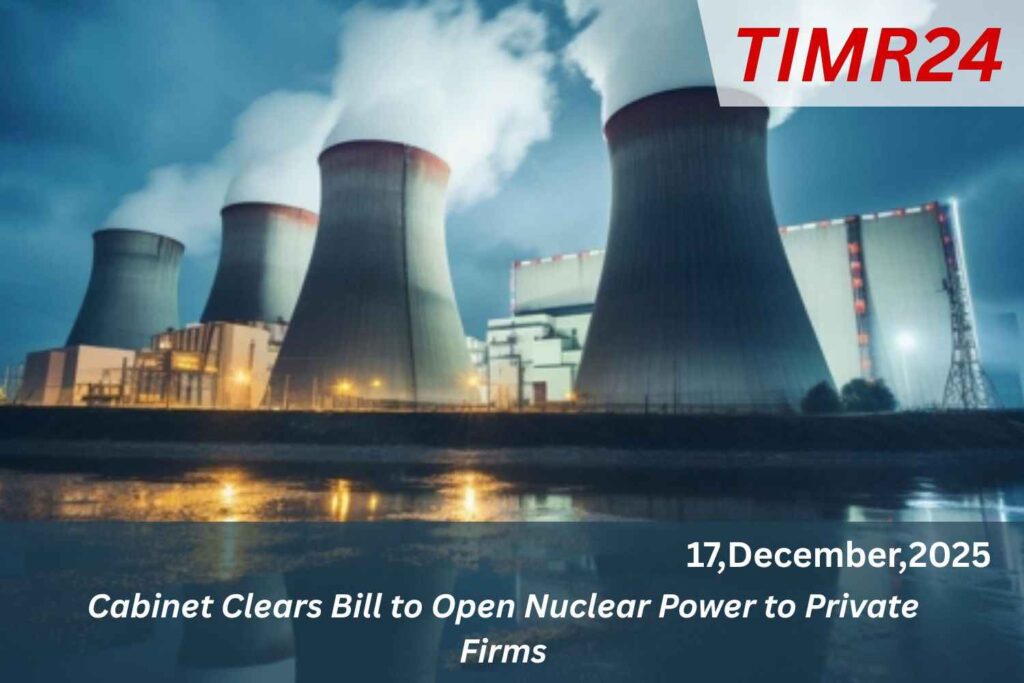
The Union Cabinet has approved the SHANTI Bill, aimed at allowing private investment in India’s civil nuclear power sector, targeting a capacity of 100 GW by 2047. This initiative, announced by Prime Minister Narendra Modi, follows Finance Minister Nirmala Sitharaman’s previous budget proposal to encourage private participation. The bill seeks to establish a regulatory framework for nuclear power generation and includes a Nuclear Energy Mission with a budget of Rs 200 billion to develop small modular reactors (SMRs), which are expected to enhance nuclear capacity economically and support India’s transition to clean energy.
Clean Energy Generation
India has taken a historic step in reshaping its energy landscape as the Union Cabinet cleared a bill that opens the nuclear power sector to private participation. The decision marks a significant policy shift in a domain that has remained largely under government control (Coal) since independence. With this move, the government aims to accelerate clean energy generation, attract long-term capital, and reduce the country’s dependence on fossil fuels while maintaining strategic oversight of a sensitive sector. The reform aligns with India’s broader commitment to achieving net-zero emissions by 2070 and strengthening energy security amid rising electricity demand.
For decades, nuclear power in India has been dominated by state-owned entities, particularly the Nuclear Power Corporation of India Limited (NPCIL), operating under strict legislative frameworks such as the Atomic Energy Act, 1962. While this ensured national security and regulatory control, it also limited the pace of expansion. As electricity consumption surges due to industrial growth, urbanisation, and digital infrastructure, policymakers have recognised the need for fresh capital, advanced technology, and faster project execution. Opening the sector to private firms is expected to bridge these gaps without diluting sovereign control over nuclear materials and safety protocols.
Nuclear Fuel Ownership, And Waste Management
The Cabinet-cleared bill proposes a carefully regulated model where private companies can participate in nuclear power generation, equipment manufacturing, and project development under government supervision. Strategic assets, nuclear fuel ownership, and waste management will remain under state authority. This hybrid structure is designed to balance investment freedom with national interest, ensuring that India’s nuclear programme remains secure while benefiting from private-sector efficiency. Similar models have been successfully adopted in countries like France, the United States, and the United Kingdom, offering India a tested roadmap for reform.
One of the most significant implications of this decision is its impact on India’s clean energy transition. Nuclear power is a low-carbon, base-load energy source capable of delivering uninterrupted electricity, unlike solar and wind which are dependent on weather conditions. As India expands renewable capacity, nuclear energy can provide stability to the grid, supporting the integration of intermittent green sources. This reform complements existing renewable initiatives discussed in our internal coverage on India’s clean energy roadmap Private participation is also expected to boost domestic manufacturing and technology transfer.
Atmanirbhar Bharat” Initiatives
Indian engineering firms, infrastructure developers, and heavy equipment manufacturers could gain access to global nuclear supply chains, fostering innovation and skill development. This aligns with the government’s “Make in India” and “Atmanirbhar Bharat” initiatives, which aim to strengthen domestic industrial capabilities. Increased localisation of components could reduce project costs and enhance India’s competitiveness in the global nuclear market From an economic perspective, the reform could unlock billions of dollars in long-term investment. Nuclear power projects require substantial upfront capital and extended gestation periods, making them suitable.
For institutional investors, sovereign funds, and infrastructure-focused private players. By sharing financial risk with private partners, the government can scale up capacity faster while optimising public expenditure. Analysts believe this move could significantly contribute to employment generation across construction, engineering, operations, and ancillary industries Safety and regulatory oversight remain central to the proposed framework. The government has reiterated that nuclear safety standards will not be compromised under any circumstances. Independent regulatory bodies will continue to oversee licensing, operations, and compliance, following international best practices.
International Atomic Energy Agency
India’s engagement with global institutions such as the International Atomic Energy Agency reinforces its commitment to safe and responsible nuclear development The bill also addresses long-standing concerns related to liability and insurance, which previously deterred private and foreign participation. By clarifying responsibility structures and offering risk-mitigation mechanisms, the government aims to create a predictable and investor-friendly environment. This clarity is essential for attracting experienced global players who can bring advanced reactor designs, safety systems, and operational expertise to Indian projects.
Strategically, the move strengthens India’s energy independence. Reducing reliance on imported coal, oil, and gas shields the economy from volatile global energy markets. Nuclear power, with its high energy density and long fuel cycles, offers a stable alternative that supports industrial growth and national resilience. The reform also enhances India’s standing as a responsible nuclear nation, capable of managing advanced technology while adhering to global non-proliferation norms Public perception and environmental considerations will play a crucial role in the reform’s success. Transparent communication, community engagement, and robust emergency.
Infrastructure Projects Underline
Preparedness will be essential to build public trust The government has indicated that environmental clearances and public consultations will remain mandatory, ensuring that development proceeds responsibly and inclusively. Lessons from past infrastructure projects underline the importance of stakeholder engagement, a theme explored in our internal analysis of large-scale energy projects the opening of nuclear power to private firms could redefine India’s power sector for decades to come. It signals a pragmatic approach to reform, blending state oversight with market efficiency. If implemented effectively, the policy could accelerate capacity addition, reduce carbon.
Emissions, and position India as a global leader in clean and reliable energy. The Cabinet’s decision is not merely a legislative change but a strategic recalibration of how India powers its future As the bill moves through the legislative process, attention will focus on implementation (India) timelines, investor response, and regulatory readiness. The success of this reform will depend on seamless coordination between government agencies, private players, and regulators. If executed with precision, the opening of nuclear power to private participation could become one of the most transformative energy reforms in India’s modern history.