












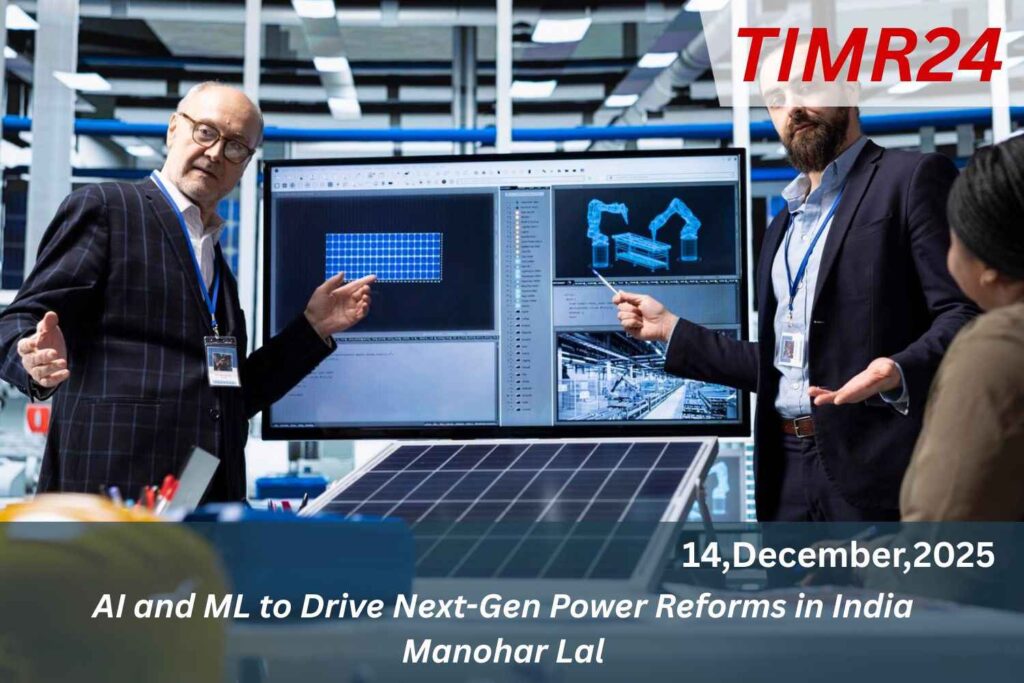
Artificial Intelligence (AI) and Machine Learning (ML) are set to revolutionize electricity distribution networks in India, as emphasized by Manohar Lal, Minister of Power, at a National Conference on AI/ML adoption. He highlighted capabilities such as smart meter analytics, predictive maintenance, and automated outage forecasting, which can enhance reliability and customer engagement. Pankaj Agarwal, Secretary of the Ministry of Power, reinforced the government’s commitment to digital adoption among Distribution Companies (DISCOMs), advocating for data-sharing and interoperability. The conference showcased 195 solutions, with winners across.
Artificial Intelligence And Machine Learning
Various categories, and introduced tools like STELLAR for load planning. Additionally, the India Smart Grid Forum released a handbook detailing AI, ML, and robotics applications for electric utilities India’s power sector is entering a decisive phase of transformation as Artificial Intelligence and Machine Learning emerge as the backbone of next-generation reforms. Union Power Minister Manohar Lal has emphasized that AI and ML will no longer remain experimental tools but will become core drivers of efficiency, transparency, and sustainability across the electricity value chain. From generation and transmission to distribution and consumer services.
Intelligent systems are expected to reshape how power is produced, managed, and delivered across the country. These reforms align closely with India’s broader vision of modernizing critical infrastructure under digital governance initiatives, as discussed in detail on our coverage of India’s power sector reforms At the heart of this transformation lies the challenge of operational inefficiencies that have long affected the power sector, especially distribution companies. High aggregate technical and commercial losses, billing gaps, and delayed fault response have weakened financial stability. AI-driven analytics can process vast amounts of real-time data from substations.
Ongoing Smart Grid Initiatives Across
Transformers, and feeders to predict failures before they occur. Machine learning models continuously improve accuracy by learning from historical patterns, enabling utilities to move from reactive maintenance to predictive maintenance. This shift not only saves costs but also ensures uninterrupted power supply, a key objective highlighted in ongoing smart grid initiatives across India Smart grids represent one of the most visible applications of AI and ML in power reforms. These grids integrate sensors, automated controls, and data platforms to monitor electricity flow in real time. With AI-enabled decision-making, grid operators can instantly detect voltage.
Fluctuations, overloads, or line faults and respond without human intervention. Manohar Lal has pointed out that such intelligence-driven systems are essential for managing India’s rapidly growing energy demand while maintaining grid stability. The Ministry of Power is actively (Railways) promoting digitization and automation, supported by institutions such as the Central Electricity Authority and policy frameworks discussed on the official Ministry Another critical area where AI and ML are set to deliver major impact is renewable energy integration. India’s ambitious targets for solar and wind capacity require advanced forecasting and balancing mechanisms.
AI-Based Forecasting Also Minimizes
Machine learning algorithms can analyze weather patterns, historical generation data, and grid conditions to accurately predict renewable output. This helps grid operators schedule power more efficiently and reduce dependence on fossil fuel-based backup. AI-based forecasting also minimizes curtailment losses and enhances the economic viability of clean energy projects, reinforcing India’s renewable energy roadmap explained further in our analysis on renewable energy in India Distribution reforms are also expected to gain momentum as AI-enabled billing and consumer analytics become mainstream. Smart meters powered by machine learning can identify.
Abnormal consumption patterns, detect power theft, and ensure accurate billing. For consumers, this translates into transparency, fair charges, and timely resolution of grievances. Automated customer service platforms driven by AI can handle complaints, outage notifications, and service requests efficiently, reducing dependency on manual processes. Such digital-first service delivery aligns with India’s broader push towards e-governance and technology-led public services Financial sustainability of DISCOMs remains a central concern in power sector reforms. AI and ML can play a decisive role in improving financial planning and risk management.
Electrification Corporation Are Increasingly
By analyzing revenue streams, payment cycles, and subsidy flows, intelligent systems can help utilities optimize cash flow and reduce dependence on emergency funding. Institutions like Power Finance Corporation and Rural Electrification Corporation are increasingly encouraging technology adoption in funded projects, reinforcing the role of AI in long-term sector stability. More insights into sector financing are available Cybersecurity and grid resilience form another dimension of AI-driven power reforms. As power systems become more digital, they also become more vulnerable to cyber threats. AI-based security tools can continuously monitor network behavior.
Detect anomalies, and respond to threats in real time. Machine learning models trained on attack patterns can identify potential breaches before they escalate into large-scale disruptions. This proactive approach strengthens national energy security and ensures uninterrupted power supply to critical infrastructure such as hospitals, transport systems, and data centers Policy planning and regulatory oversight are also benefiting from AI-led insights. Data-driven simulations allow policymakers to assess the impact of tariff changes, infrastructure investments, and demand growth scenarios. According to Manohar Lal, such analytical capabilities will enable evidence-based decision-making.
Rather than reliance on static reports. Institutions like NITI Aayog are already exploring AI-powered models to support long-term energy planning the integration of AI and ML into India’s power sector marks a shift from conventional reforms to intelligent transformation. (India) These technologies are not merely enhancing efficiency but redefining how electricity systems operate, adapt, and grow. As highlighted by Manohar Lal, next-generation power reforms will be driven by data, automation, and innovation, ensuring reliable, affordable, and sustainable electricity for every citizen. With strong policy support, institutional backing, and rapid technological adoption.
Q1. How will AI and ML improve India’s power sector?
AI and ML will help utilities predict demand, reduce losses, improve billing efficiency, and ensure reliable power supply.
Q2. What role will smart grids play in power reforms?
Smart grids powered by AI enable real-time monitoring, automated fault detection, and better integration of renewable energy.
Q3. Why is loss reduction important in the power sector?
Reducing technical and commercial losses improves financial health of DISCOMs and lowers electricity costs for consumers.
Q4. How will consumers benefit from AI-based power reforms?
Consumers will get accurate billing, fewer outages, faster complaint resolution, and better quality of power supply.
Q5. Is the Indian government actively promoting AI in energy?
Yes, the government is integrating AI into policy planning, grid management, and renewable energy forecasting.