




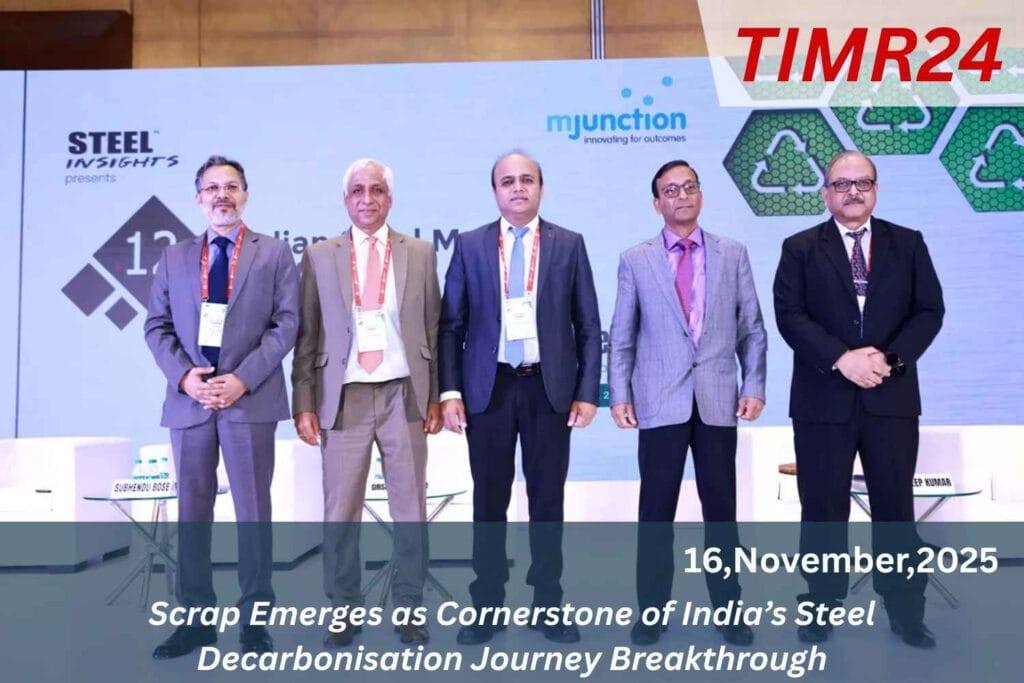
Steel scrap is emerging as a vital component in India’s pursuit of green steel, emphasized during the 12th Indian Steel Markets Conference. With the ability to be recycled endlessly, steel is seen as foundational for both industrial growth and sustainability. Currently, India consumes approximately 42 million tonnes of steel scrap annually, with a demand growth exceeding 6% yearly. The conference, themed ‘Indian Steel Value Chain Recycle. Reshape. Innovate. Sustain,’ highlighted sustainability as a crucial strategic consideration. Speakers pointed out that sourcing adequate scrap is challenging amid rising steel demand, particularly due to government-funded consumption accounting for a significant portion of this demand. The conference also explored.
The fluctuating global and domestic environment, policy changes, and sustainability as pivotal to India’s steel industry’s growth. Mjunction services limited, with over 20 years in scrap trade, has initiated an AI-driven digital procurement platform to improve scrap access for organized buyers, facilitating logistics and compliance, and reinforcing a supplier network to meet the widening demand-supply gap In recent years, scrap steel has quietly but decisively emerged as a cornerstone of India’s steel decarbonisation journey. Once considered a secondary or low‑priority raw material, scrap is now being recognized by industry leaders and policymakers alike as a strategic lever in reducing carbon emissions and enhancing circularity in steel production At the heart of India’s strategy is the realization that recycled ferrous.
Steel Produced Currently, India’s Scrap
Offers enormous environmental benefits. According to government data, using one ton of saves approximately 1.1 tons of iron ore, 630 kilograms of coking coal, and 55 kilograms of limestone. This shift also reduces water consumption and curbs greenhouse gas emissions by as much as 40–58% compared to steel produced Currently, India’s consumption is around 42 million tonnes annually, a figure that is growing at over 6% year-on-year there remains a significant shortfall in domestic availability. India produces about 25–30 million tonnes of scrap, but still imports roughly 9 million tonnes each year to meet industrial demand This reliance on imports underscores the urgency of strengthening India’s internal scrap ecosystem from collection.
To processing Recognizing potential, the Government of India has taken strategic policy steps. The Steel Recycling Policy, introduced in 2019, envisages a robust network of scrapping and dismantling centers, processing hubs, and scientific recycling facilities Complementing this is the Vehicle Scrappage Policy, introduced in 2021, which aims to systematically phase out older vehicles and channel their ferrous content back into the recycling loop These policy measures align with India’s broader circular economy ambitions. By transitioning from a traditional linear “take-make-dispose” model to one rooted in reuse and recycling, the steel sector can play a pivotal role in sustainable development Yet, the pathway to a scrap-led future is not without challenges.
For one quality remains a bottleneck. Recycled can contain impurities, which affect its suitability for high-grade steelmaking. Logistics is another hurdle: collecting, transporting, and processing scrap at scale requires efficient infrastructure. Moreover, even as domestic supply grows, experts warn of a persistent import unless this is addressed, India may struggle to realize its full decarbonisation potential these barriers, industry players are stepping up. Mjunction Services, for instance, has built an AI-driven digital platform connecting structured scrap suppliers with integrated steel plants. With its network of over 250 GST-compliant suppliers across 120 locations, Mjunction has delivered more than 1.2 million tonnes of scrap over the past three years.
Managing logistics via road and rail work is helping to bridge the gap between supply and demand and building resilience in India’s circular steel value chain On the technology front, the shift toward Electric Arc Furnace (EAF) based steelmaking is gaining momentum. EAFs, which melt rather than relying exclusively on iron ore, are far more energy-efficient and less carbon-intensive than traditional blast furnace/basic oxygen furnace (BF/BOF) routes transition is key to India’s low-emissions roadmap; over time, scaling EAF capacity can significantly reduce the carbon intensity of its steel sector Global analyses also support the importance of in India’s decarbonisation. According to a report by OECD, even under aggressive deployment of technologies like carbon.
Ship Recycling Decommissioned Vessels
Capture and green hydrogen, scrap’s share remains central to reducing emissions in the long run fact, in some decarbonisation scenarios through 2050, India’s projected growth in scrap-based EAF is pivotal for hitting climate goals Another often-overlooked source of high-quality is ship recycling. Decommissioned vessels are rich in steel up to 75–85% of a ship’s weight is ferrous metal and recycling them conserves ore and coal while cutting carbon emissions Drawing on this feedstock could supplement India’s domestic supply, offering both environmental and economic value.
For policymakers, these developments have triggered coordinated action. The Indian Ministry of Steel, for example, has created 13 task forces spanning industry, academia, think tanks, and government agencies. These groups evaluate pathways for steel decarbonisation, including expanding usage, strengthening skill development, and deploying cleaner technology Nevertheless, India’s journey toward green steel must contend with scale. (India) While scrap-based production is growing, blast furnace-based production still dominates. According to JMK Research and Analytics, achieving deep decarbonisation will require a blend of strategies: green hydrogen reduction, carbon capture, and increased scrap usage through EAFs At the same time.
Financial and infrastructural support are critical. Building the recycling infrastructure collection centers, shredders, dismantling hubs was one of the key goals of the Steel Recycling Policy accelerate this, public-private partnerships, digital marketplaces, and logistic innovation will be instrumental an industry perspective is no longer waste it’s a strategic resource. As Vinaya Varma, MD of Mjunction, put it: “Steel is one of the few materials that can be recycled infinitely without losing its strength or quality This infinite recyclability not only positions as a climate solution but also as a long-term economic asset.
Steel has transcended its traditional role to become a linchpin of India’s sustainable steel ambitions. Through targeted policies, growing market infrastructure, and a clear shift toward EAF-based (India) production, India is charting a decarbonisation pathway that leverages circularity at its core. If these efforts scale as planned, scrap could well define the future of Indian steel weak in waste, strong in sustainability.
Q1. Why is steel important for decarbonising India’s steel sector?
Scrap reduces dependence on mined iron ore and coal, cutting both energy use and CO₂ emissions.
Q2. How much does India currently consume and produce?
India consumes about 42 million tonnes of scrap annually, but domestic supply falls short imports help fill the gap.
Q3. What policies support recycling in India?
Key measures include the Steel Recycling Policy (2019) and the Vehicle Scrappage Policy (2021) to boost domestic scrap generation and processing.
Q4. What are the main challenges to scaling -based steelmaking?
Challenges include quality of scrap, insufficient domestic supply, logistics, and higher reliance on scrap imports.
Q5. How does scrap-based steelmaking reduce emissions?
Using in electric arc furnaces (EAFs) emits far less CO₂ than conventional blast furnace/basic oxygen furnace (BF/BOF) methods.