

















IST - Wednesday, February 25, 2026 10:35 pm
Hot News

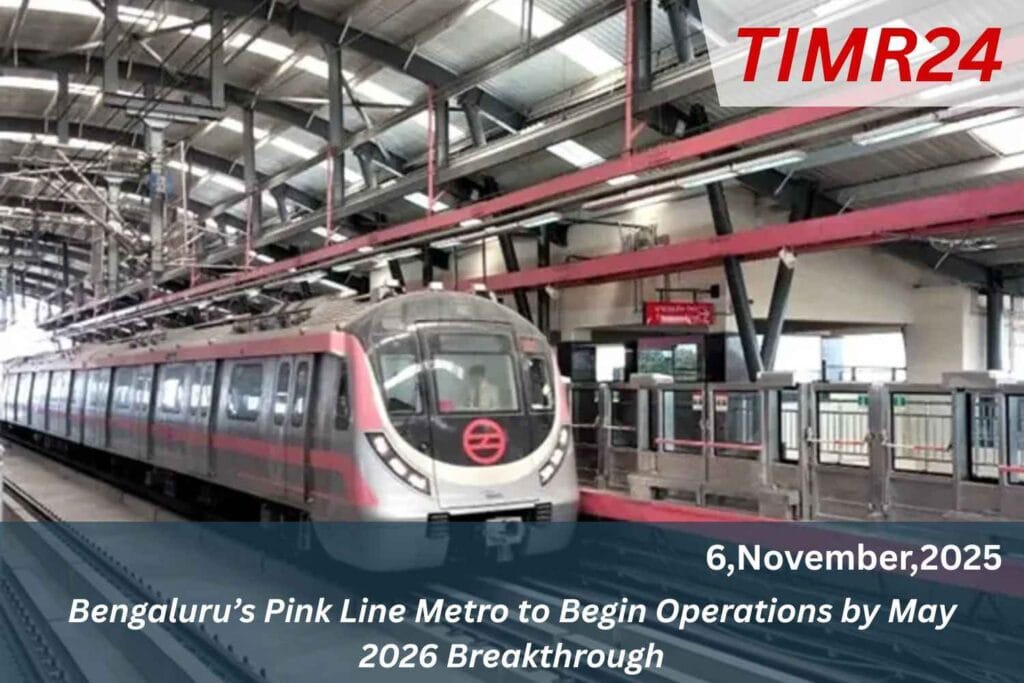
Bengaluru’s Pink Line Metro to Begin Operations by May 2026 Breakthrough

Soniya Gupta

Updated on:

Metro

Deputy Chief Minister D K Sivakumar has confirmed that Bengaluru’s Namma Metro Pink Line will be operational by May 2026. This 21.25-km corridor will connect Kalena Agrahara to Nagawara, featuring 18 stations, with six elevated and 12 underground. The line includes a significant 13.76-km underground section, which is anticipated to alleviate traffic congestion and enhance connectivity throughout major urban and commercial areas in Bengaluru In a city long beleaguered by traffic snarls and stretched infrastructure, the announcement of the upcoming Namma Metro Pink Line in Bengaluru brings fresh hope. Connecting the southern terminus at Kalena Agrahara to the northern point at Nagawara.

The 21.25-kilometre corridor promises to reshape north-south connectivity across the city The Pink Line will span 21.25 km with a total of 18 stations six elevated and 12 underground The elevated section runs along the busy Bannerghatta Road corridor between Kalena Agrahara and Tavarekere, while the longer underground section dips beneath the city through key nodes like Dairy Circle and MG Road before emerging near Nagawara Stations along the stretch include those at Tavarekere, JP Nagar 4th Phase, Indian Institute of Management Bangalore (IIMB), Halima, among others The elevated portion is described as “nearly complete”, while major work remains in the underground portion.

Opening Timeline Reality vs Announcements

One of the most striking aspects of the project is the timeline being discussed. On one hand, the Deputy Chief Minister D K Sivakumar announced that the Pink Line would be operational by May 2026, captioning it as a major leap for connectivity On the other hand, the project operator Bangalore Metro Rail Corporation Limited (BMRCL) clarified that the line will open in two phases the 7.5 km elevated stretch by May 2026 and the remaining 13.76 km underground section by December 2026 Thus, while the broader objective of a “May 2026 opening” may hold for a part of the line, the full corridor remains slated for completion late 2026. This phasing is important to set the right expectations among city-commuters and stakeholders.

The rationale behind the phased opening becomes clear when we examine the construction dynamics. The elevated section, being relatively straightforward to build, has progressed much faster; BMRCL officials suggest that only minor works remain before launch contrast, the underground section passes through dense urban tissue, involves large-scale tunnelling, complex station interiors, installation of driverless trains, signalling, ventilation and full-height platform screen door Tunnelling for the underground section was reportedly completed in December 2024, but system integration and interior finishing are still underway The underground stretch’s slower pace underscores.

Impact on Bengaluru’s Urban Mobility

The engineering challenge of metro construction beneath a live urban environment. Once operational, the Pink Line will offer a dedicated rapid‐transit corridor linking major residential clusters in the south with employment hubs and northern suburbs. By traversing Bannerghatta Road and extending northward, the line is poised to ease pressure on arterial roads, reduce journey times and provide commuters with an alternative to road-based travel Interchanges along this route (at stations like Jayadevan Hospital and MG Road) further enhance its utility by connecting to other metro lines within the city network this way, the Pink Line doesn’t act in isolation it becomes a critical link in the expanding metro ecosystem of Bengaluru.

Despite the positive projections, several caveats deserve attention. First, metro projects in Bengaluru have historically experienced delays the larger Phase II of the network still has large portions incomplete despite being underway for almost a decade Secondly, the elevated (Indore Metro) portion may indeed begin service by May 2026 but full benefits in terms of connectivity will only come when the underground portion opens. Until then, commuters may have only partial access to the corridor. Thirdly, coordinating last-mile connectivity, feeder services, and integrating with existing urban transport remains critical. The best metro line alone cannot solve congestion unless access to and from stations is smooth.

What to Monitor Moving Forward

As we look ahead, a few key markers will tell us how smoothly this project is progressing. For one, the receipt of the driverless train prototype from manufacturer Bharat Earth Movers Limited (BEML) by November 2025, and subsequent static and dynamic tests, will be a milestone Also, the completion of system works such as signalling, ventilation, platform screen doors, escalators and station finishing will determine whether the December 2026 target is achievable. Monitoring land‐acquisition, contractor performance and budget escalations will also be instructive given past patterns Finally, once partial operations begin (in 2026), ridership uptake, commuter behaviour shifts and changes in traffic.

Patterns will provide early signals of the corridor’s success Beyond just being another metro line, the Pink Line represents how Bengaluru is seeking to transform its transit infrastructure amid rapid growth. With rising vehicular numbers, limited road bandwidth and expanding IT-hub zones, connectivity bottlenecks have become a drag on both commuter experience and urban productivity. The line offers a way to unlock movement between the south and north axes of the city in a new way At a time when sustainable mobility is gaining importance, metro lines such as this help reduce reliance on cars, cut emissions and promote more compact urban travel.

Moreover, improved connectivity often triggers real-estate development, social inclusion (via better access) and potential economic uplift for suburbs that were formerly poorly linked Putting it together, the Namma Metro Pink Line is a landmark project for Bengaluru ambitious in scope, technically challenging and highly consequential for the city’s travel ecosystem. While the goal of operations by May 2026 has grabbed headlines, the more realistic and nuanced view is that the line will open in two phases: the elevated section by mid-2026 and the underground portion by late 2026. If delivered as promised, it will significantly enhance north-south connectivity, offer.

Commuters a compelling alternative to road travel and become a vital spine for the city’s metro network. That said, the usual caveats of construction risk, last‐mile connectivity and integration remain important if the full promise of the corridor is to be realised (Railways) As Bengaluru watches the trenching, tunnelling and station finishing unfold, the Pink Line stands as much a symbol of future mobility as it is a piece of infrastructure under construction.

Q1. When will the Pink Line open for operations in Bengaluru?
The elevated 7.5 km stretch between Kalena Agrahara and Tavarekere is expected by May 2026.

Q2. What is the full length of the Pink Line and how many stations will it have?
The full corridor runs from Kalena Agrahara to Nagawara, covering approximately 21.25 km with 18 stations (6 elevated + 12 underground).

Q3. Will the entire line be ready by May 2026?
No only the elevated section is slated for May 2026; the underground portion (approx. 13.76 km) is expected by December 2026.

Q4. What major areas will the Pink Line connect?
It will run along Bannerghatta Road in the south (Kalena Agrahara side) up to Nagawara in the north, strengthening the north-south corridor of Bengaluru.

Q5. What are the key features or technological aspects of this line?
The line includes both elevated and underground segments, major interchange stations (e.g., MG Road, Jayadevan Hospital), full-height platform screen doors for the underground part, and a new driverless train fleet being inducted.