








IST - Tuesday, April 7, 2026 7:48 am
Hot News

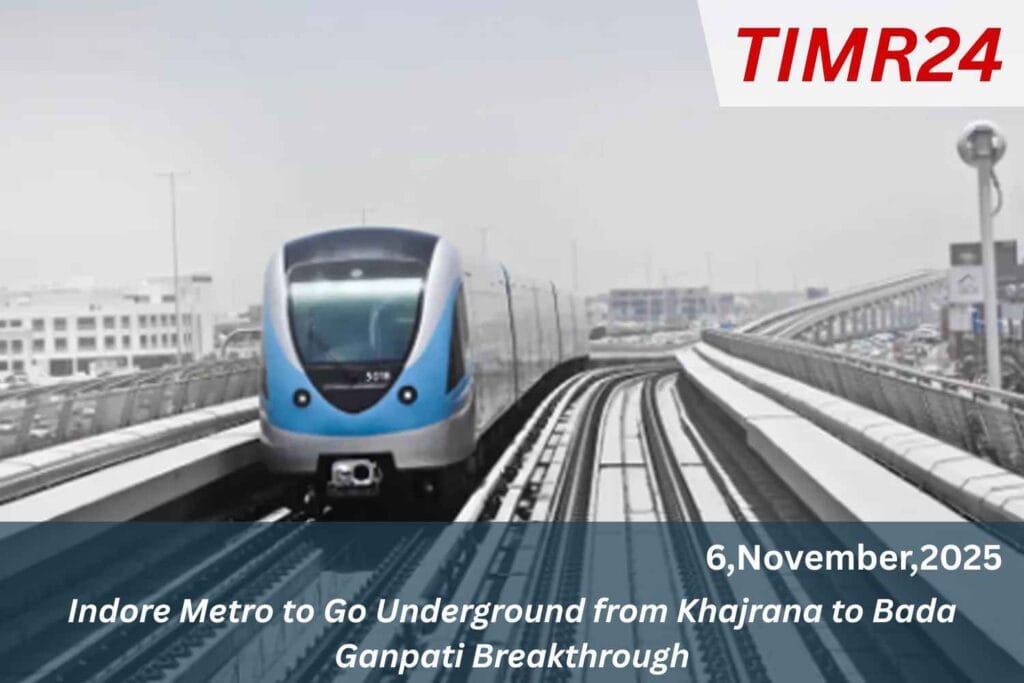
Indore Metro to Go Underground from Khajrana to Bada Ganpati Breakthrough

Soniya Gupta

Updated on:

Indore

The Indore Metro will now operate underground from Khajrana Square to Bada Ganpati, a decision made in a meeting led by Urban Development and Housing Minister Kailash Vijayvargiya. This milestone enhances urban mobility and traffic management in Indore, with unanimous approval for the proposal. A new Maharani Metro station will be built, ensuring no impact on houses or shops. The construction will utilize modern boring technology to avoid surface disruption. Further details will follow feasibility and soil tests after redesigning the track section. Additionally, officials were directed to disconnect illegal water connections related to ongoing.

AMRUT projects and to use cutting machines for road restoration to maintain technical precision. Mayor Pushy Mitra Bhargav called for expedited construction under the Pradhan Mantri Awas Yojana and suggested appointing a traffic engineer for future mobility designs The Indore Metro project marks a major turning point in the urban development of Madhya Pradesh’s commercial capital. (Source) Designed to modernize public transport and reduce traffic congestion, the metro network will now include an underground stretch from Khajrana to Bada Ganpati, a decision that showcases the government’s vision to balance infrastructure growth with environmental and social sensitivity.

As the city continues to expand, this development is expected to transform Indore’s connectivity, enhance urban aesthetics, and bring the region closer to its goal of becoming a truly “Smart City. Indore’s rapid growth over the last decade has created both opportunities and challenges. With increasing population density and vehicle ownership, the city’s roads have faced mounting congestion and air quality issues. The Indore Metro Rail Project, initiated under the Madhya Pradesh Metro Rail Corporation Limited (MPMRCL), aims to address these challenges through an integrated, efficient, and sustainable mass transport system. The decision to make the section between Khajrana Temple and Bada.

Strategic Importance of the Khajrana Bada Ganpati Corridor

Ganpati underground is a reflection of the city’s evolving urban planning priorities ensuring minimal disruption to existing structures, preserving heritage zones, and optimizing passenger convenience information about India’s sustainable metro projects that serve as a model for upcoming networks across the country. The chosen corridor is among the most critical and densely populated stretches of Indore. The area encompasses several residential, commercial, and religious hubs, making it vital for daily commuters and visitors. Khajrana, home to the famous Ganesh Temple, attracts thousands of devotees daily.

While Bada Ganpati, known for its enormous idol, serves as a cultural landmark By opting for an underground route between these two nodes, authorities aim to maintain smooth urban flow without disturbing the region’s surface-level traffic or religious sites. Moreover, this segment will act as a connector between key metro stations, linking core parts of the city to peripheral industrial and residential zones. The underground section will also help ease pressure on Indore’s arterial roads such as A.B. Road and M.G. Road, which are often congested during peak hours The shift to an underground design introduces advanced tunneling and construction technologies to Indore’s infrastructure landscape.

Modern Tunnel Boring Machines (TBMs), similar to those used in metro projects in Delhi, Mumbai, and Bangalore, will be deployed to ensure minimal environmental impact and faster execution According to officials from MPMRCL, the geological surveys and feasibility studies confirmed that underground construction is the most suitable approach, given the area’s dense population and heritage importance. Special attention will be given to soil stability, groundwater levels, and structural safety, ensuring that nearby buildings and temples remain unaffected during tunneling operations Furthermore, the underground stations are planned to include smart.

Impact on Traffic, Environment, and Local Economy

Energy-efficient designs, such as LED lighting, water recycling systems, and advanced ventilation mechanisms. This aligns with India’s broader commitment to green infrastructure, much like initiatives seen in the Nagpur and Pune Metro projects, which emphasize energy efficiency and passenger comfort. The introduction of the underground metro route promises to significantly reduce vehicular traffic on Indore’s busiest routes. By providing an affordable, reliable, and rapid alternative, the metro is expected to draw commuters away from personal vehicles and auto-rickshaws, directly impacting pollution levels and urban noise.

In addition, the project will generate thousands of employment opportunities both during construction and in operations. Local businesses, especially those around Khajrana Temple and Rajwada, are likely to experience increased footfall as metro connectivity simplifies access for visitors and tourists Environmentally, the underground design minimizes the need for road widening or tree cutting, helping preserve Indore’s green spaces and heritage structures. Once operational, the metro is expected to reduce CO₂ emissions by thousands of tons annually an important step toward a sustainable and climate-resilient Indore.

Timeline and Project Execution

The Indore Metro project has been progressing in phases, with the Priority Corridor between Vijay Nagar and AIIMS already under active development. The Khajrana Bada Ganpati underground section is part of the next expansion phase, set to begin after the completion of current elevated works The detailed project report (DPR) for the underground stretch was recently approved, paving (Smart-City) the way for tender invitations and contractor selection. As per early estimates, this section will include multiple underground stations equipped with escalators, lifts, and digital navigation systems Authorities are coordinating closely with international engineering consultants to ensure.

Global standards in design and safety. Drawing inspiration from successful implementations in Kolkata Metro’s East-West corridor and Bangalore Metro’s underground lines, Indore aims to achieve seamless construction with minimal surface disturbance For continuous updates, readers real-time progress, tender details, and route maps Indore is a city deeply rooted in history and spirituality, and the metro’s underground expansion demonstrates a thoughtful approach to preserving this essence. The Khajrana Temple and Bada Ganpati areas are not only religiously significant but also central to the city’s identity. Planners have ensure

Q1. What is the total length of the Indore Metro underground section?
The Khajrana–Bada Ganpati underground stretch covers approximately 7 km within the city center.

Q2. When will the Indore Metro become operational?
Phase I of the project is expected to be operational by 2027, subject to timely completion of tunneling work.

Q3. Who is implementing the Indore Metro project?
The project is being implemented by Madhya Pradesh Metro Rail Corporation Limited (MPMRCL).

Q4. What are the benefits of the underground corridor?
It reduces road congestion, ensures faster commutes, preserves city aesthetics, and minimizes environmental impact.

Q5. Will the metro connect tourist and religious spots?
Yes, the route directly connects Khajrana Ganesh Temple and Bada Ganpati Temple, two major spiritual landmarks.