










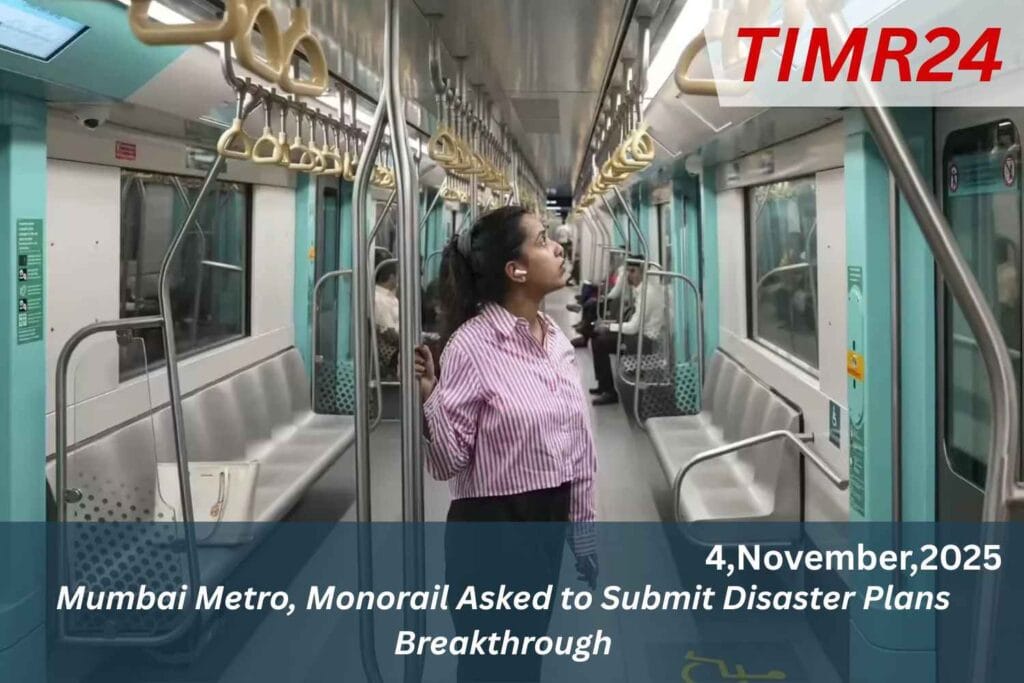
The Mumbai district disaster management authorities have instructed the Monorail and Metro networks to submit detailed emergency management plans and Standard Operating Procedures (SOPs) to enhance disaster preparedness. This directive, issued during a review (Solar) meeting led by Dr. Vipin Sharma, aims to address gaps in emergency response highlighted by a recent Monorail breakdown. Dr. Ashwini Joshi emphasized the importance of regular mock drills and improved coordination among agencies to ensure efficient management of emergencies and protect commuters. The meeting concluded with a call for standardized safety plans and better real-time communication systems among transport operators.
In the bustling metropolis of Mumbai, where millions of people rely every day on rapid-transit networks such as the city’s metro and monorail systems, the question of disaster preparedness has just taken centre-stage. The Mumbai City District Disaster Management Authority and the Mumbai Suburban District Disaster Management Authority, in collaboration with the BMC, have issued a directive requiring operator organisations of underground, elevated and conventional metro and monorail lines to submit their emergency management plans and Standard Operating Procedures (SOPs) The impetus for this move was laid bare by a technical snag that disrupted monorail.
Services near Bhakti Park in Chembur on 19 August. That incident left several passengers stranded on an elevated track, which underscored vulnerabilities in real-time communication, coordination among rescue agencies, evacuation procedures and passenger information system In a joint review meeting convened at the BMC headquarters, chaired by Dr Vipin Sharma and Dr Ashwini Joshi among others, officials emphasised that the city’s transport infrastructure cannot be treated in a piecemeal way when it comes to emergencies. “Comprehensive and independent consideration” must be given to each transport corridor elevated metro, underground metro.
Emergency-Response Mechanisms
Monorail so the overall urban network is resilient What does this mean in practical terms? Operators will now have to submit detailed documents outlining their emergency-response mechanisms. These include clearly defined evacuation routes in stations and onboard vehicles, protocols for communication with the local fire brigade and police, command-centre activation, passenger-information systems during disruptions, training of staff, and periodic mock drills to test these protocols in realistic scenarios Mock drills in particular are being mandated as a crucial element. While it’s one thing to have a written plan, it is another to test how well the multiple agencies metro/monorail operations.
Fire brigade, police, disaster-management cell, electricity providers, telecom support respond in synchrony. These drills will help expose gaps say, in how passengers are informed, how they are evacuated, whether backup power is ready, or how stranded trains are handled Another dimension is the integration of these emergency plans with the city’s overall disaster-management strategy. Mumbai is prone to heavy rainfall, flooding, storms, technical breakdowns and even fire risks in high-density infrastructure. Ensuring that the metro and monorail networks are not isolated in their emergency response, but are part of the larger civic system with the BMC, municipal fire brigade, electricity providers.
Telecom and police is central to this approach the commuter’s perspective, this development is welcome. The average train-rider expects reliability and safety. A metro or monorail breakdown not only causes inconvenience, but can pose serious risks if evacuation and stranded-train procedures are weak. The earlier incident revealed that a delay or lack of clarity in rescue or communication can quickly escalate into panic. With formalised plans and regular drills, the hope is that such emergencies will be managed far more smoothly However, the success of these directives will depend on effective implementation. Submission of a plan is only the first step. It must be accompanied by investment in training.
Public Awareness Plays a Role Passengers
Backup systems (power, signalling, communication), station infrastructure (e.g., evacuation staircases, emergency lighting, safe zones), and real-world drills that mimic challenging scenarios say fire, smoke, flooding, derailment, or power-failure. Also, public awareness plays a role: passengers should know what to do in an emergency, how to follow announcements or staff instructions, and where safety zones are In terms of broader transport-policy implications, this move signals a shift in mindset. If the city’s transport networks are to scale up more lines of the Mumbai Metro, further extensions of the Mumbai Monorail, integration with suburban rail, bus networks and more then safety and emergency.
Preparedness cannot be treated as after-thoughts. Rather, they must be baked into the system: from design of stations and tracks to signalling, to operations, to incident-response planning For those interested in reading more about the background and details of this directive, reliable (Recent) reporting comes from The Print, Hindustan Times and Free Press Journal By moving to formalise and standardise the emergency management framework for metro and monorail services in Mumbai, the civic authorities are taking a necessary step towards making the city’s rapid-transit infrastructure safer. While no system can guarantee zero risk, well-drilled coordination, clear SOPs, up-to-date equipment and informed passengers.
Q1. What exactly have the authorities asked the metro and monorail operators to do?
The Brihanmumbai Municipal Corporation (BMC) and district disaster-management bodies have directed all agencies running elevated or underground metro and monorail services in Mumbai to submit their emergency management plans and Standard Operating Procedures (SOPs).
Q2. Why has this directive been issued now?
The trigger was a breakdown of a monorail train near Bhakti Park in Chembur on 19 August, when passengers were stranded mid-route for hours. The review meeting was convened to assess coordination and readiness in light of such incidents.
Q3. Which systems are covered by this directive?
All agencies operating metro and monorail systems in the city’s transport network elevated and underground have been asked to prepare standalone, comprehensive plans aligned with the city’s disaster-management framework.
Q4. What should the emergency-plans include?
The plans are expected to include SOPs for incident response, evacuation routes, communication protocols, coordination with fire/police/disaster-control agencies, periodic safety audits, and scheduled mock drills to test readiness.
Q5. What about follow-up actions after the submission of plans?
After submission, the disaster-management authorities will review the plans; periodic mock drills will be mandatory, and coordination between metro/monorail agencies, the fire brigade, police and other civic services will be enhanced to respond swiftly in real emergencies.