









IST - Monday, April 13, 2026 6:58 pm
Hot News

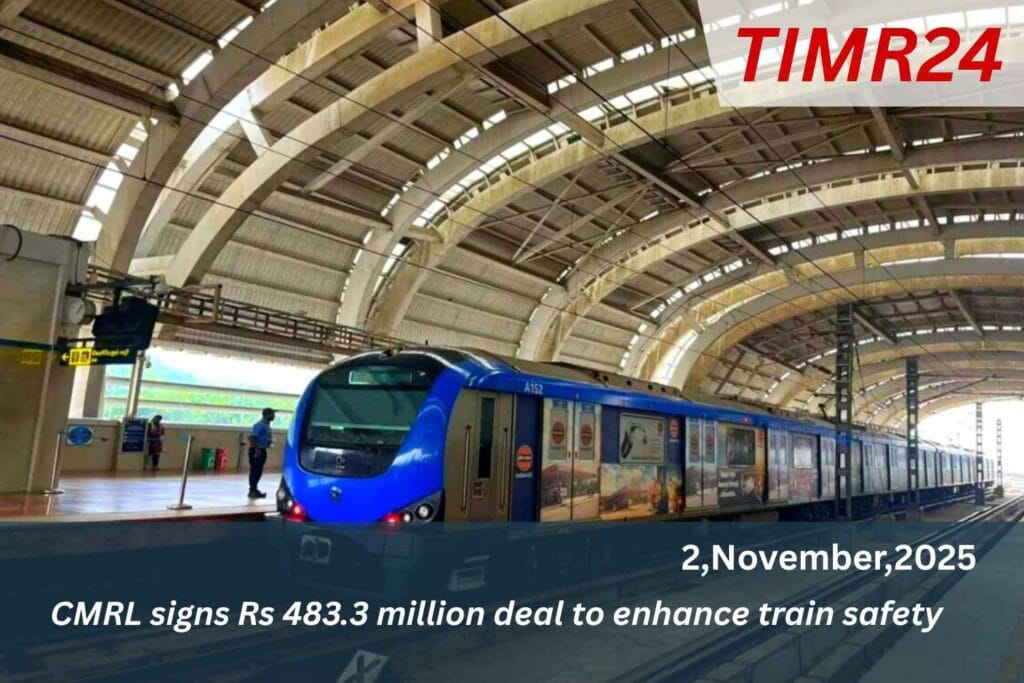
CMRL signs Rs 483.3 million deal to enhance train safety

Soniya Gupta

Updated on:

CMRL

Chennai Metro Rail Limited (CMRL) has secured a Rs 483.3 million contract with Faiveley Transport Rail Technologies India Pvt Ltd to enhance passenger safety across its Phase-1 trains by implementing an advanced anti-drag door safety feature. This system will better detect smaller items that could cause door entrapment during boarding, automatically applying the emergency brake if an item remains caught as the train begins to move. Although CMRL has not reported any door entrapment incidents to date, this upgrade is described as a proactive safety enhancement. The technology will also be used in trains under Phase-2 of the Chennai Metro project. Additionally.

CMRL has inaugurated new passenger amenities at Saidapet Metro Station and commenced Vigilance Awareness Week 2025 with an integrity pledge ceremony In a major leap towards ensuring a safer, smarter, and more reliable metro network, Chennai Metro Rail Limited (CMRL) has entered into a ₹483.3 million agreement aimed at upgrading its safety infrastructure and technology systems. This landmark deal focuses on implementing advanced train protection mechanisms, cutting-edge communication systems, and automated monitoring frameworks that align with international metro safety standards. As Chennai continues to grow into a major metropolitan hub.


Strengthening Metro Safety and Efficiency

The initiative reflects CMRL’s long-term vision of building a transport ecosystem that combines passenger comfort with world-class operational safety CMRL’s new ₹483.3 million safety enhancement project represents a forward-looking investment in the city’s metro network. The focus of this initiative is on upgrading signalling systems, integrating artificial intelligence-driven monitoring, and implementing automated communication networks that ensure seamless train operations. Chennai Metro, already recognized for its efficiency and punctuality, seeks to elevate safety protocols through innovative digital tools and advanced control systems.

This development places CMRL among the ranks of advanced global metro networks such as the Singapore MRT, Tokyo Metro, and London Underground, where automation and predictive safety technologies play a crucial role in ensuring commuter well-being. By adopting (NTPC) these state-of-the-art safety standards, CMRL aims to minimize human error, prevent system failures, and guarantee a smooth, stress-free travel experience for passengers. The ₹483.3 million agreement primarily involves the implementation of Communication-Based Train Control (CBTC) systems and Automatic Train Supervision (ATS) upgrades. These systems are designed to improve communication between trains.

Technological Advancements Under the Deal

Control centers, and track equipment, ensuring that each train operates within safe speed and distance limits. The new systems will allow for train-to-train real-time communication, enabling faster response times in case of potential hazards or technical malfunctions. Moreover, AI-powered software will be deployed to monitor door operations, track conditions, and energy consumption. By using Internet of Things (IoT) devices, the metro authority can collect valuable data from every operational segment, helping predict possible faults before they lead to critical breakdowns Such advancements have already been successfully.

Implemented in the Delhi Metro Rail Corporation (DMRC) and Bangalore Metro Rail Corporation (BMRCL), which have reported significant improvements in punctuality and passenger safety after similar how Delhi Metro leverages technology for safety in our related post on Chennai’s commuters, this project marks a new era of smart metro travel. With real-time monitoring, automated braking systems, and high-precision signalling, the chances of collisions or operational disruptions are drastically reduced. The system also includes continuous speed supervision and emergency.

Communication channels that allow drivers and control centers to take immediate action in case of anomalies Passengers will benefit from increased punctuality, fewer technical delays, and an overall smoother travel experience. The automation also supports enhanced surveillance helping CMRL respond to any unusual activity swiftly. These advancements not only ensure safety but also promote sustainability, as efficient train movement reduces unnecessary power usage and operational waste.

Strategic Financial Insights and International Partnerships

The ₹483.3 million deal is part of CMRL’s broader modernization strategy, financed through internal funds and with possible support from the Japan International Cooperation Agency (JICA). CMRL’s collaboration with international safety technology firms underscores India’s growing emphasis on building globally compliant urban infrastructure This project aligns with the national Make in India and Digital India initiatives, which focus on adopting advanced technologies while promoting local skill development and manufacturing. Through technology transfer and specialized training, this project will create employment opportunities in the metro safety and automation sectors.

CMRL plans to execute this project in phases, starting with high-traffic corridors and eventually expanding to the entire network. Each phase will focus on installing new communication lines, upgrading signalling modules, and integrating centralized control software. Once these systems are fully operational, they will be continuously optimized through AI-based analytics to adapt to real-time conditions such as passenger load, weather, and maintenance schedules In parallel, the authority will train its staff to handle these new technologies, ensuring seamless transition and maximum operational safety. The goal is to make the Chennai Metro one of the most advanced and digitally governed metro systems in India by 2027.

Environmental and Social Impact

Beyond technology, the new safety deal also contributes to sustainable mobility. Automated systems ensure smoother acceleration and braking, reducing energy consumption. The project’s predictive maintenance model minimizes waste and extends the lifespan of key mechanical components. Additionally, fewer service interruptions mean reduced crowding at stations and smoother passenger flow during peak hours From a social perspective, this initiative strengthens public confidence in the metro as a dependable mode of transportation. As more commuters choose metro over private vehicles, it helps reduce road congestion and air pollution, making Chennai’s urban environment cleaner and more livable.

The completion of this project, CMRL aims to gradually shift towards driverless or semi-automated metro operations under its upcoming expansion phases. The upgraded signalling systems will serve as the foundation for autonomous metro technology, similar to those operating in Dubai and Singapore With increased automation, CMRL plans to achieve near-perfect scheduling, predictive maintenance, and energy-efficient train control. Moreover, data collected from smart sensors will be used to enhance passenger safety protocols and inform future design improvements. This transition is expected to make Chennai one of the leading metro networks in Asia for technological innovation and operational excellence.

The ₹483.3 million safety enhancement deal marks a transformative chapter in Chennai Metro’s journey toward becoming a digitally intelligent and globally competitive transport system. By integrating advanced signalling, communication, and monitoring technologies, CMRL is setting a (CMRL) benchmark for urban transit safety in India. The project not only ensures a safer, smoother ride for millions of commuters but also represents a broader step towards sustainable, tech-driven infrastructure development in the country.

Q1. What is the purpose of the ₹483.3 million deal by CMRL?
To upgrade signalling, communication, and monitoring systems for safer and efficient train operations.

Q2. Which technology will be implemented under this agreement?
Advanced Automatic Train Supervision (ATS), Communication-Based Train Control (CBTC), and IoT-enabled diagnostic systems.

Q3. How will this project benefit passengers?
It ensures improved safety, reduced delays, and enhanced overall commuting experience.

Q4. Who are the key partners involved in this initiative?
CMRL and an international technology provider, with potential support from JICA.

Q5. When will the upgraded systems be operational?
Implementation will begin in phases, with completion expected within the next two years.