
















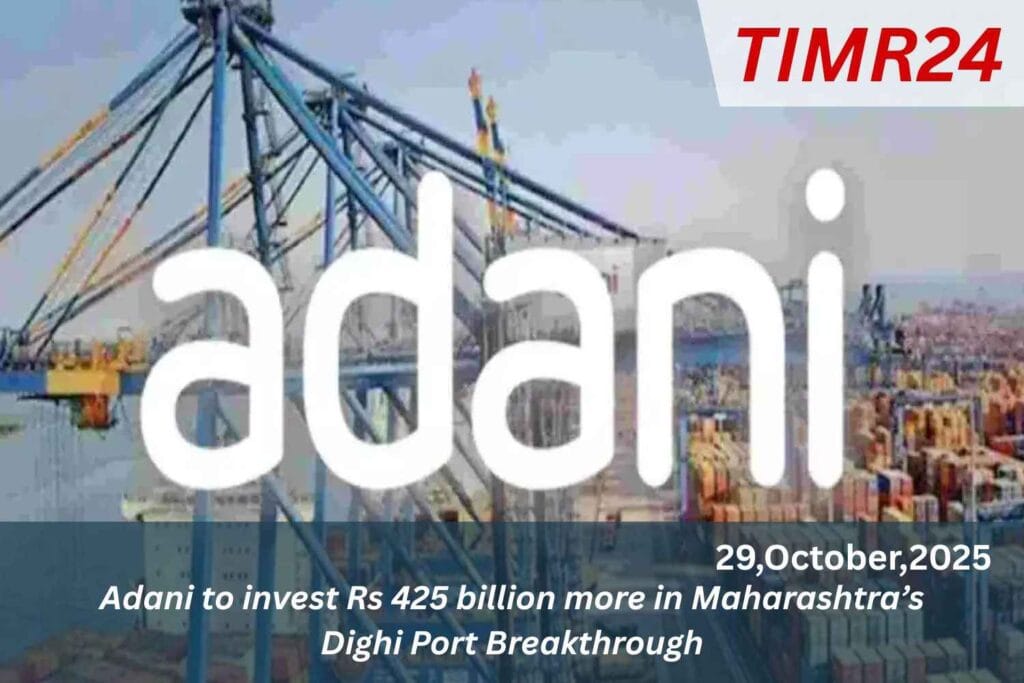
The Adani Group has announced an additional investment of Rs 425 billion in the Dighi Port project, part of a broader initiative by the Maharashtra government encompassing 15 MoUs worth over Rs 560 billion. The MoU, signed with the Maharashtra government, focuses on expanding the port and improving infrastructure. Chief Minister Devendra Fadnavis emphasized the investments will enhance Maharashtra’s maritime capabilities and global supply chain integration. Additional commitments include Rs 37.09 billion from the JSW Group for Jaigad port expansion, and Rs 50 billion from the Chowgule Group for shipbuilding. Other investments include Rs 10.
Billion from Synergy Shipbuilders and Rs 20 billion from Goa Shipyard. The government also plans to launch a water taxi service connecting Navi Mumbai Airport with the Gateway of India and develop a marina in Mumbai. IIT Bombay will assist in creating training and skill development facilities in maritime education. The Adani Group, one of India’s largest conglomerates with diverse interests in ports, logistics, energy, and infrastructure, has announced a fresh investment of ₹425 billion to further develop Maharashtra’s Dighi Port. This strategic expansion reflects the company’s growing focus on transforming India’s maritime infrastructure, improving logistics.
Efficiency, and strengthening trade capacity along the country’s western coastline. The move is part of Adani Ports and Special Economic Zone Ltd (APSEZ)’s long-term plan to position India as a global hub for maritime trade by 2030. Dighi Port, located in Raigad district between Mumbai and Goa, offers a natural deep-water advantage, making it ideal for large-scale cargo handling and international shipping connectivity Dighi Port holds a unique geographical and economic advantage due to its proximity to major industrial regions of Pune, Nashik, Satara, and Raigad. The Adani Group’s expansion will significantly upgrade port capacity and operational infrastructure.
Allowing it to handle large container ships and multiple types of cargo, including bulk, liquid, and containerized goods. By linking the port more effectively to the Delhi-Mumbai Industrial Corridor (DMIC), the project will improve freight movement and reduce transit time for manufacturing industries across western India.
This development also complements the Sagarmala Project, a flagship initiative by the Government of India aimed at modernizing ports, enhancing connectivity, and driving coastal economic growth. With Dighi Port’s integration into this framework, Maharashtra stands to become one of the leading maritime states in the country.
Economic Growth and Industrial Impact
The state government’s collaboration with private players like Adani ensures both capital infusion and global expertise in modern port management Adani’s ₹425 billion investment will create new economic opportunities across Maharashtra’s coastal belt. The Dighi Port expansion is expected to generate thousands of direct and indirect jobs in logistics, construction, transport, and auxiliary industries. It will also stimulate growth in sectors such as steel, cement, automotive, and chemicals, which rely heavily on port-based logistics. This aligns perfectly with India’s Make in India initiative, which focuses on enhancing domestic manufacturing and export competitiveness.
Furthermore, the port’s expansion will improve India’s logistics performance index by offering an efficient multi-modal connectivity model linking road, rail, and sea transport seamlessly. Adani Ports’ focus on integrating warehousing, inland container depots, and digital supply chain tracking will reduce logistics costs and delays. Maharashtra’s industrial clusters, especially near Chakan, Talegaon, and Aurangabad, will benefit from this connectivity, enabling faster export cycles and reduced dependency on traditional congested ports like Mumbai and Nhava Sheva.
Infrastructure Development and Modernization Plans
The Dighi Port project includes comprehensive infrastructure upgrades such as new deep-water berths, state-of-the-art container terminals, advanced storage facilities, and efficient cargo handling systems. These developments will allow the port to handle over 100 million tonnes of cargo annually once completed. Adani Ports also plans to implement smart port technologies, including automation, AI-based monitoring, and digital twin systems, ensuring precision in cargo movement and minimizing operational downtime The integration of renewable energy into port operations represents another crucial element of this expansion.
Adani aims to power Dighi Port using solar and wind energy to achieve carbon neutrality within a few years. This commitment aligns with the company’s broader sustainability agenda, which includes major investments in green hydrogen, clean logistics, and renewable infrastructure. The shift toward sustainable maritime operations sets a new benchmark for Indian ports, reducing carbon emissions while increasing efficiency India’s coastline plays a pivotal role in trade, handling more than 70% of the country’s international cargo volume. The Dighi Port expansion under Adani’s leadership supports the National Maritime Vision 2030, which aims to develop world.
Class port infrastructure and strengthen India’s position in global maritime logistics. The government’s Sagarmala Project, which seeks to unlock the economic potential of India’s coastal regions, finds a strong private sector ally in Adani Ports By developing Dighi Port into a deep-draft, multi-purpose port, the project will decongest existing ports like Jawaharlal Nehru Port Trust (JNPT) and diversify trade routes along the western coast. This diversification is essential for managing increasing trade volumes and ensuring supply chain resilience in the face of global disruptions. The synergy between Sagarmala and Adani’s expansion will also help improve port-led.
Employment Generation and Skill Development
Industrialization and attract foreign investments in maritime logistics Adani’s investment in Dighi Port will not only create employment opportunities but also foster skill development in port management, logistics, and engineering. The company is known for collaborating with local communities through Corporate Social Responsibility (CSR) initiatives, including education, healthcare, and vocational training. The Dighi expansion project is expected to generate approximately 25,000 indirect jobs during the construction phase and over 10,000 permanent roles post-completion. This will significantly uplift the socio-economic condition of local areas.
Like Alibag and Murud, ensuring inclusive development for Maharashtra’s coastal communities.
Additionally, Adani’s collaboration with the Maharashtra Maritime Board (MMB) ensures that development takes place within the state’s environmental and social governance framework, balancing industrial growth with ecological preservation Adani Ports and SEZ already operates a vast network of ports across India, including Mundra, Hazira, Kattupalli, Krishnapatnam, and Ennore. With Dighi’s expansion, the company strengthens its western coastal presence, adding strategic depth to its portfolio. The new investment reinforces Adani’s position.
As India’s largest private port operator and one of Asia’s fastest-growing maritime infrastructure players.
This move will also enhance India’s global trade competitiveness by providing advanced logistics solutions for exports to the Middle East, Europe, and Africa. With (iana) efficient hinterland connectivity, Dighi Port is poised to become a critical export-import hub for industries based in western and central India. Adani’s integrated port-to-logistics business model ensures that Dighi will not only serve as a cargo gateway but also as a foundation for economic transformation across multiple sectors.
Sustainability and Long-Term Vision
Adani Group’s commitment to sustainability extends beyond business expansion. The Dighi Port project will incorporate eco-friendly construction practices, water recycling systems, and biodiversity preservation plans. The company also plans to develop green corridors for clean cargo transport and introduce electric vehicles and LNG-powered vessels in port operations. Such initiatives are crucial as India strives to reduce carbon intensity and align with global sustainability goals The long-term vision for Dighi Port goes beyond infrastructure it symbolizes India’s ambition to build a future-ready maritime ecosystem that balances growth.
Technology, and environmental consciousness. With increasing emphasis on digitalization, smart logistics, and renewable operations, Adani’s Dighi Port will stand as a benchmark for modern port management in Asia The Adani Group’s ₹425 billion investment in Maharashtra’s Dighi Port marks a monumental step in India’s infrastructure and maritime development journey. The expansion will unlock new avenues for trade, enhance industrial competitiveness, and generate vast economic opportunities across western India. As Dighi Port evolves into a state-of-the-art maritime hub, it will not only transform Maharashtra’s logistics landscape but also play.
A crucial role in shaping India’s global trade future. By (Railways) combining innovation, sustainability, and strategic vision, Adani Ports continues to redefine the country’s maritime growth story and drive India toward becoming a global logistics powerhouse.
Q1. What is the total investment by Adani in Dighi Port?
Adani Ports has announced an additional ₹425 billion investment to enhance Dighi Port’s capacity and infrastructure.
Q2. Why is Dighi Port strategically important?
It’s located between Mumbai and Goa, offering vital connectivity to the Delhi-Mumbai Industrial Corridor.
Q3. What are the key benefits of this expansion?
It will boost trade efficiency, create jobs, and strengthen India’s logistics network with sustainable development.
Q4. How does this investment support Maharashtra’s economy?
The project will generate employment, attract industries, and improve trade flow across western India.
Q5. Is this part of India’s Sagarmala Project?
Yes, the Dighi Port expansion complements the government’s Sagarmala initiative for coastal infrastructure development.