












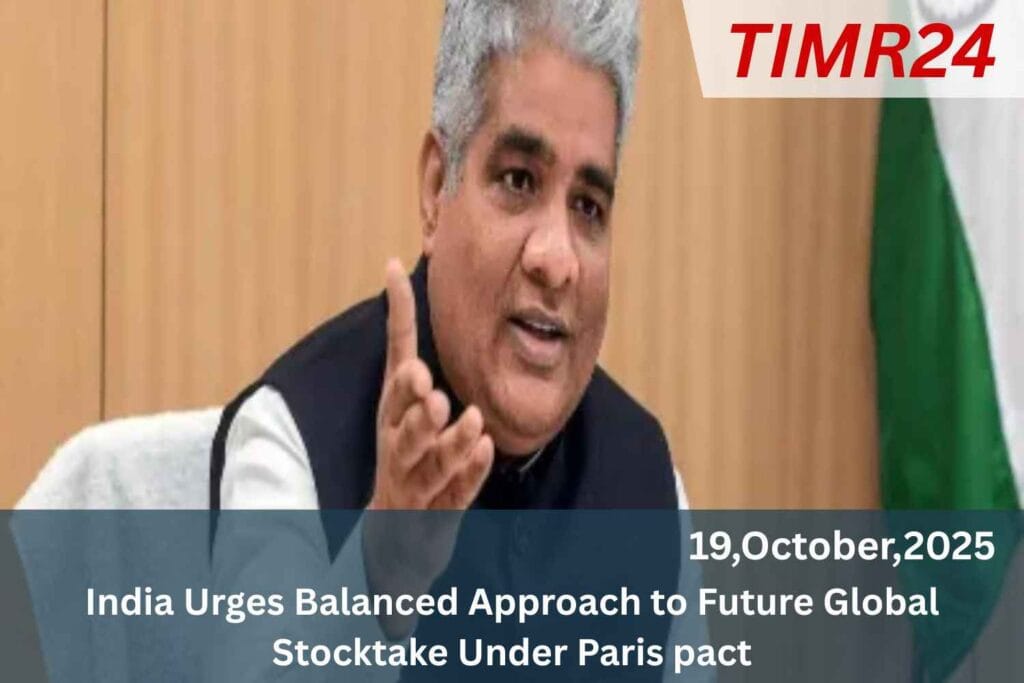
Union Minister for Environment, Forest and Climate Change, Shri Bhupender Yadav, congratulated the world on the successful conclusion of the first Global Stocktake (GST) session, describing it as a strong affirmation of the Paris Agreement’s implementation. He emphasized the GST as a key driver of the Paris framework, fostering political momentum and sustaining dynamic efforts towards higher ambition. He urged ongoing dialogues to incorporate GST insights for cooperation and climate action. The Paris Agreement, adopted in 2015 under the United Nations Framework Convention on Climate Change (UNFCCC), established a comprehensive global framework for.
Addressing climate change. Central to this framework is the Global Stocktake, a periodic process aimed at assessing collective progress toward achieving the long-term goals of the agreement. The Global Stocktake evaluates progress on three key areas: mitigation, adaptation, and means of implementation, including finance, technology transfer, and capacity-building. As countries gear up for the next phase of this assessment, India has emphasized the necessity of adopting a balanced approach that reflects equity, fairness, and the differentiated responsibilities of nations. This stance underscores India’s commitment to climate justice while also safeguarding the developmental priorities of emerging economies.
India’s call for balance is rooted in the principle of Common But Differentiated Responsibilities and Respective Capabilities (CBDR-RC). This principle acknowledges that while climate change is a shared challenge for humanity, the historical emissions and economic capacities of developed countries create a differentiated responsibility. India has consistently argued that developed nations must take the lead in reducing greenhouse gas emissions, providing climate finance, and facilitating technology transfer to developing countries. At the same time, developing countries require flexibility in implementing their nationally determined contributions (NDCs) to meet their climate targets.
Without compromising economic growth and social development. By emphasizing CBDR-RC in the context of the Global Stocktake, India is ensuring that the evaluation process remains just and reflective of real-world disparities During recent international climate discussions, Indian representatives highlighted the need for an inclusive approach that considers the challenges faced by developing nations. Many of these countries grapple with limited financial resources, lack of access to advanced clean technologies, and heightened vulnerability to climate impacts such as floods, droughts, cyclones, and heatwaves. India’s advocacy, therefore, goes beyond emission reduction metrics.
Emphasizing climate resilience, adaptation measures, and sustainable development. By linking climate action with socio-economic priorities, India presents a comprehensive perspective that bridges global climate objectives with national developmental agendas. This approach ensures that the Global Stocktake reflects not only progress in reducing emissions but also the capacity of nations to adapt and respond to climate-induced challenges Financial support remains a cornerstone of India’s advocacy. The Global Stocktake is intended to identify gaps in climate action, and India stresses that adequate funding from developed nations is critical to addressing these gaps.
Climate finance enables developing countries to invest in renewable energy infrastructure, energy efficiency initiatives, sustainable agriculture, and climate-resilient urban planning. Moreover, it supports efforts to enhance scientific research and technology development, allowing (Framework) emerging economies to leapfrog to low-carbon development pathways. India has also pointed out the importance of predictable and accessible financing mechanisms, which can provide long-term support rather than ad hoc or short-term assistance. By highlighting these needs, India aims to create an environment where developing countries can confidently implement their climate strategies without compromising their growth trajectories.
Technology transfer is another critical component emphasized by India. While developed countries possess advanced clean technologies, many developing nations face challenges in accessing these innovations due to high costs, intellectual property restrictions, and lack of infrastructure. India has argued that the Global Stocktake should evaluate not only emissions reductions but also progress in facilitating the transfer of climate-friendly technologies. This could include renewable energy systems, energy storage solutions, water-efficient irrigation systems, and climate-resilient construction techniques. Technology transfer coupled with capacity-building initiatives.
Enables developing countries to implement climate solutions effectively while simultaneously fostering local innovation and job creation The adaptation component of the Global Stocktake is equally significant. Climate change impacts are increasingly affecting agriculture, water resources, health, and coastal communities, particularly in developing nations. India has consistently underscored that adaptation efforts should receive equal attention alongside mitigation. This involves evaluating the effectiveness of early warning systems, disaster preparedness plans, resilient infrastructure projects, and community-based adaptation programs. By advocating for a balanced.
Assessment that integrates adaptation measures, India ensures that the Global Stocktake reflects the broader spectrum of climate actions required to safeguard vulnerable populations and ecosystems India’s position is also closely linked to its domestic climate policies and achievements. Over the past decade, India has made substantial strides in renewable energy deployment, particularly in solar and wind energy, under initiatives like the National Solar Mission and ambitious renewable energy capacity targets. These efforts demonstrate India’s commitment to transitioning toward a low-carbon economy while continuing to prioritize energy access, economic.
Growth, and employment generation. By showcasing its domestic achievements, India positions itself as a credible actor in international climate negotiations, highlighting how developing nations can actively contribute to global climate goals while addressing national development imperatives The upcoming Global Stocktake will have far-reaching implications for future NDCs and international climate cooperation. India’s insistence on a balanced approach seeks to ensure that the assessment informs practical and equitable policy decisions. By taking into account the differentiated responsibilities of nations, the Stocktake can provide insights into necessary adjustments.
In mitigation targets, climate finance commitments, and technology-sharing arrangements. India’s advocacy for inclusivity also promotes trust and cooperation among countries, strengthening the multilateral framework necessary for effective climate action Moreover, India has emphasized the need to address loss and damage, which refers to the irreversible impacts of climate change that cannot be avoided through mitigation or adaptation alone. Vulnerable communities in developing countries face significant risks, including displacement, crop losses, and extreme weather events. India’s approach calls for structured mechanisms within the Global Stocktake to quantify.
Assess, and support nations facing loss and damage, ensuring that the climate regime does not leave the most affected populations behind Critically, India’s balanced approach is not merely a diplomatic position but a reflection of its broader vision for climate-resilient development. By advocating for equity, financial support, technology transfer, adaptation, and loss-and-damage mechanisms, India demonstrates a holistic understanding of the multifaceted nature of climate action. This perspective reinforces the principle that achieving the Paris Agreement’s objectives requires collaboration, fairness, and mutual accountability among all parties.
In conclusion, India’s call for a balanced approach to the future Global Stocktake under the Paris Agreement emphasizes fairness, inclusivity, and differentiated responsibilities. By linking mitigation, adaptation, finance, technology, and loss-and-damage considerations, India is championing a climate framework that recognizes the unique challenges of developing nations while ensuring collective global progress. As countries prepare for this crucial assessment, India’s advocacy highlights the importance of equity and cooperation, reinforcing the need for a climate response that is effective, just, and sustainable for all nations. The upcoming Global Stocktake will not only serve as a checkpoint for global progress.
But also as a platform to strengthen partnerships, bolster climate resilience, and (NDC) create a path toward a sustainable future that balances environmental imperatives with socio-economic development goals.
Q1. What is the Global Stocktake under the Paris Agreement?
The Global Stocktake evaluates collective progress toward climate goals, focusing on mitigation, adaptation, and support.
Q2. Why is India advocating for a balanced approach?
India emphasizes equity and differentiation to ensure developing nations receive financial and technological support for climate action.
Q3. How does CBDR-RC relate to India’s stance?
It means all nations share responsibility, but developed countries with historical emissions lead in reductions and support.
Q4. What role does finance play in the Global Stocktake?
Adequate climate finance enables developing countries to meet emission targets and adapt to climate change impacts.
Q5. How will the Global Stocktake impact future climate actions?
It guides adjustments to NDCs, strengthens global cooperation, and identifies gaps in collective climate efforts.