











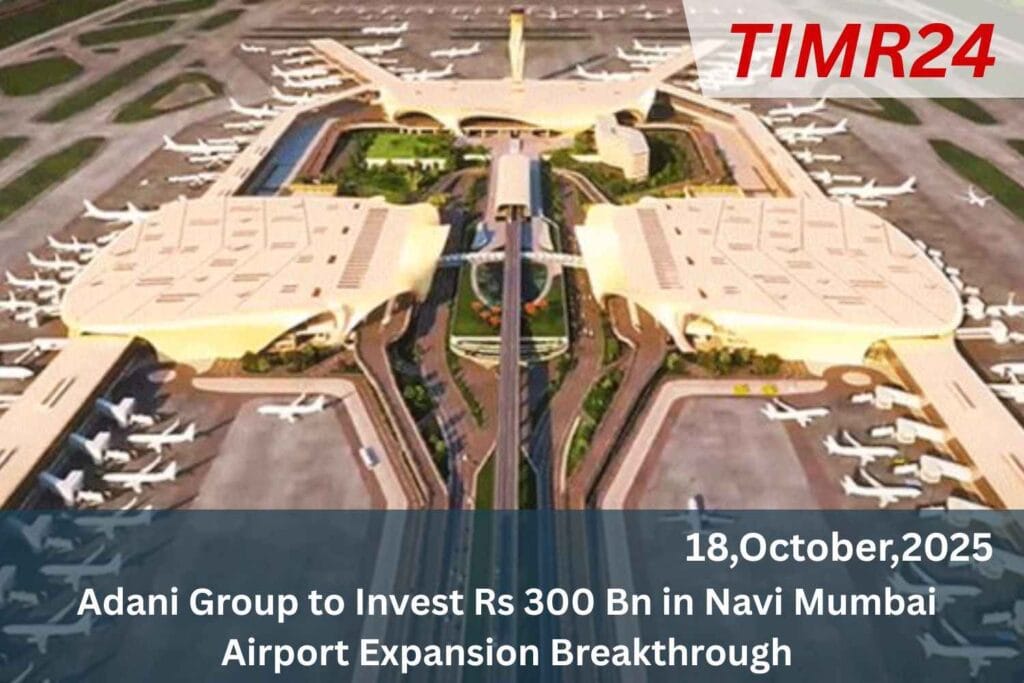
The Adani Group plans to invest Rs 300 billion to expand Navi Mumbai International Airport, India’s largest airport by capacity. The expansion will begin operations in December 2025, with the first phase handling (MMRDA) 20 million passengers per annum for domestic and international flights. The second phase will add 30 million passenger capacity, a major cargo terminal, and India’s largest maintenance, repair, and overhaul facility. Funding will come through a mix of debt and equity, with the Maharashtra government holding a 26% stake (Adani Airports) The Adani Group has announced a landmark investment of Rs 300 billion for the Navi Mumbai International Airport (NMIA).
Expansion, signaling a massive step in India’s aviation infrastructure growth. The project, which is being developed through Adani Airports Holding Limited (AAHL), aims to transform the Navi Mumbai region into a key aviation and commercial hub by 2026. This expansion not only supports the increasing passenger traffic in the Mumbai Metropolitan Region (MMR) but also aligns with India’s broader goal of developing world-class, sustainable airports that enhance regional connectivity and drive economic growth. The Navi Mumbai Airport, once completed, is expected to complement the Chhatrapati Shivaji Maharaj International Airport (CSMIA) in Mumbai, offering relief.
To congestion and strengthening Mumbai’s status as one of Asia’s leading aviation gateways The vision of the Navi Mumbai Airport project is to create an international aviation hub that matches global standards of infrastructure, technology, and passenger experience. With Adani Group’s strategic approach, the Rs 300 billion investment will focus on both capacity expansion and sustainability initiatives. The project will include multiple passenger terminals, a cargo complex, integrated metro and highway connectivity, and advanced digital systems for seamless operations. Adani Group’s plan includes expanding the airport’s capacity to handle 90 million passengers annually by.
The end of its final phase, making it one of the largest airports in India For the Adani Group, this expansion is not merely an infrastructure project but a part of its long-term commitment to build future-ready aviation ecosystems that integrate technology, environment, and commerce. The company aims to make NMIA a model for smart airport design, featuring energy-efficient operations, renewable power integration, and minimal environmental impact.
Boosting Connectivity and Regional Development
One of the most significant impacts of this Rs 300 billion investment is the enhancement of connectivity between Navi Mumbai, Pune, and other western regions of Maharashtra. The airport’s proximity to major industrial and logistics corridors, such as the Mumbai–Pune Expressway and the Jawaharlal Nehru Port (Nhava Sheva), makes it a crucial node in India’s economic network. It is expected to attract businesses, hotels, and logistics companies, thereby creating thousands of new jobs and boosting the local economy Additionally, the airport will serve as a key catalyst for real estate and commercial growth in Navi Mumbai, Panvel, and surrounding areas.
With major infrastructure projects like the Mumbai Trans Harbour Link (MTHL) and Navi Mumbai Metro, the region is poised to become one of the fastest-growing business destinations in India. The Adani Group’s airport expansion project will integrate multi-modal transport options to ensure faster access for passengers and cargo movement, making NMIA a strategic partner in India’s economic transformation A core aspect of the Navi Mumbai Airport expansion under the Adani Group is its strong commitment to sustainability and environmental responsibility. The project follows a detailed environmental management plan to protect the nearby Ulwe River, mangrove.
Ecosystems, and wetlands. Adani Airports has pledged to make the airport one of India’s greenest aviation facilities, with features such as rainwater harvesting systems, solar power generation, electric vehicle (EV) infrastructure, and zero-waste policies By using low-emission materials, energy-efficient designs, and renewable energy sources, the Adani Group aims to make NMIA carbon-neutral in its operations. The expansion will also feature advanced air traffic management systems that reduce fuel consumption and emissions, thereby contributing to India’s net-zero goals.
Technological Advancements and Passenger Experience
Technology is at the heart of the Navi Mumbai Airport expansion plan. The Adani Group intends to deploy AI-driven operations, biometric-enabled boarding, smart baggage handling systems, and real-time data monitoring to ensure smooth passenger experiences. These advancements will make NMIA a fully digital airport, capable of offering seamless connectivity from check-in to take-off The airport will include state-of-the-art terminal buildings, luxury lounges, duty-free shopping areas, and entertainment zones designed to reflect both modern architecture and Indian cultural aesthetics. Through its digital integration strategy, the Adani Group aims to make NMIA a benchmark.
For smart airport infrastructure that rivals international counterparts like Dubai, Singapore, and Doha The Rs 300 billion investment in NMIA’s expansion will have a massive multiplier effect on India’s economy. The project will create direct and indirect employment opportunities across construction, logistics, hospitality, and retail sectors. It will also encourage foreign direct investment (FDI) in Navi Mumbai and surrounding industrial areas. Once operational, the airport is expected to generate significant revenue from passenger services, cargo operations, and commercial real estate, making it one of the most profitable airport ventures in South Asia.
Challenges and Government Collaboration
The Adani Group’s diversified portfolio across energy, logistics, and infrastructure gives it a unique advantage in integrating NMIA with its other business verticals. For instance, Adani Ports and Special Economic Zone (APSEZ) can leverage the airport’s cargo terminal for air-sea logistics, creating a seamless multimodal transport network that enhances trade efficiency Despite its massive potential, the Navi Mumbai Airport project has faced challenges, including land acquisition issues, environmental clearances, and rehabilitation of affected communities. However, with the Maharashtra Government’s active cooperation and policy support, these hurdles are being.
Addressed progressively. The Adani Group is working closely with the City and Industrial Development Corporation (CIDCO) and other state authorities to ensure that the project is completed within the planned timeline Government officials have emphasized that the airport is not only a transport project but also a symbol of India’s infrastructure modernization under public-private partnerships (PPP). The collaboration between the Adani Group and government agencies highlights a model of sustainable and strategic development that other infrastructure projects can emulate.
The Adani Group’s Rs 300 billion investment in the Navi Mumbai Airport expansion is a defining milestone in India’s journey toward becoming a global aviation powerhouse. Beyond its economic and infrastructural impact, the project reflects a forward-looking vision of sustainability, technology integration, and regional empowerment. As India continues to emerge as one of the fastest-growing air travel markets in the world, the Navi Mumbai International Airport is set to play a transformative role in shaping the country’s aviation future.
Once operational, NMIA will not only decongest Mumbai’s existing airport but also stand as a symbol of India’s ambition and innovation, connecting millions of travelers, supporting trade, and positioning Maharashtra as a hub of global connectivity and sustainable growth.
q1. What is the total investment by Adani Group in Navi Mumbai Airport?
Adani Group has announced a ₹300 billion investment for the airport’s expansion and future phases.
q2. When will the Navi Mumbai International Airport open?
The airport’s first phase is expected to become operational by mid-2026.
q3. How will this project impact Mumbai’s existing airport?
It will significantly reduce congestion at Mumbai’s CSMIA and boost passenger efficiency.
q4. Will the airport follow green building principles?
Yes, the project will feature renewable energy systems, LEED certification, and smart energy design.
q5. How many passengers will the airport handle annually?
After full completion, it can handle up to 90 million passengers per year.