












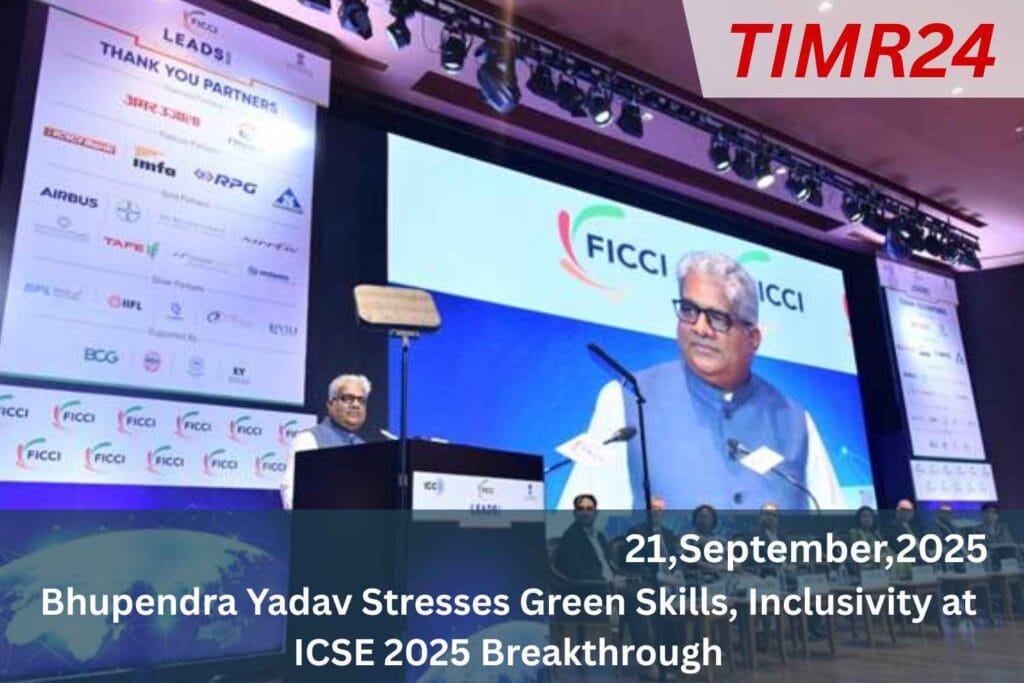
Union Minister for Environment, Forest and Climate Change Bhupendra Yadav delivered a special address at the 7th International Conference on Sustainability Education (ICSE), organised by the Mobius Foundation in partnership with UNESCO, UNEP, CEE, IUCN and other environmental and educational agencies. Yadav emphasized India’s progress towards transitioning from fossil fuel dependence to renewable energy sources and praised the Mobius Foundation’s initiatives, particularly in promoting girl child education in rural areas and stabilizing population growth through Project Aakar. He also emphasized the need for widespread adoption of green education, stating.
That while the government is working towards sustainable development and promoting renewable energy, education remains key to accelerating progress. The International Conference on Sustainable Employment (ICSE) 2025 emerged as a landmark platform where leaders, policymakers, educators, and industry experts gathered to deliberate on the future of work, with special emphasis on sustainability and inclusivity. During the event, Union Minister Bhupendra Yadav addressed the audience with a compelling message: the workforce of tomorrow must be equipped with green skills and guided by the principle of inclusivity. His keynote speech underlined that India’s.
Green Skills The Core of a Sustainable Workforce
Economic progress cannot be separated from environmental responsibility and social equity, and both factors must converge to build a future-ready nation. This vision resonates strongly with India’s commitment to becoming a Viksit Bharat by 2047, where growth is not just rapid but also inclusive and sustainable Green skills refer to the technical knowledge, abilities, and values needed to develop and support a sustainable society. As India rapidly advances towards renewable energy, electric mobility, waste management solutions, and eco-friendly manufacturing, the demand for green jobs is set to surge. Bhupendra Yadav emphasized that without equipping the workforce with.
These skills, India’s green transition will face significant bottlenecks. Sectors like solar and wind energy, sustainable construction, and circular economy initiatives will open millions of job opportunities in the coming years. For example, large-scale projects supported by the Renewable Energy demonstrate how investments in clean energy are creating new employment avenues while reducing carbon footprints. Green skills ensure that such growth is not just technologically driven but also socially beneficial, offering workers sustainable livelihoods while protecting the environment.
Inclusivity as the Foundation of Growth
While technological advancement is crucial, Yadav reminded the gathering that economic growth cannot be truly meaningful without inclusivity. In India, inclusivity means ensuring that women, youth, differently-abled individuals, and marginalized communities are equal participants in workforce transformation. Today, only a fraction of women are employed in India’s green economy, and bridging this gap requires gender-sensitive training programs and supportive workplace policies. Initiatives under the have already started addressing these concerns by designing customized training courses that meet the specific needs of diverse groups. Yadav highlighted that inclusivity is not.
A peripheral agenda but an economic necessity because diverse workplaces perform better, innovate faster, and adapt more effectively to changing environments ICSE 2025 brought together representatives from international organizations, global think tanks, and industry leaders who (Skill India) engaged in discussions on policies, best practices, and innovation. The conference focused on how countries can collaborate to create globally recognized training frameworks for green jobs. These frameworks ensure that skills acquired in one country are transferable and relevant across borders, thereby supporting international workforce mobility. Sessions also explored how public.
Government Policies Driving Workforce Development
Private partnerships can accelerate training and capacity building. By enabling dialogue among stakeholders, ICSE reinforced the idea that sustainability and inclusivity are shared global challenges requiring collective solutions The Government of India has been proactive in introducing policies that align education and training systems with the needs of a green economy. Under the National Education Policy (NEP) 2020, vocational and skill-based education is being integrated from school level, ensuring students are work-ready from an early age. Programs supported by the provide platforms for youth to gain practical training in renewable Energy, electric vehicles, and sustainable.
Infrastructure. Yadav noted that such measures are essential to bridge the gap between academic learning and industry demand. By prioritizing reskilling and upskilling, the government ensures that India’s workforce remains competitive in a rapidly evolving global job market The private sector plays a critical role in translating policy into action. Companies in manufacturing, energy, logistics, and construction are increasingly adopting sustainable practices and supporting green skills training. For instance, initiatives by Eicher to deploy electric trucks for clean urban logistics reflect the direct application of green skills in transportation. Similarly, Adani Cement’s record.
Setting sustainable construction project showcases how industries are investing in green infrastructure and workforce training simultaneously. Through collaborations with academic institutions and training centers, industries are ensuring that workers not only learn theoretical concepts but also acquire hands-on experience, making them job-ready for real-world challenges Education and training institutes have a responsibility to embed sustainability into their curricula. Universities and vocational schools are now including subjects such as environmental science, sustainable engineering, and clean technology as part of their regular programs. By aligning coursework with.
Industry needs, these institutions are bridging the skill gap and preparing students for green jobs. Yadav emphasized that lifelong learning must become a culture, where workers continue upgrading their skills throughout their careers to stay relevant in dynamic industries The message delivered at ICSE 2025 aligns with broader sustainable initiatives taking place across India. For example, the demonstrates the integration of sustainable materials into national infrastructure. Similarly, the highlights urban planning innovations designed for efficiency and sustainability. By connecting ICSE’s vision with these ongoing projects, it becomes evident that green skills and inclusivity are not.
Abstract concepts but practical requirements shaping India’s development landscape Bhupendra Yadav’s closing message at ICSE 2025 was clear: sustainability and inclusivity are the twin pillars on which India’s future workforce must be built. While technology and innovation are essential drivers of progress, they must be balanced with equitable access and environmental responsibility The pathway to a developed India lies in preparing every citizen, irrespective of their background, for meaningful participation in the green economy. It is only by combining green skills training, inclusive policies, government initiatives, and industry collaborations that India can achieve its ambitious vision of sustainable development.
Conclusion: India’s Leadership in Global Sustainability
The discussions at ICSE 2025, anchored by Yadav’s address, reinforced India’s leadership role in shaping a sustainable global workforce. By focusing on green skills, the nation is preparing its citizens for industries of the future, while inclusivity ensures that no one is left behind. With collaborative platforms like ICSE, robust government policies, active industry participation, and innovative educational frameworks, India is well-positioned to emerge as a model for the world in balancing growth with sustainability. As Yadav noted, the true breakthrough lies in equipping the next generation not just with jobs, but with purpose, responsibility, and a shared vision for a greener, more inclusive future.
Q1. What was the key focus of Bhupendra Yadav’s speech at ICSE 2025?
The Union Minister stressed the importance of green skills, sustainable practices, and inclusivity in workforce development.
Q2. Why are green skills important for India’s future?
Green skills ensure employment opportunities in renewable energy, waste management, and sustainable industries.
Q3. How does inclusivity tie into workforce development?
Inclusivity ensures equal participation of women, youth, and marginalized groups in India’s growth story.
Q4. What role does ICSE 2025 play in policy dialogue?
ICSE provides a platform for global leaders to share insights on sustainable workforce transformation.
Q5. How is the government supporting skill development?
Through initiatives like Skill India Mission and collaborations with international partners.