

















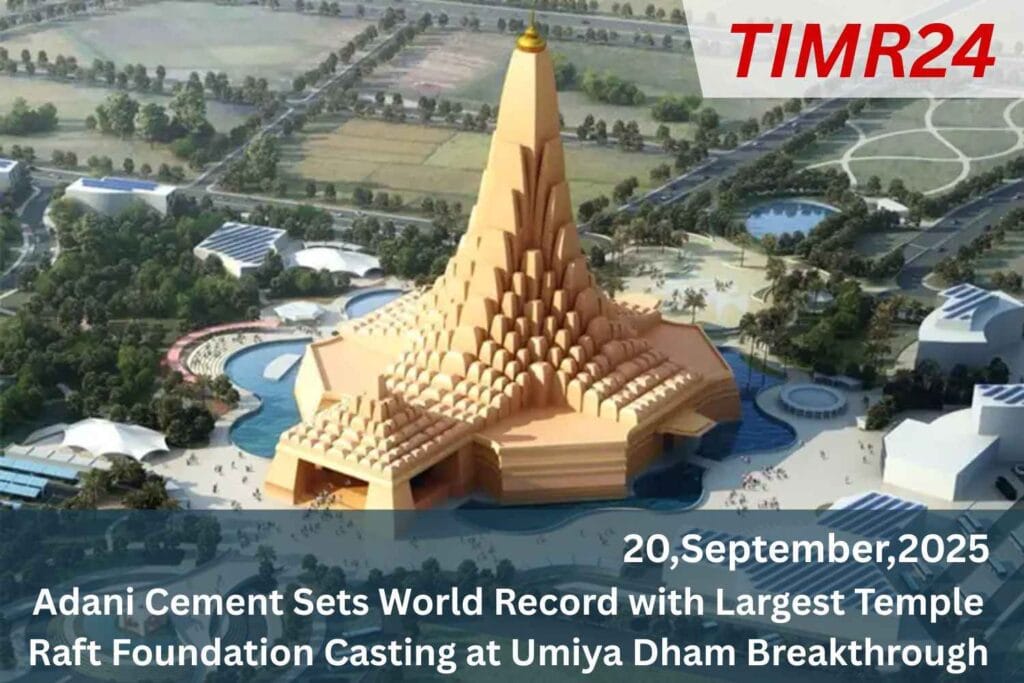
Adani Cement has completed the world’s largest religious temple raft foundation casting at Umiya Dham near Ahmedabad. The 54-hour operation involved 24,100 cubic metres of ECOMaxX M45 grade low-carbon concrete, Adani Cement’s proprietary sustainable mix. The operation was powered by 26 Ready-Mix Concrete plants, over 285 transit mixers, 3,600 tonnes of high-performance cement, and over 600 skilled workers and technical experts. The raft foundation will support 1,551 Dharma Stabs for the 504 ft tall Jagat Janani Maa Umiya Temple, envisioned as the spiritual nucleus of a vast social and cultural campus in Jaspur. The ECOMaxX M45 concrete mix incorporates.
66% Supplementary Cementitious Material (SCM), resulting in a 60% carbon footprint reduction. The raft foundation was witnessed by over 1,000 attendees on-site and more than 10,000 online. Adani Cement continues to play a pivotal role in India’s infrastructure and realty landscape, including the Umiya Dham Temple Adani Cement has once again proven its leadership in the construction industry by setting a world record for the largest temple raft foundation casting at the grand Umiya Dham project in Gujarat, a development that not only highlights India’s engineering excellence but also reflects the seamless blend of cultural heritage and modern infrastructure.
The Umiya Dham temple, dedicated to Goddess Umiya Mata who is revered by millions of devotees across Gujarat and the Indian diaspora, has been envisioned as a monumental spiritual and cultural hub, and laying such a massive raft foundation is a crucial step in ensuring its longevity, durability, and architectural magnificence. The record-breaking casting by Adani Cement was achieved through continuous pouring of high-performance concrete over an extended area, executed with unmatched precision and advanced technological methods, marking a milestone that has earned global recognition in the construction sector. To understand the cultural context, one can explore.
The is actively supervising the temple’s progress and ensuring that it becomes a center of devotion and community engagement once completed. What sets this achievement apart is not only the scale of the casting but also the sustainable engineering practices integrated into the process, as Adani Cement deployed advanced concrete mix designs capable of bearing immense structural loads while minimizing the environmental impact, aligning with global standards promoted by organizations such as This kind of innovation reflects the company’s commitment to reducing its carbon footprint while still delivering world-class quality, and it positions Adani Cement as a key driver in India’s transition towards greener construction methods.
The significance of this project extends far beyond engineering alone because the Umiya Dham temple is expected to become a major pilgrimage and tourism destination, creating large-scale employment opportunities for the local population and reinforcing Gujarat’s reputation as a state rich in spirituality, tradition, and cultural heritage. The temple will not only serve religious purposes but will also emerge as a catalyst for regional economic growth, with hospitality, retail, and service industries benefiting from the influx of devotees and tourists. This connects to India’s broader vision of promoting cultural tourism through initiatives like where heritage and infrastructure work together.
To attract both domestic and international travellers. The record-setting foundation by Adani Cement is therefore symbolic in many ways—it represents strength in structure, devotion in spirit, and progress in economy. From a construction industry perspective, this breakthrough underlines India’s growing influence in global infrastructure, demonstrating that Indian companies are not just participants but leaders in executing mega projects that require speed, precision, and sustainability. This is similar to other major infrastructure developments such as (NHAI’s) which showcase how the nation is steadily preparing itself for a leadership role in global infrastructure and trade.
The engineering aspect of the raft foundation itself is worth a deeper look because casting at this scale requires meticulous planning, state-of-the-art machinery, and coordination among multiple teams working around the clock. The uniform distribution of concrete across such a vast area minimizes settlement and ensures that the temple structure built above will remain stable for centuries to come. The logistics involved in sourcing, mixing, transporting, and pouring such volumes of concrete are comparable to some of the largest infrastructure projects globally, placing the Umiya Dham temple foundation in the league of record-setting engineering marvels.
For students and professionals in civil engineering, this project stands as a real-world case study in mega-scale construction management, similar in importance to large bridges, flyovers, and high-speed rail projects that shape the future of transportation and connectivity. If we draw a parallel to urban transport, projects like demonstrate how India is simultaneously building religious monuments and modern transit solutions with equal attention to detail and innovation From a sustainability perspective, Adani Cement’s achievement at Umiya Dham also resonates with India’s commitment to green construction practices. By integrating eco-friendly cement alternatives and optimizing.
Energy consumption during the casting, the company has reduced the overall carbon intensity of the project, contributing to national and global climate goals. Such practices align with international climate-focused initiatives and reflect a responsible approach to growth, a necessity in today’s world where infrastructure development must balance economic ambition with environmental stewardship. Moreover, this achievement inspires other construction companies to adopt similar practices and helps push India towards becoming a global leader in sustainable infrastructure, a goal reflected in several government roadmaps including India’s vision for 2047.
The cultural importance of Umiya Dham cannot be overstated because for millions of devotees, this temple is not just a place of worship but a unifying symbol of faith, identity, and community. The temple’s design and scale reflect the grandeur of Indian temple architecture, and by setting a world record at its foundation stage, Adani Cement has made the project even more historic. In time, Umiya Dham is expected to attract visitors in the same way that iconic temples like Somnath, Akshardham, and Kedarnath have, but what will make it unique is its modern foundation built with the most advanced technology available today. This combination of tradition and technology is becoming.
A hallmark of India’s new wave of development, where the preservation of cultural roots goes hand in hand with embracing global standards of construction Looking ahead, Adani Cement is well-positioned to contribute to other landmark projects in India and abroad, continuing its focus on innovation, sustainability, and excellence. Its success with Umiya Dham sends a powerful message that Indian companies can deliver on a scale that rivals or surpasses international benchmarks, boosting confidence in India’s infrastructure sector as a whole. When coupled with other initiatives such as the expansion of metro networks, mega highways, and green urban spaces, achievements like.
This show that India is steadily transforming its infrastructure landscape in a holistic way. For readers interested in similar developments, our internal feature on (Climate Action) provides further insights into how such large projects reshape cities and communities the world record achieved by Adani Cement at Umiya Dham is a defining moment in India’s construction journey. It highlights the successful integration of culture, engineering, and sustainability in a single project that will stand as an inspiration for generations. More than just a foundation of stone and concrete, it represents the foundation of India’s aspirations to lead the world in infrastructure.
Innovation while staying deeply connected to its spiritual and cultural heritage. As the Umiya Dham temple rises above its record-setting base, it will symbolize not only devotion to Goddess Umiya Mata but also the strength, vision, and resilience of modern India.
Q1. What world record did Adani Cement achieve at Umiya Dham?
Adani Cement set a global record for completing the largest temple raft foundation casting.
Q2. Where is the Umiya Dham temple foundation project located?
It is located in Gujarat, India, known for its cultural and architectural heritage.
Q3. How significant is the raft foundation for Umiya Dham?
The raft foundation ensures the temple’s long-term strength, durability, and stability.
Q4. What makes this casting a breakthrough in construction?
The massive scale, advanced concrete technology, and sustainability practices make it unique.
Q5. How does this achievement impact India’s construction industry?
It highlights India’s capability in mega construction projects and boosts global recognition.