

















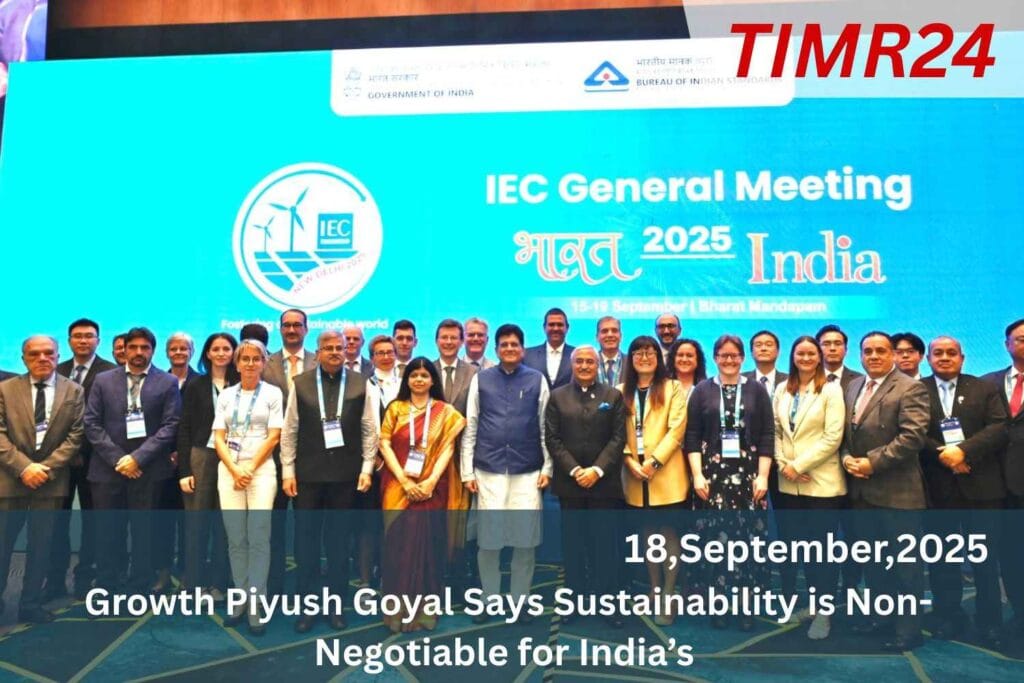
Union Minister Shri Piyush Goyal emphasized the importance of sustainability in India’s growth, highlighting the need for global alignment to enhance quality, boost free trade, and strengthen collaboration. He highlighted the critical role of the electrical and electronic industry in this. Writ India is undergoing one of the fastest economic transformations in the world, but as Union Minister Piyush Goyal emphasized, this growth cannot come at the cost of the environment. Calling sustainability non-negotiable for India’s progress, he highlighted that the nation’s long-term prosperity depends on integrating green principles into every aspect of development. This statement reflects the government’s.
Clear intention to place sustainable practices at the heart of industrialization, trade, and governance. Unlike earlier decades when economic expansion was pursued with little concern for ecological balance, today’s strategy acknowledges that unchecked growth is no longer viable. For India, sustainability is not an optional add-on it is the foundation of its future growth story. Goyal’s vision reframes sustainability as more than just an environmental concern; it is a robust economic strategy. The push for renewable energy, green finance, and eco-conscious supply chains aligns with India’s ambition to become a $5 trillion economy. By embedding sustainability into growth plans.
India is preparing for resilience against climate-related disruptions such as extreme weather, water scarcity, and air pollution. The emphasis on Green Infrastructure Development also connects with India’s growing urban centers, which are adapting to modern energy-efficient buildings and transport systems. For context, our internal feature on the shows how future infrastructure in the capital is already being shaped by green principles At the center of this growth path is India’s commitment to renewable energy. The country has become the world’s third-largest producer of renewable electricity, driven largely by solar and wind power. Goyal stressed that this transformation is not only.
About reducing dependence on fossil fuels but also about creating millions of new jobs in clean energy sectors. India’s National Green Hydrogen Mission is a key step toward achieving global leadership in clean fuel technologies. Meanwhile, the International Solar Alliance, co-founded with France, demonstrates how India is exporting its green vision beyond borders. Readers can explore more global perspectives through the (Energy Agency) which tracks renewable transitions worldwide. For a local industry example, our internal coverage on highlights how Indian companies are setting new sustainability standards.
Sustainable Industry and ESG Practices
Industries are at the heart of India’s sustainability transformation. Goyal emphasized that companies can no longer view environmental responsibility as a voluntary choice. Global investors are now prioritizing businesses with strong Environmental, Social, and Governance (ESG) practices. For India’s “Make in India” initiative, this means manufacturing growth must go hand in hand with reduced emissions, energy efficiency, and ethical supply chains. This shift is already visible, with corporates rethinking packaging, waste management, and resource optimization. In fact, our report on showcases how Indian industries are not only adopting greener models but also empowering skilled talent to lead this transition.
Another major aspect of Goyal’s remarks was the push for a circular economy. Instead of the traditional take-make-dispose model, India is moving toward systems that maximize the use of materials, encourage recycling, and reduce dependency on imports. This is critical for a nation of India’s scale, where resource efficiency can directly impact trade balances and energy security. Policies promoting extended producer responsibility and waste-to-energy projects are already being rolled out. For readers interested in global frameworks, the provide useful insights into how circular economies are being encouraged worldwide. Internally, you can also read about to see how technology-led projects are aligning with efficiency and sustainability.
Digital Technology as an Enabler
Digital transformation is closely tied to India’s sustainability push. Smart technologies such as AI-driven monitoring systems, blockchain-enabled supply chain transparency, and IoT-based energy management tools are accelerating the green transition. For instance, energy-efficient data centers (NITI Aayog) have become a priority, with collaborations like the Invenia-STL project for PowerGrid showing how India is preparing for a future where data growth does not equate to higher emissions. Moreover, smart grids are improving electricity distribution and reducing losses, while digital platforms help industries monitor carbon footprints in real time. This technological leap represents how sustainability is merging with innovation.
Ensuring that India remains competitive in the global digital economy Sustainability is also about inclusive growth. Piyush Goyal stressed that green transitions will not only protect the environment but also create new opportunities for employment. From technicians installing solar panels to engineers designing sustainable infrastructure, the green economy promises millions of jobs. Rural India stands to benefit greatly, as solar-powered irrigation, biogas plants, and decentralized renewable energy systems bring both energy access and livelihood improvements. Women and youth, in particular, will have new roles to play in this expanding sector, making sustainability not just an.
India’s Role in Global Climate Leadership
Environmental obligation but also a social empowerment strategy. Our coverage on (Dubai’s) draws parallels by showing how policies can spark youth-driven growth, a concept equally relevant in India’s green job revolution Goyal’s remarks also underline India’s global leadership ambitions in sustainability. As one of the world’s fastest-growing economies, India’s choices carry weight in international climate negotiations and trade. The commitment to net-zero emissions by 2070, while ambitious, signals to global partners that India is serious about balancing growth with climate responsibility. By fostering international collaborations, India is also ensuring that its industries remain.
Competitive in markets increasingly influenced by carbon regulations. This global outreach mirrors initiatives such as the International Solar Alliance, reinforcing India’s status as a thought leader in clean energy diplomacy. To understand how sustainability is shaping global economic policies, the provide valuable insights Ultimately, Piyush Goyal’s message is clear: sustainability is the guiding principle for India’s growth trajectory. From infrastructure and energy to industry and employment, every sector is expected to embed environmental responsibility into its core strategy. This shift is not just about compliance with international agreements but about building a resilient economy.
That can thrive in a rapidly changing world. Internal transformations such as the also reflect how new developments are aligning with energy efficiency and sustainability goals sustainability as “non-negotiable” is more than a political statement; it is a roadmap for India’s future. By focusing on renewable energy, green manufacturing, digital innovation, circular economy practices, and social inclusion, India is building a growth model that ensures prosperity for both people and the planet. Piyush Goyal’s vision demonstrates that for India, sustainability is not a burden it is the greatest opportunity to redefine development in the 21st century and position the country as a global leader in climate-conscious growth.
Q1. Why did Piyush Goyal call sustainability “non-negotiable” for India?
Because it is central to balancing economic growth with environmental responsibility.
Q2. How is sustainability linked to India’s long-term growth?
It ensures cleaner energy, job creation, and resilience against climate risks.
Q3. What role do businesses play in India’s sustainability journey?
They are encouraged to adopt renewable energy, sustainable supply chains, and ESG practices.
Q4. How does India’s policy framework support sustainability?
Through initiatives like the National Solar Mission, Net-Zero targets, and circular economy policies.
Q5. What sectors will benefit most from India’s sustainability push?
Energy, manufacturing, infrastructure, technology, and green finance sectors.