













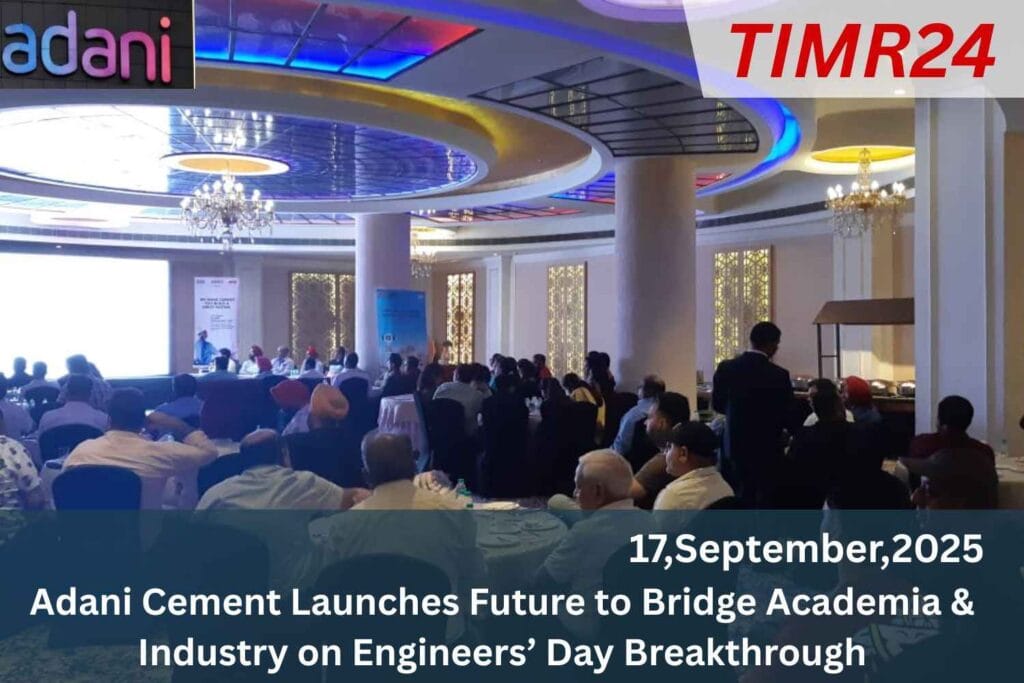
Adani Cement has launched Adani Cement Future, a Nationwide Academia-Industry Engagement Programme aimed at connecting classrooms with real-world infrastructure and sustainability challenges. The initiative aims to create a future-ready workforce in India, aligning with the government’s Yoga Bharat Mission and the Ministry of Education’s focus on employability and entrepreneurship skill gaps. Adani Cement will engage with over 100 premier engineering institutions and schools across 100+ cities, ensuring young talent is equipped with the knowledge and skills to drive sustainable nation-building Adani Cement has taken a remarkable step on the occasion of Engineers’ Day by.
Unveiling its breakthrough initiative Future to Bridge Academia & Industry, a program designed to reduce the existing gap between classroom learning and the real-world industrial environment. The initiative comes at a time when India is rapidly expanding its infrastructure and construction ecosystem, demanding not only skilled manpower but also a workforce that is future-ready. Engineers’ Day, which celebrates the legacy of Sir M. Visvesvaraya, has always been a moment of reflection on how engineering drives national progress, and this year, Adani Cement has added a new dimension to it by launching a project that places young talent at the core of industry-driven innovation.
This program is not just a CSR gesture but a structural investment in the knowledge economy, making it significant for both educational institutions and the corporate sector The first layer of impact lies in understanding why academia and industry need such bridges in the first place. For decades, engineering colleges and universities across India have been producing graduates with strong theoretical knowledge but with limited exposure to industrial practices. As industries evolve with new-age technologies like automation, AI, and sustainable materials, the challenge for students has been to keep pace with these changes. By directly involving industry mentors, technical.
Experts, and practical training modules, Adani Cement’s initiative ensures that the upcoming generation of engineers does not remain confined to textbooks but gains exposure to live projects and real-time problem-solving environments. For a broader picture of how industry-academia partnerships are shaping India’s future, one may also look at (NITI Aayog’s) that emphasize collaboration as a growth enabler From the perspective of Adani Cement, this initiative serves multiple purposes. It strengthens the company’s positioning as not only a cement manufacturer but also as a nation-builder investing in human capital. Cement, after all, is not just a material it is the foundation of infrastructure.
The people behind infrastructure are engineers. By engaging with students, Adani Cement aligns its business vision with national missions like Make in India and Skill India. Students gain opportunities in internships, research projects, and live site visits, while the company gains a workforce already familiar with its operations and innovation-driven culture. Readers can also explore our coverage which highlight how industrial growth directly connects to employment and student opportunities One of the most interesting elements of the initiative is its collaborative network. Adani Cement is not limiting this effort to a single college or city but is reaching out to premier institutes like.
IITs, NITs, and reputed private universities, along with regional engineering colleges. The inclusion of diverse institutions ensures that the program touches students from different geographies and socio-economic backgrounds, creating a broader impact. The students enrolled will not only work on live industrial challenges but also earn certifications that add credibility to their resumes. A similar model has been encouraged by global organizations, with reports like the highlighting the demand for skill-based education blended with real-world exposure When discussing industry impact, it becomes clear that such collaborations create a win-win scenario. While students.
Benefit from industry exposure, the companies benefit from access to fresh ideas and youthful innovation. The cement and construction sector in particular has been undergoing rapid technological change with advancements in sustainable materials, green buildings, and digital project management. By working with students who are already experimenting with AI-driven modeling, IoT-based monitoring, and eco-friendly material research, Adani Cement can adopt solutions faster and remain ahead of the curve. Moreover, such initiatives enhance India’s global competitiveness as it transitions into an economy driven not just by labor but also by knowledge and innovation.
Readers who want to explore how India is promoting sustainable construction can check our feature on (WeHouse’s) The timing of the launch on Engineers’ Day carries strong symbolic weight. Engineers’ Day in India is not just about paying tribute to a legendary engineer; it is about acknowledging the role engineers play in shaping modern India. Sir M. Visvesvaraya was known for his visionary approach and innovative engineering solutions that laid the groundwork for India’s early infrastructure. By launching a forward-looking program on this day, Adani Cement positions itself as a torchbearer of that legacy, reinforcing the message that true tribute lies in carrying forward the vision of innovation.
Progress, and nation-building. Readers can also revisit our detailed coverage to understand the cultural and historical depth behind the celebration Another important dimension of this initiative is its contribution to the employability of students. Industry reports have consistently indicated that a significant percentage of graduates in India remain unemployable because of a lack of practical skills. Programs like Adani Cement’s Future to Bridge Academia & Industry address this challenge directly by embedding industry expectations into student training. Students will graduate with not only theoretical knowledge but also experience in working with industry-grade.
Technologies and problem statements. This dual advantage strengthens their career prospects and contributes to India’s broader economic goals. On a policy level, this aligns with the government’s initiatives to strengthen public-private partnerships in education From a social responsibility perspective, Adani Cement has set a new benchmark for how corporations can contribute beyond traditional CSR activities. Instead of one-time scholarships or training workshops, this is a sustained engagement model that creates long-term value. The program has the potential to inspire other companies in infrastructure, IT, manufacturing, and energy sectors to initiate similar bridges between.
Academia and industry, creating a ripple effect across the economy. Such ripple effects can be compared to the government’s broader infrastructural push, like which show how investments in one sector generate growth across multiple areas Adani Cement’s Engineers’ Day initiative is more than just a corporate program it is a strategic breakthrough for India’s future workforce. By bridging academia and industry, the company is investing in the very foundation of nation-building, which is its people. It provides students with the skills, exposure, and opportunities they need, while also strengthening the industry’s innovation capacity. Launching it on Engineers’ Day reinforces.
The values of innovation and nation-building associated with engineering, while also creating a forward-looking model that other corporations can adopt. If India’s growth story in the coming decades is to be written by skilled and visionary engineers, then initiatives like these will be the ink that makes it possible. In essence, Adani Cement has not only built cement for structures but has laid down the cement for India’s future talent pipeline, making this launch a defining moment in the story of industry-academia collaboration.
Q1. What is Adani Cement’s new initiative on Engineers’ Day?
Adani Cement launched Future to Bridge Academia & Industry to connect students with real-world industrial practices.
Q2. How does this program benefit engineering students?
It provides hands-on training, mentorship, and exposure to live industry projects.
Q3. Which academic institutions are part of this collaboration?
Leading Indian universities, IITs, and regional engineering colleges will partner in the program.
Q4. What role does industry play in this initiative?
Industry experts will mentor students, share innovations, and provide career-oriented insights.
Q5. Why was Engineers’ Day chosen for this launch?
Engineers’ Day honours M. Visvesvaraya, and the initiative highlights engineering excellence and future innovation.