













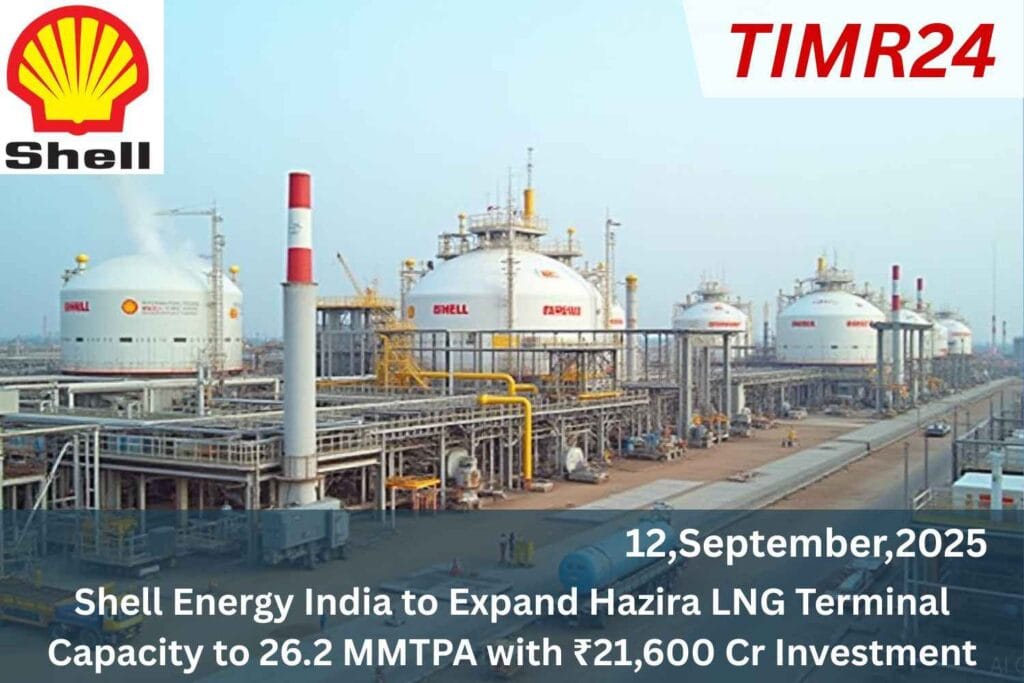
Shell Energy India has received environmental clearance to expand its Liquefied Natural Gas terminal at Hazira Port in Gujarat, increasing its capacity from 6.28 MMTPA to 26.2 MMTPA. The expansion includes 25 MMTPA regasification capacity and a 1.2 MMTPA truck loading terminal, with key developments including LNG storage tanks and a new jetty. Shell Energy India has announced one of its most significant projects in the country’s energy sector—a massive ₹21,600 crore investment to expand the Hazira LNG terminal’s capacity to 26.2 million tonnes per annum (MMTPA). This expansion is not only a milestone for Shell’s India operations but also a crucial step toward.
Advancing India’s energy transition goals. Located on the western coast of Gujarat near Surat, Hazira already serves as a vital LNG hub. The new expansion plan is set to transform it into one of Asia’s largest import and regasification terminals, strengthening India’s energy security while supporting economic growth and environmental sustainability India is aiming to increase the share of natural gas in its primary energy mix to 15% by 2030, up from the current 6-7%. To meet this ambitious goal, the country needs robust infrastructure to import, degasify, and distribute LNG across sectors. Shell’s Hazira expansion directly contributes to this strategy by enhancing LNG import capacity.
Economic Growth and Industrial Competitiveness
Ensuring steady supply to industries and households. The expansion will integrate with the National Gas Grid, helping reach regions beyond Gujarat, including Delhi-NCR, Maharashtra, and southern India. The ₹21,600 crore investment in Hazira will have a far-reaching economic impact. Not only will it create thousands of direct and indirect jobs during the construction and operational phases, but it will also lower energy costs for industries dependent on natural gas. Fertilizer plants, steel manufacturers, and power generation companies will benefit from reliable and cost-effective LNG supplies, enabling them to scale operations and remain globally competitive. Additionally.
The expansion will support city gas distribution projects, which supply piped natural gas (PNG) to households and compressed natural gas (CNG) to transport networks in urban areas (Railway) Hazira’s geographic advantage lies in its deep-water port and connectivity to major industrial clusters in Gujarat, Maharashtra, and beyond. The expansion ensures Hazira becomes a reliable gateway for global LNG exporters, including countries in the Middle East, Africa, and the United States. With India’s LNG imports projected to rise significantly, Hazira’s upgraded capacity will reduce import bottlenecks and improve energy availability. The move also reinforces India’s role as a strategic LNG.
Destination in Asia, making it attractive for global suppliers seeking long-term partnerships (Natural Gas) One of the most critical aspects of the Hazira expansion is its role in India’s clean energy journey. Natural gas emits about 50% less carbon dioxide compared to coal, making it an important “bridge fuel” in the country’s energy transition. With rising concerns about air pollution and climate change, LNG offers an immediate pathway to reduce emissions while supporting energy-intensive industries. The expanded terminal will also facilitate greater use of LNG in transportation and shipping, sectors that are gradually shifting toward cleaner fuels.
Supporting Government’s Energy Vision
The Government of India has been aggressively promoting policies to increase natural gas consumption, such as expanding city gas networks, offering incentives for LNG-powered trucks, and building LNG fueling stations along highways. Shell’s Hazira expansion aligns seamlessly with these initiatives, helping achieve both economic and environmental targets. By boosting natural gas availability, the project strengthens the foundation for India’s energy security, reduces dependence on coal, and curtails reliance on costly oil import India currently imports nearly 85% of its crude oil requirements, leaving it vulnerable to global price shocks. Expanding LNG import capacity at Hazira.
Diversifies the energy portfolio, providing a more stable and sustainable supply. Moreover, natural gas is not just about cleaner energy it is also a crucial feedstock for fertilizers, chemicals, and industrial processes. The Hazira project ensures that as demand grows, industries will not face shortages or price spikes, thereby maintaining resilience in the supply chain In addition to economic and energy benefits, the Hazira LNG terminal expansion has positive social and environmental implications. The project is expected to reduce greenhouse gas emissions by promoting greater use of LNG across industries. Communities around Hazira will benefit from employment.
Hazira as an LNG Hub of the Future
Opportunities, skill development programs, and corporate social responsibility initiatives led by Shell. Furthermore, by reducing reliance on coal-fired power, the project will improve air quality in major urban and industrial regions When completed, the Hazira terminal will stand as a benchmark for large-scale LNG infrastructure in Asia. It will not only meet India’s rising domestic needs but also potentially support regional LNG trade in the future. As demand in South Asia and Southeast Asia continues to rise, Hazira could become an export gateway, further elevating India’s role in the global natural gas market. The facility’s state-of-the-art technology, storage, and regasification units will ensure efficiency and sustainability at every stage.
Shell Energy India’s investment in expanding the Hazira LNG terminal is more than just a business decision it is a commitment to India’s future. By ensuring cleaner energy supply, supporting industries, creating jobs, and reducing emissions, this project strikes a balance between growth and sustainability. As India marches toward becoming a global economic powerhouse, projects like Hazira LNG expansion will play a defining role in shaping a secure, sustainable, and inclusive energy future. Shell Energy India has announced a massive ₹21,600 crore investment to expand its Hazira LNG terminal capacity to 26.2 million tonnes per annum (MMTPA). This expansion strengthens India’s position in the global LNG market and supports the country’s energy transition goals by enhancing natural gas infrastructure.
The upgraded terminal will not only cater to rising domestic demand but also boost industrial, power, and transportation sectors reliant on clean energy. With LNG becoming a cornerstone of India’s sustainable growth strategy, Shell Energy India’s move reflects long-term commitment to energy security, environmental responsibility, and economic progress. The Hazira terminal expansion aligns with the government’s objective of increasing the share of natural gas in the country’s energy mix, reducing carbon emissions, and ensuring reliable energy access. This project positions Hazira as one of Asia’s largest LNG hubs, promoting cleaner fuels, reducing import bottlenecks, and enabling sustainable growth for industries and households alike.
Q1. What is the total capacity of Hazira LNG terminal after expansion?
The capacity will increase to 26.2 MMTPA.
Q2. How much investment is Shell Energy India making in this project?
The company is investing ₹21,600 crore.
Q3. Why is this LNG terminal expansion important for India?
It boosts natural gas availability, supporting clean energy transition and industrial growth.
Q4. Where is the Hazira LNG terminal located?
It is located near Surat, Gujarat.
Q5. When will the expanded LNG terminal be operational?
The project is targeted for phased commissioning within the coming years.