

















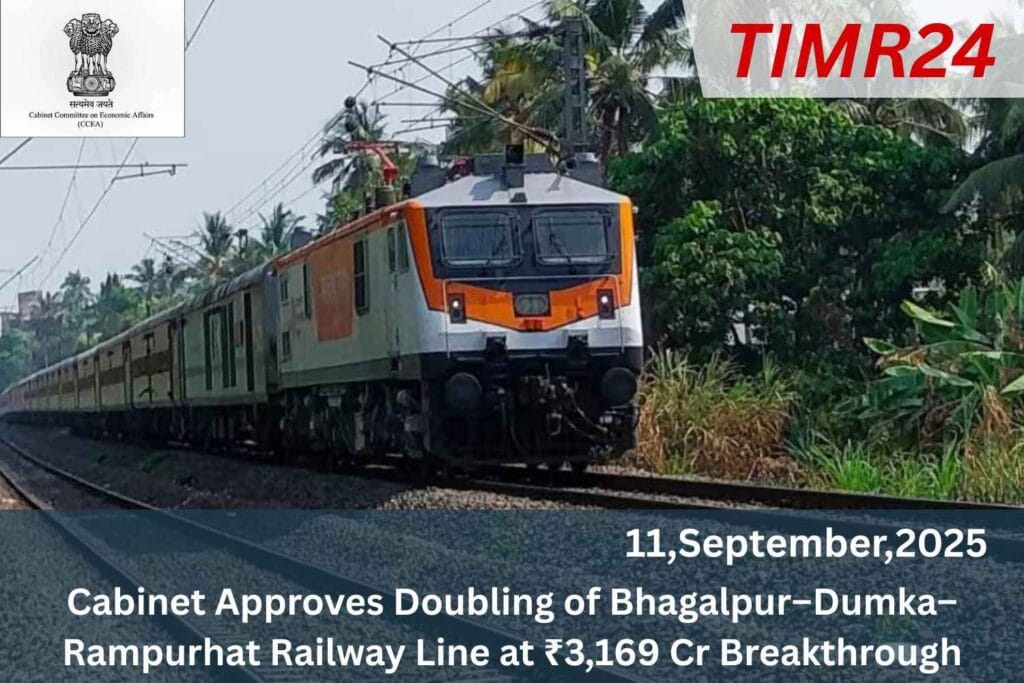
The Cabinet Committee on Economic Affairs, chaired by Prime Minister Narendra Modi, has approved the doubling of the Bhagalpur–Dumka–Rampurhat railway line, covering Bihar, Jharkhand, and West Bengal, at an estimated cost of ₹3,169 crore. The project aims to enhance line capacity, improve mobility, and ensure better efficiency and reliability for Indian Railways. The multi-tracking will ease congestion, streamline operations, and strengthen infrastructure on one of the busiest sections of the network. The project aligns with Modi’s vision a “New India” and is expected to boost regional development, create employment opportunities, and support self-reliance.
he Indian government’s recent decision to approve the doubling the Bhagalpur–Dumka–Rampurhat railway line at a cost of ₹3,169 crore represents a significant milestone in enhancing connectivity across eastern India, particularly in Bihar, Jharkhand, and West Bengal. This corridor has long served as a critical transport artery, connecting key commercial and industrial hubs, yet it has faced limitations due to single-track operations. By introducing a second track, Indian Railways aims to improve both passenger and freight movement, reducing congestion, delays, and operational inefficiencies. The doubling this line is expected to transform the travel experience for commuters who rely on rail services for daily transportation as well as long-distance journeys.
Currently, the existing single track often experiences bottlenecks, especially during peak hours, limiting the number of trains that can run efficiently. With the addition of a second line, scheduling flexibility will increase, allowing more trains to operate simultaneously, thereby improving punctuality and overall service reliability. The economic implications of this project are profound. The Bhagalpur–Dumka–Rampurhat corridor passes through areas with significant industrial and commercial activity. Bhagalpur, known as the silk city of India, will benefit from improved logistics, facilitating the transport of silk and handicrafts to broader markets. Dumka, located in Jharkhand, is an.
Emerging industrial and educational hub, and enhanced rail connectivity will support the movement of raw materials and finished goods. Rampurhat, serving as a gateway to West Bengal’s cultural and commercial regions, will see increased passenger traffic and trade activity. The project, therefore, not only strengthens regional trade networks but also acts as a catalyst for economic growth, attracting investment in logistics, warehousing, and ancillary industries. For businesses along this corridor, faster and more reliable rail services translate to reduced transportation costs, more timely deliveries, and expanded market reach, aligning with broader initiatives to bolster regional economic development.
From an infrastructure perspective, the project involves more than simply laying an additional track. Modern signaling systems will be installed to enhance safety, reduce the risk of human error, and support real-time train monitoring. Stations along the route will undergo modernization to (Railways) accommodate higher traffic volumes, with upgrades including improved waiting areas, digital information systems, and better passenger amenities. Such improvements are expected to elevate the overall travel experience, providing commuters with a safe, comfortable, and reliable service. Additionally, doubling the track supports operational efficiency by allowing freight and passenger trains to run.
Concurrently without interference, a critical factor for corridors that serve both heavy industrial transport and long-distance passenger routes. Indian Railways has consistently emphasized the importance of safety, and integrating advanced signaling technology is a step toward meeting international standards in railway operations The environmental benefits of expanding rail infrastructure are equally significant. Rail transport is among the most energy-efficient modes of mass transit, offering a lower carbon footprint compared to road transport. By enhancing the capacity of the Bhagalpur–Dumka–Rampurhat railway line, a shift from road-based freight to rail transport is anticipated.
Reducing greenhouse gas emissions and easing congestion on highways. This aligns with India’s broader sustainability goals and commitment to greener transportation solutions. Furthermore, the project complements other government initiatives such as railway electrification and the development of Dedicated Freight Corridors, which aim to reduce dependence on fossil fuels and optimize energy consumption in the transport sector. Through these interconnected efforts, railways contribute not only to economic growth but also to environmental conservation, creating a more sustainable transport ecosystem Employment generation is another critical dimension of this project.
Large-scale railway projects require significant human resources, including engineers, laborers, administrative staff, and project management teams. During construction, local employment opportunities will arise, stimulating economic activity in the region. Beyond the construction phase, increased rail connectivity supports service industries such as logistics, hospitality, and retail, indirectly creating jobs and fostering community development. This is particularly relevant for towns like Dumka and Rampurhat, where enhanced infrastructure can attract businesses, educational institutions, and tourism-related ventures. The project exemplifies how infrastructure development can generate both direct and indirect economic benefits.
Contributing to regional prosperity and social development From a strategic standpoint, the doubling of the Bhagalpur–Dumka–Rampurhat line strengthens the national railway network, creating redundancy and resilience. Single-track lines are vulnerable to disruptions; any delay can cascade through the schedule, affecting multiple trains. By establishing a double line, the corridor gains operational flexibility, reducing the impact of unforeseen events such as technical failures, maintenance requirements, or natural disruptions. This ensures continuity of service and greater reliability, particularly for freight operations that support industrial and commercial supply chains.
The enhanced capacity also supports future growth in rail traffic, positioning the corridor to accommodate rising demand as population and economic activity increase in eastern India Tourism and cultural exchange also stand to benefit from this development. The region surrounding the railway line is rich in heritage and cultural landmarks. Bhagalpur attracts tourists for its silk industry and historical significance, while Rampurhat serves as a gateway to West Bengal’s religious and cultural sites. Improved rail connectivity will make it easier for travellers to explore these areas, boosting local tourism and associated businesses. Enhanced accessibility encourages both domestic and international tourists.
Creating a multiplier effect on local economies. Additionally, more reliable train services facilitate cultural exchange, allowing residents of Bihar, Jharkhand, and West Bengal to travel more easily for educational, social, and business purposes, strengthening social cohesion and regional integration The government’s decision to invest ₹3,169 crore in this project reflects a long-term vision of modernizing India’s railway infrastructure to support sustainable economic development. By integrating technological upgrades, modern station facilities, environmental considerations, and employment opportunities, the project aligns with broader national objectives. Internal connectivity between towns.
And cities in Bihar, Jharkhand, and West Bengal will be strengthened, supporting trade, industry, and passenger convenience. For more details on railway projects and their economic impact, readers can explore resources on (Ministry of Railways) the doubling of the Bhagalpur–Dumka–Rampurhat railway line represents a multi-dimensional investment in eastern India’s infrastructure. It addresses current operational constraints, improves safety and efficiency, promotes regional trade and tourism, generates employment, and contributes to sustainable transport practices. Once completed, the corridor will serve as a model for integrating economic, social, and environmental objectives through railway infrastructure development. By bridging key economic hubs and cultural regions,
Q1. What is the Bhagalpur–Dumka–Rampurhat railway doubling project?
It is a government-approved initiative to double the existing railway line between Bhagalpur, Dumka, and Rampurhat, enhancing rail capacity and connectivity.
Q2. What is the total cost of the project?
The project has been approved at a total cost of ₹3,169 crore.
Q3. What benefits will the project bring?
It will reduce travel time, improve freight transport, boost regional trade, create jobs, and strengthen economic development.
Q4. When is the project expected to be completed?
The official completion timeline will be announced by Indian Railways, depending on construction schedules and approvals.
Q5. Which states will benefit from this railway upgrade?
Bihar, Jharkhand, and West Bengal will see enhanced connectivity, fostering trade and commuter convenience across these regions.